Showing posts sorted by date for query bag. Sort by relevance Show all posts

Wednesday, June 13, 2012

Insulin, the Un-dead and coffin nails

Things keep getting in the way of the next post, which is roughed out but needs tidying. I've also been meaning to post on the Somogyi overswing effect in diabetes treatment for some time, so here is a minor diversion down that route, mostly because it's very illuminating.

The Somogyi effect is quite common in those unstable diabetic dogs which tend to get shunted in my direction at work. Any clinician will recognise the effect. A dog is given 8iu of lente insulin at 7am with a meal of utter crap (ultra low fat Chappie usually). Blood glucose spikes to 22mmol/l by 9am from the carb load then falls progressively until about mid day, as the slow onset insulin struggles with the hyperglycaemia. It looks like there is a nadir at about 6mmol/l around mid day. The 1pm reading is unexpectedly high at 30mmol/l. No food, no behavioural signs. Just sudden hyperglycaemia. The Somogyi overswing. This fades slowly to around 15mmol/l by the next meal time at 7pm. The cycle repeats.

Management (if you can't change anything else) is to reduce the dose rate of insulin, which stops that sudden surge in blood glucose at 1pm. Somogyi attributed the effect to a reflex release of glucose from the liver to prevent catastrophic hypoglycaemia in response to insulin overdose. Most clinicians seem to still think in these terms.

Logical but incorrect. The advent of continuous glucose meters has pretty well disposed of the "hidden hypo" explanation and people are now looking at the effects of hyperinsulinaemia per se. The sudden rise in blood glucose appears to be associated with progressively rising or even peak levels of insulin in the blood.

Let's have a think about what is happening. Under insulin deficiency conditions glucose can still be used as a fuel, in a somewhat unregulated manner, using concentration driven supply through GLUT1, independent of insulin. Hyperglycaemia is essential for this. It's not good. The poorly regulated glucose supply generates free radicals in the electron transport chain. Superoxide is the main one and this appears to be the key to causing insulin resistance. Hyperglycaemia causes insulin resistance. This is not controversial, as far as I am aware.

As the insulin kicks in we have a period where glucose levels are falling so GLUT1 transport is decreasing and insulin regulated GLUT4 transport is increasing. Initially excess glucose above cellular needs diverts to glycogen and the respiratory chain is kept happy by insulin. As insulin levels continue to rise above physiological needs we end up with a situation where insulin is putting a ton of GLUT4s out, far more than are needed. This happens because we have inadvertently injected a supraphysiological dose of insulin.

All those excess GLUT4s allow glucose molecules to pour in to the cells. You might as well have hyperglycaemia and GLUT1 mediated oversupply, as far as the respiratory chain is concerned. Glucose in excess of the cell needs generates superoxide. Superoxide triggers, as an antioxidant defence mechanism, insulin resistance. With thanks to Dr Guyenet. Again. It is difficult to emphasise how good this paper is.

Somogyi overswing is likely to be caused by acute onset insulin resistance occurring as a direct result of excess glucose uptake in to cells due to supraphysiological insulin concentrations.

The temporal association with hypoglycaemia, which misled Somogyi, comes from the time course of switching sources of glucose oversupply. The hypoglycaemia is not causative, it is just common for it to occur at around the same time that insulin/GLUT4s oversupply substrate to the mitochondria and they say no to it, using insulin resistance.

Let's summarise. This is very, very important:

Excess insulin causes insulin resistance

End summary.

This is just day to day internal medicine. You have to pay the mortgage somehow.


If anyone is interested there is a rather nice discussion paper here, it's pay per view and doesn't say much more than is in the abstract but it has a nice set of references. I have access to a great Athens account. All the comments on insulinomas ring so true to clinical life too.

It's also interesting to go back to the controversies around the Somogyi effect, you can read Somogyi's ideas here and the continuous glucose monitoring evidence here. All very fascinating stuff (well it is to me!) but what does it have to do with shooting fish in a barrel?


Question: Who are the Un-dead?

Which can be rephrased as: Can we control the Somogyi effect?

If we take the average bodybuilder from a few years ago and watch him self-inject with insulin for its anabolic effects and then forget to eat the carb load needed to balance it, we can see the acute effects of insulin overdose. Insulin rises very rapidly from the regular insulin used and every GLUT4 receptor in his body pops on to every cell surface which uses them. There is a free fall of glucose from plasma in to the cells, blood glucose plummets and the chap ends up in A&E or, quite possibly, in a mortuary. There is no time for the massive cellular caloric overload from over-translocation of GLUT4s to generate enough insulin resistance to stop the hypoglycaemia. Glucose pours out of the bloodstream until it drops to levels low enough to kill the brain. Sad but true. Somogyi effect is too late, too little. Insulin overdosed bodybuilders are not the Un-dead.

So who really are the Un-dead?

What if you give insulin as a constant rate infusion, initially at a low rate and gradually crank it up?

Think it through. Progressively increasing insulin levels allow progressively greater amounts of glucose in to cells. If the cellular glucose supply is greater than cellular needs there is increased generation of superoxide by the respiratory chain which signals the cell to become resistant to insulin. A balance is achieved. Increase the insulin CRI, overcome the insulin resistance, generate more superoxide, generate greater insulin resistance, achieve a balance. Do it again. And again. More. Again. How high can you get plasma insulin by playing this sort of game? Here's the table we need:


Okay, they stopped at a total of 6iu/24h/per rat. They could possibly have gone higher but hell, we have here a set of rats with a mean insulin level of 588.9microIU/ml. No, that is not a typo. The SEM was 89.7. Anyone like to guess how high the highest insulin level measured was? Quite high perhaps?

These are the Un-dead. They walk around, without any genetic modification, with an insulin level which, if achieved acutely, would have put them rapidly in to a clinical waste bag. They are very, very, very, (repeat ad nauseam) insulin resistant, otherwise they would look like the bodybuilder in the mortuary.

*****************************************************************
WARNING: There is a black box paradox warning about the paper providing Table 1. I'll stick an addendum on the end of the post.
*****************************************************************

Soooooooo. They are, undoubtedly, hyperinsulinaemic. Are they fat? Of course not. Why should they be fat? They are the Un-dead. If they were remotely sensitive to insulin they would be not be the Un-dead, quite the contrary. But insulin induced insulin resistance does not spare adipocytes. These have mitochondria and generate superoxide. They too will ignore insulin, to a level determined by their mitochondrial superoxide production.

Here's a bit of an aside: The process is physiological. It involves a careful titration of cellular insulin resistance to the cellular energy needs. This is no blanket insulin blocking drug. The responsiveness to insulin is carefully adjusted to just allow enough glucose in to cells to meet their needs. This applies to adipocytes as well as well as to muscle cells. With the number of GLUT4s being translocated by the residual insulin sensitivity, in an environment of 588microIU/ml of insulin, you don't need much of a blood glucose level to supply glucose needs. Table 1 suggests the body settles to a plasma glucose of about 71mg/dl, as opposed to 148mg/dl in the control rats. Metabolism is still largely glucose based, with some responsiveness to insulin preserved despite the need for resistance to survive at 588microIU/ml. Transplanting tissues to a petri-dish allows you to pick up this responsiveness. Free fatty acid release from adipocytes is not significantly inhibited because the adipocytes are insulin resistant to a level where they maintain normal function. Weight gain is similar to that of control rats.

And another BTW. The process is cellular. Bugger the hypothalamus.


A nail in someone's coffin?

Apparently these rats are a nail in the coffin of the insulin hypothesis of obesity.

The actual coffin nail [nb if the link comes up with a failed log-in just refresh the page] is a pay per view article in a journal not covered by Pubmed and I'm unwilling to shell out $40 for it. Perhaps I could ask The Good Doctor for a copy. Fortunately the information on CRI rodent models is freely available in the paper which provided Table 1 above. What is crashingly obvious is the utter lack of understanding of insulin induced insulin resistance by people who are fixated on insulin as a satiety hormone.

This might have been acceptable in 1980 when the physiology of insulin resistance was completely unknown. But to see this explanation promoted by the same obesity researcher who provides us with the concept of insulin resistance as a cellular antioxidant defence mechanism, mediated through superoxide, is utterly depressing. We are, after all, talking about a complete failure to understand the basic physiology of insulin resistance, with the key paper sitting as a free download from Pubmed.

Does the Good Doctor not understand his own citations or is he stuck with terminal cognitive dissonance?

Or perhaps he's just utterly confused.

I feel the coffin nail is misplaced.

Peter


OK the paradox: In the paper providing Table 1 the rats have a blood insulin level of 588microIU/ml with physiological blood glucose levels. BUT isolated muscle and fat cells taken from these rats are highly insulin sensitive, more so than those from the control rats. How is this possible? I can imagine the Good Doctor or some other idiot shouting that the rats aren't insulin resistant at all, because the paper clearly shows their tissues are extra insulin sensitive, ergo the insulin hypothesis of obesity is wrong. Peter is misquoting a paper, you know what I'm like!!!! Gotta read all those papers cited, the Good Doctor knows how few people follow the links.

But the rats are definitely Un-dead.

If you culture adipocytes at consistently supra maximal insulin levels they behave exactly as the whole rats do. So if you pull out a muscle or fat cell from an Un-dead rat, having made it an un-Un-dead rat by decapitation, how long will the insulin resistance last? This is probably determined by the elimination half life of superoxide. Which is, err, not very long... Actually, it's probably determined by the cellular redox state providing the superoxide, which should last at least a few seconds after decapitation.

Friday, June 17, 2011

Mice and breast cancer

Laura and Elizabeth (thanks for full text) both forwarded links to this study.

Low carb diets, in the correct mouse model, delay onset and slow progression of breast cancer.

It says the sorts of things you would expect it to say and, if you really feel this highly artificial mouse model has relevance to the sorts of breast cancer humans might develop, it certainly suggests that a low carbohydrate diet might have some benefits. But the paper itself is awful.

Two giggles did come out of it. First was the use of high percentage of casein as the sole protein source. Now somewhere, sometime, there was a vegan nut who screamed that casein was carcinogenic. China? China Syndrome? China Study? T. Colon Campbell???? Shrug. These has-been vegans get everywhere.

The second is the extreme fat phobia of the authors. I know these people have to make a crust and funding is not what it used to be and fat bashing is always helpful but there eventually comes a point when people really believe that fat causes cancer. Even highly saturated milk fat.

You can just imagine that cows evolved casein and palmitic acid to kill their calves. Or humans are not mammals in the same way as cows are, human breasts having evolved to sell newspapers rather than to feed offspring. Human babies should be fed sucrose water with a little soya bean oil added of course. It's a strange world.

I have reached the point where I no longer give any credence to high fat diet studies where 30% of the calories are coming from sucrose or the pellets are stained red to signify Crisco. Not so the current authors.

Ultimately, while sucrose and trans fats are excellent substances to study when looking at the effects of pushing the profitability of the food industry to its absolute maximum, they have nothing to do with a high fat diet based on Food.

Reading through the full text there are so many failures of perception and basic biochemistry that it might be worth a post in the end, but here's a typical blooper. Not only do we have Gourmand rats, we also have mice who need false teeth!

First we have to have another black box warning

******************************************************************
Untested ad hoc hypotheses can make you look very stupid.

******************************************************************

Here we go:

"Although mice on 8% CHO diet had slower growing tumors, they lost weight, weighing, on average, 20% less than mice on 5058 diet (Fig. 1D). This was consistent with the mice eating less than the 5058 group (data not shown), likely because the 8% CHO pellets were significantly harder to chew."

Executive summary: We're idiots.

Extended translation:

Diet 5058 is standard breeding colony crap-in-a-bag with 55% of calories from starch. It appears to be mildly obesogenic compared to 8% of calories from starch... That MUST be because the lower carb diet is too hard to chew. We couldn't be arsed to have a control group offered a harder diet with 55% carbs because we're idiots, as are our scrutineers.

GCBC anyone?

Oh, and another giggle: 5058 is described, COMPLETELY incorrectly, as a "Western Diet". It's a starch based, sucrose free, 20% fat, mostly PUFA, trans free diet, remarkably similar to Barnard's idiotic vegan diet for the progression of diabetes in humans. It's standard mouse chow.


Where do funding bodies find these people to throw their money at?

Eeeh, yer has ter larph.

Peter

Saturday, February 12, 2011

Normoglycaemia independent of insulin?

This post has been lying around for a while so I'll just stick it up before getting on to IDE and potatoes.


You sometimes have interesting conversations in reception. A lady commented to me that she had no trouble getting arthritis meds in to her dog, some difficulty with antibiotics and that there was no way that she could persuade him to take the tramadol which had been prescribed as a supplementary analgesic for his arthritis.

I mentioned that he might not find the psychotropic effects of tramadol pleasant. A bit like morphine, not everyone finds the effects enjoyable. She concurred about the effects of morphine. It turned out that she had once been given morphine after surgery and had lost her automatic ability to breathe.... A sort of iatrogenic and thankfully temporary Ondine's curse. More poetically here.

In her case the solution had been that a nurse was assigned to sit by her bed and remind her to take a breath whenever she forgot, until automaticity of breathing returned as the morphine wore off. It's a rare side effect.

It started me thinking about control systems. The pancreas monitors blood glucose and responds with insulin and glucagon. It has a generous nerve supply with a whole host of neurotransmitters affecting insulin output. There are also glucoreceptors in the aortic bodies feeding information to the autonomic nervous system. There are, not surprisingly, nuclei in the brain which have glucosensors. There are probably insulin receptors in the brain too.

I think it is just worth pointing out that I have absolutely no problem with the fact that the brain controls blood glucose. Not the pancreas, not the liver, not the adipocytes. Long term stability needs brain input. You could probably say the same about body weight.

It's an integrated system.

But I doubt very much that the brain is central to the bulk management of metabolism. You would hardly expect a regulatory system such as the pancreas/liver/glucose axis to be intrinsically unstable and only kept functional by continuous and aggressive brain intervention. Metabolism ought to be largely self regulatory, with fine tuning by the brain to meet specific conditions.

Aside: Apparently the Eurofighter is intrinsically unstable in flight and is kept stable by enormous computing power and continuous hardware activity. It uses this intrinsic instability, given tightly controlled expression, in order to flip the aircraft from zero to 7 G in a completely unreasonable period of time. Keeping the pilot conscious under these conditions is the challenge to be met. I only heard any of this because we had an interesting presentation about this latter aspect at an anaesthesia meeting on cerebral perfusion pressures not so long back... Back to metabolism:

There is clearly a regulatory set point for the control of breathing. There is also one for blood pressure, blood sodium, potassium, pretty well everything else. I manipulate many of these daily to earn a living. Why not one for bodyweight?

At the moment I have an insulinocentric view of metabolism and bodyweight. Insulin appears to explain a fairly large chunk of weight control issues. It doesn't intrinsically need a set point concept, but there is every reason to accept some brain input to determine bodyweight. But the idea that the brain can over ride the obesogenic effect of a diet which requires chronic hyperinsulinaemia to maintain a semblance of health is very hard to accept.

It was working through these concepts that I dug out a fascinating paper on leptin and blood glucose emailed to me by Stephan a little while ago. I finally got to read it in depth last week.


The streptozotocotin diabetic rat strikes me as a pretty good model for type 1 diabetes. It looks to be a pure beta cell failure model, ie it lacks the stupidity of considering metabolic freaks such as the Otsuka diabetic rat as in any way representative of any form of human type 2 diabetes. I have time for STZ diabetic rats as being a model for type 1 diabetes. STZ produces acute, persistent and profound hypoinsulinaemia.

The researchers made some rats severely diabetic with STZ (BG > 400mg/dl), then infused leptin in to the cerebrospinal fluid within the third ventricle of the brain.

End result: Normoglycaemia. No change in blood insulin level.

That's quite impressive. No, it's bloody amazing. They did a ton of other things too and had a number of excellent control groups. The conclusion the researchers reached is that there appears to be neural control of hepatic glucose synthesis and output, plus neural control of muscle glucose uptake. They're probably correct. It's a very interesting paper. But is a massive intracranial infusion of leptin genuine physiology or is it pushing a fine tuning system to its ultimate limits using a chemical gorilla? Turbocharging a Morris Minor to out-accelerate a performance BMW?

They were putting almost as much leptin per minute in to the CSF/brain volume as would be produced by whole body fat mass. They probably achieved intracerebral concentrations of leptin way above what might every be produced in plasma.

Of course the goal of the group is to produce a centrally acting leptin mimetic to treat diabetes. Hmmmm, the unintended consequences will be interesting!


As always, picking through the results tables provides a wealth of information to be fitted in to the insulinocentric view of metabolism.

Let's look at the blood insulin levels:


It looks like STZ produces profound hypoinsulinaemia. It doesn't matter what else you do, insulin is low after STZ. No problems here. Hypoinsulinaemia across the board.

Before we look at blood glucose levels let's peek at leptin levels:


Interesting? Well the rats in the control non-diabetic group have lots of leptin. Unless the rat is being given a subcutaneous infusion of leptin (right hand column) there is very little leptin in the blood stream of the diabetic rats. Why so? STZ does nothing to leptin production. But hypoinsulinaemia does a great deal to lipolysis. These rats have had uncontrolled type one diabetes for a couple of weeks before the six day experiment. We don't get any bodyweights in the paper but leptin reflects adipose tissue mass. The STZ rats are profoundly fat depleted compared to the non diabetic controls. I think they're emaciated. This thin:

"WAT [White Adipose Tissue] had clearly atrophied in size in STZ-SAL rats. WAT in STZ-LEP and STZ-PF rats was further atrophied compared with the STZ-SAL group. For that reason, we could not extract enough RNA for Northern blotting"

That's thin.

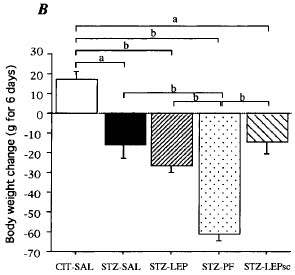
So now let's look at weight change. During the 6 day experiment the non diabetic control rats gained about 15g. The hypoinsulinaemic groups all lost 15-25g bodyweight (except the semi starved group in column 4, starvation of type one diabetics is not advised, ND for leptin in the above graph wasn't that they didn't look for leptin, it's just the amounts present where below the limits of their assay).


This is irrespective of whether they were spilling glucose through their kidneys or not. Hypoinsulinaemia allows lipolysis. Drop insulin and you drop fat, however much rat carbohydrate-crap-in-a-bag you eat. Intracerebral leptin does not stop this.

Now let's look at food intake:


STZ diabetic rats become hyperphagic. At least when they are fed on rodent chow and allowed free access. High carbohydrate, low fat. As the authors point out this does not happen if you feed a high fat diet but I've blogged about this elsewhere.

I'd just like to consider why this hyperphagia should occur from the hang-glider perspective, rather than the Eurofighter perspective.

STZ rats lack insulin. They do lipolysis to extreme levels and run their muscles on fatty acids. Until there is not a lot of fat left, as reflected by hypoleptinaemia. Down on the ground the cells needs calories but there is not enough fat left for this level of hypoinsulinaemia to provide free fatty acids for metabolism. But it is possible to get blood glucose levels high enough to use non GLUT4 transporters to get glucose into muscle cells (see here). With hyperglycaemia there is a chance of survival. To do this you need marked hyperglycaemia. You need it, so metabolism does its best to provide it. In fact these rats will have been hyperglucagonaemic to help raise their blood glucose.

So the rats will eat a ton of glucose precursor, fail to retain it in the liver due to hypoinsulinaemia, add as much to it, using glucagon, as possible and push glucose in to muscles using the brute force of a concentration gradient. The cost is calorie loss through glycosuria and whole body hyperglycaemic damage. But death is postponed. Life is tenaceous.

The STZ control rats ate over twice as much crapinabag as the non STZ controls while continuing to lose weight hand over fist.... Good old hypoinsulinaemia and the body's adaptation to it.

The paper certainly gives support to the concept that the brain is significantly involved in glucose homeostasis. How this will relate a fat mass set point is a line of thought I'm looking forward to seeing Stephan develop.

I rather like this paper. It doesn't need me to move from my insulinocentric bias for weight loss. Ah, good.

Back to LC for diabetes and adaptation to high carb next.

Peter

Earning a crust

We seem to have had a fair number of diabetic dogs come through work recently. Most of them have presented in ketoacidosis. This is a direct consequence of catastrophic insulin deficiency. Hypoinsulinaemia leads to unrestrained lipolysis with production of ketone bodies to the point of profound metabolic acidosis, vomiting, dehydration and risk of rapid death. Oh, and weight loss.

I keep reading snippets about the unimportance of insulin in the control of weight loss from various sources in the blogosphere, so it's sort of tempting to inhibit lipolysis with a couple of big, high calorie blocks of butter or maybe by an Intralipid infusion (yeugh, soyabean oil intravenously, disgusting). But, what the hell, I'm still a bit of a traditionalist on occasion, so I still shut down lipolysis with insulin.

It doesn't seem to matter how much insulin you inject. Once upon a time I would have reached for soluble neutral insulin and bunged it in by intramuscular injection. I had been considering changing to using a GIK (glucose/insulin/potassium) infusion for ketoacidosis but the loss of any soluble insulin preparation from the veterinary market in the UK has stopped my thoughts along those lines.

So now it's lente insulin (the only formulation we have left) by subcutaneous injection and aggressive fluid therapy to allow its absorption. Ultimately it doesn't matter. Any old insulin at almost any old dose rate will inhibit lipolysis well enough to get ketone production under control. You then start seriously supplementing with potassium while catching the hypoglycaemia with an iv glucose infusion as soon as the insulin level in the blood gets high enough to start doing things other than inhibit lipolysis..........

Replacing the missing insulin inhibits lipolysis first. As the blood insulin level increases it then shifts potassium from plasma in to cells. Still higher levels get GLUT4s on to cell surface membranes and facilitate glucose transport.

This is utterly basic A&E work.

Of course the lipolysis of weight loss might just be different from the lipolysis of ketoacidosis. I dunno. Stranger things have happened.


The other thing which has happened is that I have accumulated a couple of these patients who have turned out to be unstable diabetics. They are fascinating cases. You have to understand that as a heretic I try keep my nose out of other clinician's cases, especially diabetic dogs. The basic standard veterinary approach to diabetes is to feed your patient a meal of utter crap, mostly made of sustained release carbohydrate, and cover it with an industrial dose of 12 hour acting lente insulin. Repeat every 12 hours. You can book the cataract surgery for a year's time on the day you make the diagnosis.

The first patient, I'll call her Grace, is a spaniel with a two year history of dry eye, failure to produce tears. A sort of type one diabetes of the eye... What does dry eye have to do with diabetes? Dr Penny Watson of Cambridge Vet School gave a very perceptive presentation about chronic pancreatitis leading to diabetes at the 2010 BSAVA congress. In dogs pancreatitis is often a chronic inflammatory disease which can end up as a "type one like" diabetes syndrome or, alternatively, as an exocrine secretion deficiency giving a failure to digest food. Occasionally both. Which happens to occur in a given individual is probably a genetic lottery.

This dog had had dry eye well before her pancreatic beta cell failure. Dr Watson pointed out that dry eye is an autoimmune attack on the tear producing glands and the attack is aimed at ductal tissue. Stem cells for pancreatic beta cells are derived from pancreatic ductal tissue, which is similar enough to tear gland ductal tissue to produce an association, both diseases in the same patient. Cocker spaniels are far more commonly affected than other breeds. She had some absolutely amazing immunohistochemistry slides.

A sort of Sjögren’s Syndrome of the pancreas, probably another gift of gluten.


The other patient is a middle aged terrier, let's call him William. He has a two year history of chronic hepatopathy before presenting as a type-one-like diabetic. I'd guess he has a combination of non alcoholic fatty liver disease combined with non alcoholic fatty pancreatic disease. He was on a diet of commercial ultra crap, rice mixed with a mess of enzymically degraded protein to limit pre existing skin allergies. Imagine trying to catch the glucose spike from a bowl of white rice with a slow onset sustained release insulin. That initial spike of blood glucose was being caught, too late, with an enormous dose of lente insulin. Two hours later he would have a blood glucose of around 10mmol/l, but dropping like a stone. Suddenly the next reading would be back above 30mmol/l. Dr Bernstein doesn't have a lot of time for the Somogyi overswing. I do, certainly for this dog. The liver is loaded with glycogen, it panics and dumps a fair dose of glucose to (over) correct the incipient hypoglycaemia.

With the standard management approach both dogs had immediately come out of ketoacidosis and had gained weight over several weeks. Did I mention that insulin inhibits lipolysis? Ok, I'll drop it in to casual conversation again. Insulin inhibits lipolysis. Weight gain? Now there's a surprise. Of course there is no ketosis but also no suggestion of normoglycaemia at any stage of a 12 hour glucose curve either.

For some reason Grace had been dropped in to the middle of an afternoon consulting session for a random, post absorptive blood glucose check with me, presumably to adjust her insulin dosage. I wasn't her clinician. I think this reading was somewhere around 25mmol/l. She was ravenous, depressed and polydipsic. Next morning I had her admitted, halved her insulin and fed her a can of cat food with a carbohydrate content of approximately zero, except whatever cooked liver was in the can. The curve came down from somewhere over 35mmol/l to about 14mmol/l and stayed there. We've incremented her insulin up and are aiming for peak blood glucose below 10mmol/l and post absorptive levels below 7mmol/l. Probably the best we can do with lente insulin.

William came to me because lente plus ultracrap was giving completely random blood glucose levels. His owner had been offered referral to an endocrinologist or to see the weird in-house vet who didn't feed sugar to diabetics. That's me. They chose to see me for some reason.

He behaved similarly to Grace when fed all meat cat food and half dose insulin, which is good but we probably need better glycaemic control if we are going to get his hepatopathy to halt. We're getting post absorptive glucose levels between 5mmol/l and 7mmol/l but there is a post feeding spike to over 14mmol/l, which suggests there is a lot of liver in the cat food to provide significant glycogen in the diet. But so far he's a lot more stable now than he ever was on ultracrap.


So why low carbohydrate? Why not simply adjust insulin to cover normal diabetic crap-in-a-bag?

This comes down to the difference between exogenous insulin and pancreas secreted insulin.

Let's recap the two main functions of insulin. First is the inhibition of lipolysis, I may have mentioned this before. This bit is easy.

The next is the suppression of glucose release from the liver. This is utterly core to normoglycaemia. This is not quite so easy.

This is because insulin is normally produced by the pancreas and it travels directly to the liver. There is first pass metabolism by the liver, lots of it. The liver extracts between 50% and 80% of all of the insulin produced by the pancreas. Relatively little ever gets to the systemic circulation. This residue is what should be controlling adipocyte function.

If we turn this on its head we can say that we need to provide relatively high levels of insulin by subcutaneous injection to achieve those levels at the liver which would normally be delivered from the pancreas. But we end up not just bathing the liver with this specific high concentration of insulin. To reach "pancreatic" concentrations at the liver, from a subcutaneous injection site, we will have to hit the adipocytes far harder than we want to. We might well achieve adequate control of hepatic glucose output but at the cost of suppressed lipolysis. Weight gain. And hunger of course.

You could add in a third role for insulin as the management of dietary carbohydrate, ie portal vein glucose sequestration in to the liver and its metabolism by muscles when it spills over in to the systemic circulation. Generally I regard this as what Douglas Adams described in the Hitchiker's Guide to the Galaxy as an SEP. This is a "Somebody Else's Problem".

You want to do that? Fine, you sort out the mess.

I really have to discuss this in some detail because it is perfectly clear that non diabetic humans, so long as they have a functional physiology, can generally deal with massive amounts of carbohydrate rather well. So well that they can lose weight, rather a lot of it, by eating a diet of potatoes alone. This perfectly compatible with why LC is the logical and necessary approach to diabetes. That needs a separate post with a few links to pubmed rather than me rambling on about how I earn my living.

Peter

Monday, May 10, 2010

Arteriosclerosis (3) and von Willebrand Disease

As soon as you start to think about arteriosclerosis as a thrombotic, platelet driven process you immediately think about von Willebrand disease (vWD) of course. vWD is a real laugh for a surgeon who makes the diagnosis 10 minutes in to an operation on a young Doberman which won't stop bleeding wherever he cuts it. Giving that NSAID at premed time suddenly seems to have morphed in to a very dumb idea. And the desmopressin seemed too expensive to have on the shelf before today. But I digress.

vWD means your platelets won't stick. Generally this is a Bad Thing.

OK, more pictures. Fuster's group produced this nice early paper "Resistance to arteriosclerosis in pigs with von Willebrand's disease. Spontaneous and high cholesterol diet-induced arteriosclerosis" from which the micrographs are taken.

Similar data were generated by Griggs et al but interpreted somewhat differently. Personally Fuster comes over as by far the more convincing. At least he doesn't inflate a balloon in a coronary artery, then pull on the catheter to induce "arteriosclerosis"!

Happily there is some convergence of opinion, as should happen when both sides are fairly correct and a lot of ifs, buts and maybes are still present in our knowledge base of arteriosclerosis.

So lets look at the micrographs from Fuster. Here's the first set:


These are all taken from normal pigs eating normal crap in a bag. Image A is stained for elastin and was taken from a non damaged area of aorta. Look at the elastin layer. Nice and continuous. Intima is one cell thick.

Image B is from a similar pig but the section is taken through a fibrous plaque. Obviously there's a plaque, which is what Fuster is interested in. But to me there is duplication and fraying of the elastin layer, especially on the left of the picture, but also to the right. Both images A and B are taken at X160 magnification, just eyeball-compare the quality of the elastin in the two areas.

Image C is Sudan IV stained for lipid, so elastin doesn't show. The arrow shows a cell with lipid. There are a few more scattered around but this is certainly not a lipid lesion. It's worth pointing out that platelets are 17% lipid, so some will be floating around from this source.

These next two pictures are from a pig with severe homozygous vWD:


The macroscopic picture is of the fatty areas (Griggs, the rival paper, describes these as "sudanophilia" and implies that they are arteriosclerotic. They're not). The micrograph below in image B is also stained with Sudan IV and shows exactly how shallow this lipid layer is. There is no intimal thickening, no fibrosis and there is absolutely no change in the media below the lesion. At some time I'll have a think about what is going on here, but for the moment let's leave it as non-arteriosclerostic fatty accumulation which does not form an epithelium and does not stop Evans Blue dye from penetrating in to the wall of the aorta.

Finally some fantastic electron micrographs, all from pigs with severe vWD:


First look at the scanning EM image C. This is a non stressed area of aorta. Nice epithelialised surface. Image A is from a stressed area of aorta which would have developed a fibrous plaque, given a few platelets to cover it, but in vWD this is not going to happen. Rough is not the word. Images B and D are the comparable transmission EMs.

Having vWD is no fun. Endothelial injury is normal. vWD patients bruise all over the place, all the time. These injuries also occur in normal people and are repaired without problem in normal people. Duguid considered atherosclerosis to be pathological and Moon came to the same conclusion. I'm not sure it is that simple. The process which causes arteriosclerosis also keeps us alive. Life saving pathology?


Addendum: Eddie Vos, through THINCS, quoted from this book while I was typing the above post.

From a section describing 49 aortas from monkeys SHOT in the wild,(page 248):

"The small elevated plaques are composed predominantly of smooth muscle cells and elastic tissue and are practically devoid of fats. Thus, the resemblance to human fibrous plaques noted grossly is not borne out microscopically."

My own opinion is that this would be true if all human lesions were lipid based. As many humans develop many small non lipid plaques which sound to be of similar nature to those described in chimps I'm tempted to believe these lesions are normal and physiological. Converting these non lipid plaques to unstable plaques full of linoleic acid and cholesterol crystals is the trick needed to keep cardiologists in business.

Peter

Sunday, October 04, 2009

Excession

Iain Banks has written a mixed bag of science fiction but, in general, Excession is one that I like. Excession carries this paragraph (actually, it's all one sentence except that it has a ... stuck in the middle. I think it's intended to be a continuous stream of visual ideas, but maybe not). Anyway, this was one of the bits I liked from the novel. The "Outside Context Problem" is what the novel is all about. The paragraph explains:

"The usual example given to illustrate an Outside Context Problem was imagining you were a tribe on a largish, fertile island; you'd tamed the land, invented the wheel or writing or whatever, the neighbours were cooperative or enslaved but at any rate peaceful and you were busy raising temples to yourself with all the excess productive capacity you had, you were in a position of near-absolute power and control which your hallowed ancestors could hardly have dreamed of and the whole situation was just running along nicely like a canoe on wet grass... when suddenly this bristling lump of iron appears sailless and trailing steam in the bay and these guys carrying long funny-looking sticks come ashore and announce you've just been discovered, you're all subjects of the Emperor now, he's keen on presents called tax and these bright-eyed holy men would like a word with your priests."

There do seem to be some inconsistencies there, but you get the idea.

This abstract appears to describe an OCP from the 18th century in what was destined to become southeastern USA. It certainly brought Banks' novel to my mind. The final line caught my eye, as it was supposed to.

"A reduced dietary breadth during the mission period may have contributed to the extinction of these populations in the eighteenth century"

Particularly the word extinction. So like excession.


John Hawkes has a post about the genetic changes in Europe between the origin of agriculture about 11,000 years ago in the Fertile Cresent and its arrival at the Western seaboard of Europe about 7,500 years ago.

In his classic essay "The Oil We Eat" Richard Manning cites archaeologists describing this rate of cultural spread as "blitzkrieg", specifically the leap across Western Europe in just 300 years.

This is the paper cited by Hawkes. The overwhelming impression I get is that mankind, the sort of mankind which had maintained a stable global population of around 10,000,000 for millenia, did NOT adopt agriculture. Agriculture was adopted by a subgroup of these humans. Agriculturalist genes then replaced those of hunter gatherers across Europe. I doubt the change was welcomed by the hunter gatherers.

Excession. Blitzkieg.

Oh, and if Manning is correct, famine. Gift of agriculture.

Peter

Friday, September 18, 2009

Hepatic insulin resistance through caloric overload

It seems from Dr Lustig's commentary that one specific method of developing insulin resistance is by increasing fatty acid acyl-CoA moieties within a cell. Acyl-CoA is a single fatty acid molecule joined to a CoA group and represents an "activated" fatty acid, ready to do things metabolically. In both muscle and liver it appears to be these activated lipids, rather than stored triglycerides, which are the metabolic signal, via JNK1 and serine phosphorylation of IRS1, which is used to down regulates the activity of insulin on glucose control.

This paper suggests high levels of free fatty acids are taken up by the liver and inhibit it's response to insulin. My feeling is that the FFAs can come from hepatic lipase (as above), from overstuffed adipocytes leaking FFAs or even from dietary intake, as lipoprotein lipase spills diet derived FFAs from chylomicrons in to plasma as well as in to adipocytes.

Reducing FFA delivery to the liver by inhibiting hepatic lipoprotein lipase does nothing to get rid of hepatic lipid droplets (they have to go out as VLDLs) but the decrease in FFA delivery lowers Acyl-CoA and allows normal liver response to insulin.

Is it possible to overload the delivery of FFAs to the liver without in-situ generation of acyl-CoA from either fructose or alcohol?

Apparently yes. You can do it by diet. It's not easy, but if anyone wants to try it here's the technique. It works in dogs anyway.

This is a post I've had around for a few days while the little palmitate storm blew over:

There is a key concept in veterinary medicine which states that cats are not small dogs. No one would argue with this, especially those who associate with the superior species.

However, dogs might well be reasonably viewed as small humans, it makes a great deal more sense than considering mice to be very, very small humans.

So, if someone tells you that they fed a high fat diet to a group of dogs, restricting their caloric intake to weight stability, and that they all developed virtually complete hepatic insulin resistance within a few weeks, you might just have to sit up and take notice. Especially as the fat was cooked bacon grease, provided by the university canteen. Don't ask. The dogs didn't get the bacon (as far as I can tell). This is that study, free full text.

Anyway. They initially fed these poor dogs a "can a day" of an Hills "prescription" diet (that's the sum total of the methods info, except the macronutrient ratio in the can) and enough dry diet (some random food made by Wayne Dog Food) to maintain weight stability. They did this for two weeks then took away some of the dry cr*p in a bag and replaced it with bacon grease. About 2g/kg bodyweight of bacon grease. They kept it almost isocaloric with those first two weeks of eating traditional dog food. The idea was weight stability. The agenda was to prove that, under isocaloric and weight stable conditions, fat was bad, bad, bad. Replacing as little as 8% of mixed calories with bacon grease will cause total hepatic insulin resistance.

Like wow!

So what does this group consider a caloric intake to maintain weight stability in a 27kg mongrel while it is eating cr@p in a bag? Are you sitting down?


Cr@p in a bag: Total calories 3,885kcal/d

For "less cr@p in a bag but plus 2g/kg bacon grease": more like 3,945kcal/d


This is for a 27kg dog sitting in a cage.

Go on, read that again; 3,945kcal/d. I'm not joking.

OK, so the first question is whether these dogs were weight stable. Ha ha ha ha. The amazing thing is that they only gained about 2kg during the study period. Make that 3kg if you include the weight gained in the pre study "weight stability" period.


Aside: look at how they wangled the weight stability. Pre study admission time until study week zero, about 1kg weight gain. Not statistically significant. From study week zero to week 12 there was a 1.9kg gain which fluctuated in and out of statistical significance WHEN COMPARED TO STUDY WEEK ZERO. Had they compared the on-going weights to the weight at the time they first got their hands on these pooches (minus 2 weeks), virtually all weights from about week 4 would have been significantly up on the enrollment weight. Funny that. Back to the dogs:

3.0 kg in 14 weeks is >10kg per year. In three years, at this feeding rate, the dogs would weigh >60kg. Some weight stability!

Also, there is no control group. I would love to see what 3,885kcal/d of cr@p in a bag would do to a dog's weight in 12 weeks. Waltham's daily energy requirement for a 27kg "typical" adult dog is 1300 kcal/d and for an active dog 1480 kcal/d. Personally I doubt that chronically catheterised laboratory mongrels are getting a huge amount of exercise.

So this is another study where the introduction and discussion are utterly divorced from the methods and the results (and from reality). It's worth just flicking through the methods and, in your mind's eye, look at how much money was used on these dogs. A clinical MRI was around about £1000 a shot in the UK Home Counties in 2009.

For all this money spent, is there anything of interest in the study?

Fortunately yes, lots.

The first thing is that if, like me, you eat somewhere in excess of 2g per kilogram bodyweight of dietary fat every day DO NOT, under any circumstances, add 3000 kcal of carbohydrate to it. If you do this you will develop virtually complete hepatic insulin resistance within a few months. You will also get very very very very fat. Not in a week, but certainly in a couple of years. Thank goodness for this study, saved my liver.

Second is that you will not immediately develop peripheral insulin resistance. This will take significantly longer to develop. That's interesting. The liver is the initial site of injury in caloric overload, just as it is from fructose poisoning, or alcohol too for that matter. I might have guessed at muscle/fat for caloric overload.

Third is how would Garry Taubes view the achievement of getting a group of medium sized dogs to consume 4000 kcal/d? The equivalent of how do you get a 64kg human to consume 10.000 kcal/d? Challenging.

I would guess a mass of uncoupling proteins and elevated insulin to cover hepatic glucose leakage...

Anyway, if anyone has personally managed to consume 10,000kcal per day for a few years I'd love to know how you are getting on. Foie gras?

Peter

BTW the really scary features of this paper are that it got through it's grant proposal, it got through scrutineering and it spawned another, even more expensive, project using the same model which also got approved, completed and published. As my wife says, the peer review process is awful, but no one can think of anything less bad so far. Fortunately the group are wasting USA tax payer's dollars rather than my pounds sterling. Phew.

Addendum: What's the physiology behind the pathology? Well a dog never eats carbs in the wild, beyond the gut contents of herbivores. It usually takes in a massive caloric load of fat. It needs insulin to store that fat, so fat intake ought to make the liver a little insulin resistant, leak a little glucose and then it's up to the pancreas to sort out the glucose, taking the lipids along with it in to fat cells. This is normality. Adding massive carbs to massive fat will simply break a perfectly adaptive system... That's my take. Don't do it!

Tuesday, September 15, 2009

Hepatic insulin resistance

Jenny Ruhl pointed out this study not so long ago:

"These data demonstrate that IHTG [intra hepatic triglycerides], not VAT [visceral adipose tissue], is a better marker of the metabolic derangements associated with obesity"

which leads neatly to this article:

"These results show that progressive increases in IHTG content are associated with progressive impairment of insulin action in liver, skeletal muscle, and adipose tissue in nondiabetic obese subjects"

Both of these are interesting as they make the liver the centre of the changes commonly found in type 2 diabetes and its precursor, IGT. There are now quite a few observational studies suggesting that VAT is not particularly tightly associated with insulin resistance.

I don't think anyone would consider the central role of the liver surprising when you think about the involvement of fructose in this syndrome. Because fructose barely penetrates beyond the liver you would really expect the liver to be the site of its effect on the body.

The development of insulin resistance is usually associated with the accumulation of lipid in a given tissue (or I guess you should say the processes leading to that accumulation, it may not be the lipid per se). The metabolism of fructose guarantees that this occurs in the liver. There's a nice paper describing an intervention study here:

"A 7-d high-fructose diet increased ectopic lipid deposition in liver and muscle and fasting VLDL-triacylglycerols and decreased hepatic insulin sensitivity"

This is a study in PEOPLE, not rats!

Note that it only induced hepatic insulin resistance, systemic insulin resistance should take longer.

If the liver stops listening to insulin it will not take up glucose or store it as glycogen in response to "physiological" concentrations of insulin. It will then leak glucose in to the blood stream in totally unacceptable amounts. It is up to a combination of muscle and adipose tissue to keep the blood glucose level remotely acceptable. This will require lots of insulin, because there is lots of glucose available to leak from the liver. The palmitic acid from fructose will be shipped out as VLDLs and stored as fat by the enormous quantitiy of insulin needed to keep blood glucose remotely normal...

Ultimately, in the longer term, adipocytes will become so full that they too will become insulin resistant, which can then lead to inappropriate NEFA release, muscle insulin resistance and type two diabetes. Obviously there will be genes which determine at what size your adipocytes give up their unfair struggle. So we can look at the genetics of resistance to a functional poison or we can just avoid the poison. I know that latter is a silly idea, but I like it!

Makes it a bit hard to see how abdominal "fat-ectomy" might cure diabetes in rats and mice, which it does seem to do... Mind you, in dogs, visceral fat-ectomy improves peripheral insulin sensitivity modestly, so this would fit in with VAT accumulation being a down stream effect spreading hepatic insulin resistance to the periphery by NEFA, and only when VAT has given up listening to insulin itself...

So the accumulation of visceral fat becomes a consequence of fatty liver rather than a cause... In the short term fructose is perhaps the best trigger for hepatic insulin resistance. It can be achieved in other ways, I'll discuss giving a dog some bacon fat alongside its cr*p in a bag on another day...

Peter

Tuesday, September 30, 2008

The Terminator

This post is pure fiction. Any semblance to currently living bloggers is probably totally libelous, so you'd better stop reading now.

Here we go. First, let's set the scene. We're looking at the Magdalenian period, 18,000-10,000 years ago, the end of the last ice age. Wiki gives a nice overview here. These HGs are fully developed homo sapiens, a great deal more sophisticated, in all probability, than many of us around today. They're not loaded with omega 6 PUFA for a start.

A few more pieces of fairly hard data come from the UK Archeological Data Service, in particular a paper which is split in to two pdfs, here and here. For those who don't want to slog through the archeology-speak, these quotes give the flavour:

We're talking about reindeer hunting btw.


"In the autumn in particular, the herd [reindeer] is at its nutritional and weight peak, and can supply substantial quantities of a high-quality, fat-rich, storable resource for over-wintering"


"The toothwear for the one and two year old individuals [reindeer] indicates that the [mass] kill took place during the autumn at both sites, within a few weeks and a little later at Verberie than at Pincevent. The large size of the kill and the season point towards a hunt related to the autumn migration (at least at Verberie) (David, in press)"


"The primary use made of reindeer was, of course, nutritional. The autumn hunts indicated by the dental eruption sequences at Pincevent and Verberie would be designed to exploit the prey in its best condition of the entire year. The summer forage would have fattened up the herd to its maximum annual weight, and even more importantly, to its highest fat content. Both meat and marrow are important for the diets of reindeer hunters. Speth and Spielmann’s arguments (1983) about the desirability of fat in the diet are particularly pertinent for cold climate hunter/gatherers in the winter. The fat in marrow can supply twice as many calories per gram as protein can, and can allow efficient metabolism of the protein from meat. There are no whole bones in the faunal assemblages from Pincevent or Verberie. There are abundant impact fractures, systematically placed to open the medullary cavities for the extraction of marrow"


Not sure what Cordain would think of this. I believe we are supposed to eat the skinny ones in the spring, not store the fat ones from autumn. Pesky facts!

Anyway, that's the end of the facts. It might also be useful to know who Fanatic Cook is and to have watched at least one of the Terminator movies (Terminator I does the job nicely and I think it has that chase scene down the dry floodwater channel). Here we go:


The wind is moaning over the autumn landscape of northern France at the tail end of the last ice age. It's October and the snow has been over a foot deep for weeks. The reindeer have fed well through the short subarctic summer and are loaded with fat for the winter. Gatherable foodstuffs are sandwiched between the snow cover and the permafrost. No one is digging. There has been a slaughter of reindeer and the tribe has divided up in to groups to butcher them. There is work for the present and food for the winter in plenty. The sound of shattering bones means marrow fat for all.

Away from the encampment there is a smell of ozone in the air and the Terminator style electric blue globe flickers and crackles to deposit a human form in to the frozen landscape. Luckily for everyone, the new time machine transports clothes as well as Terminators. And a crucial bag of white powder.

The Terminator approaches the butchery site through the heaps of reindeer bones from many previous harvests on this spot. Literally thousands of bones, all shattered to allow removal of the marrow. She approaches the main decision maker of the tribe and his shaman, both busily engaged in extracting the solid saturated fat from around the kidneys of a recently killed reindeer. Small cubes of the still warm delicacy are given to the children who scamper around, these are real treats. The rest will be frozen in a matter of minutes and be available for winter feasting later in the year.

The babel fish in the Terminator's ear does its best.

"ohmygoddon'tyouknowyouwillhardenthearteriesofthatpoor-childwithallofthatsaturatedperirenalfatandshewillget-canceranddiabetesandendherlifeinmiserywithouthospitals-tocareforherandhaven'tyoureadCordainwhereisyourflaxoil-andyoumusttrimallofthefatoffandthrowitaway"

Decision Maker (Chief, if you must), "Who's she?"

Shaman, "Looks like the angel of death to me. Wonder what the white powder in the bag is"

Terminator, "ifyoueatallofthatfatyouwillbecomeso-insulinresistantyouwillallgetdiabetesIhaveproof-
ofithereinthispowder"

Decision Maker, "What's this diabetes she keeps going on about?"

Shaman, "High blood sugar"

Decision Maker, "Waddayamean, high blood sugar? My blood sugar has been 4.6mmol/l for the last 45 years and I don't see it budging any time soon. Can you change it?"

Shaman, "Watch the powder, it ain't crack or angel dust"

Terminator, "Youmusteat100gramsofthispowderbefore-everymealofsaturatedfatandyouwillendupassickasa-labratonahighfatdietanditwillbethefatwhichisthe-
causeofallofyoursuffering"

Decision Maker, "But I'm already on a high fat diet! I live on not much else every winter and the few leaves we get in the summer give me the gripes. Why do I need to eat her white powder to be on a high fat diet?"

Shaman, "Buggered if I know. Want to humour her? It might be like the Special K that last Terminator brought. Cracking trip, if you're a shaman"

Decision Maker, "I'm no shaman, I might get lost on a trip like that and never find my way back to reality, your call"

The shaman licks his finger, dips it in the powder, touches it to his tongue. The grimace and spitting are extreme. "Dextrose mono bloody hydrate! You lend me your spear mate, I was right about the angel of death!"

The shaman promptly saves mankind from hyperglycaemia for another 10,000 years, minimum. But not for ever. The next Terminator will drop in to Egypt, about 12,000 years later. The ground will be more fertile and whole grains will sow death far more successfully in the now warmer climate. No need for the white powder.

End of fiction. Now you can go read the abstract of the paper cited by Bix here if you feel like it, but please try to apply a little more comprehension than she does. Not difficult.

Peter

Wednesday, March 05, 2008

Familial Hypercholesterolaemia and porcelain

What IS an LDL particle? There is a very neat picture here. Perhaps the most striking thing about it is that there is only one single protein molecule embedded in the particle surface, the apo-B100 protein molecule. It wraps neatly around the sphere of lipid to give support and identity. Identity is very important.

Of course the LDL particle has to come from somewhere. It is derived from IDL (Intermediate Density Lipoprotein) and before that from VLDL (Very Low Density Lipoprotein), which was secreted by the liver. All of these precursors also have the apo-B100 protein molecule, plus a whole load of other proteins too, apo-C1, apo-C2, apo-C3, and apo E. VLDLs are big (relatively), they need to be to fit all those proteins on to their surface! Most of these proteins are there to either turn on or turn of lipoprotein lipase, in order to get fatty acids from the lipid particle in to cells. That's how lipids get bulk transported. Apo-E gets the particle back in to the liver, should the liver want it back.

Quite where all of these proteins disappear to as LDL is formed is a bit of a mystery to me. Certainly it looks like LDL, derived from IDL/VLDL, has only apo-B100 and none of the other surface proteins of VLDL/IDL particles. Probably they hop on to HDL particles. Some of them came from there in the first place, rather than the liver directly, so that would be appropriate.

So there is this bag of lipid with just one identification tag on its surface, looking for a home. There is a receptor which exactly fits the apo-B100 id tag. The LDL cholesterol receptor. This is the archetypal, best studied endocytosis receptor of all time. LDL attaches to this receptor and the whole lipoprotein is engulfed by the cell sporting the receptor. The particle gets stripped of the engulfing apparatus, eventually fused with a lysosome and the cell is in clover with a supply of both lipid and cholesterol. It recycles the LDL receptor to the cell surface and does it all again. Cells appear to need both lipid and cholesterol.

But here's the interesting bit. The LDL receptor is a statin as in:

"Consistent with this hypothesis, they found that addition of LDL to the culture medium of normal human fibroblasts inhibits the activity of 3-hydroxy-3-methylglutaryl coenzyme A reductase (HMG-CoA reductase), the rate-limiting enzyme in the cholesterol biosynthetic pathway

EDIT: When you go to the original authors it becomes obvious that it is the cholesterol itself which inhibits HMG-CoA, a classic negative feed back mechanism. Have to do some more thinking about xanthomata. End edit.

The LDL receptor inhibits the intracellular synthesis of cholesterol, at the HMG-CoA step, when activated by an LDL particle. There is impeccable logic to this. Cholesterol is a complex molecule, synthesised in a stupendously intricate and energy demanding process. Usually the liver does this for cells of the body, shipping it out in lipoprotein particles. After all the liver is a biosynthetic powerhouse with lots of energy to play with. It's not some poor smooth muscle cell or fibroblast struggling to make metabolic ends meet in the arterial media. If, as a cell, you have just swallowed a big ball of cholesterol you can afford to switch off the production apparatus. It would be wasteful not to.


Cells need cholesterol. Homozygous familial hypercholesterolaemia means that a patient's cells have zero functional LDL receptors. If they can't get cholesterol by swallowing whole LDL particles they really do have to make it themselves. But the other feature of a non functional LDL receptor (remember, it's a statin) is that it doesn't give the ability to limit local cholesterol synthesis, so there might be quite a lot of cholesterol made. Enough to generate tendon xanthomas. These xanthomas should be composed of cholesterol synthesised from acetate in local cells, not from sticky LDL particles. I don't suppose anyone has checked this.

The synthesis of one molecule of cholesterol requires 14 NADPH molecules and 18 ATPs. It yields 6 phosphate (Pi) molecules and 4 pyrophosphate (PPi) molecules. While PPi appears to be an inhibitor of soft tissue calcification Pi is a promoter. Alkaline phosphatase, an enzyme whose production is upregulated by hyperglycaemia, converts PPi (calcification inhibitor) to Pi (calcification promoter). Hyperglycaemia is a feature of refined carbohydrate diets. Did I say low fat?

So there is the potential for an awful lot of inorganic phosphate ions, possibly 14 per molecule, being produced as a spin off from cholesterol synthesis on low fat diets. One LDL particle provides about 2000 molecules of cholesterol.

We know that insulin converts smooth muscle cells to bone secreting cells. Local cholesterol synthesis provides a supply of inorganic phosphate. A low fat (high sugar) diet raises insulin.

Perhaps it should come as no surprise that there is the phenomenon of "porcelain aorta", seen in patients with homozygous familial hyprecholesterolaemia. Aortic cells manufacturing cholesterol, which they can't get from LDL, produce inorganic phosphate and pyrophosphate as a spin off from the synthesis. A modern low fat diet, based on sugar, elevates blood glucose which increases alkaline phosphatase production and so the conversion of pyrophosphate to inorganic phosphate. A modern low fat diet elevates insulin too, which makes smooth muscle cells secrete bone matrix proteins.

Add calcium to phosphate in soft tissues and you have bone.

How good is the evidence base for current dietary recommendations in Familial Hypercholesterolaemia, particularly in children, who don't seem to get put on a pharmaceutical statin (yet)?

The Cochrane Review seems to think they are completely unsubstantiated.

Should all homozygous FH people be on a pharmaceutical statin? Another post there.

Peter


NB I didn't see any calcium or phosphate in that picture of the LDL particle. Soddy: "Rutherford, this is transmutation!" Rutherford snapped back, "For Christ's sake, Soddy, don't call it transmutation. They'll have our heads off as alchemists." Or cardiologists.

Monday, December 31, 2007

Fruit and vegetables re post

It is remarkably widely accepted that fruit and vegetables are good for you. Three a day, five a day, nothing but fruit and vegetables all day..... The problem is that all of the evidence of benefit is epidemiological, and this never proves causation, merely association.

Where does hard science take us? This was the first study I stumbled across, about Polish cyclists.

Effects of a low carbohydrate diet and graded exercise during the follicular and luteal phases on the blood antioxidant status in healthy women.

I only have the abstract of this paper so there is no information as to exactly what comprised the 5% of energy intake which was derived from carbohydrate. Whether it was pure sucrose, apples or bananas, there wasn't a lot there in total. So minimal plant based antioxidants to speak of. End result?

"The 3 days of the L-CHO diet, which had been preceded by glycogen-depleting exercise, resulted in a stimulation of the blood antioxidant defence system in young eumenorrhoeic women both at rest and during the graded cycling exercise to maximal oxygen uptake."

Not bad for three days of dumping the fruit and veg.

The next study, which is an excellent piece of work, was this one:

Green tea extract only affects markers of oxidative status postprandially: lasting antioxidant effect of flavonoid-free diet.

Never mind the green tea bit, that turned out to be irrelevant. It's what happened when almost all fruit and vegetables were removed from the diet of the volunteers for 10 weeks that's interesting. The result being:

"The overall effect of the 10-week period without dietary fruits and vegetables was a decrease in oxidative damage to DNA, blood proteins, and plasma lipids, concomitantly with marked changes in antioxidative defence."

This later study was NOT a low carb study. Potatoes, bread and cake were all included in the sample menus provided in the full text. Please note the DECREASE in oxidative damage to your genes, your protein structure and your lipids. Great stuff fruit, when you put it in the bin.

The conclusion seems to be that there is something nasty in fruit and vegetables, something pro-oxidant. You just have to ask yourself why a plant should manufacture an antioxidant in the first place. You can bet your bottom dollar that it was not for the benefit of herbivores! No, plants hate herbivores and negotiate with substances like strychnine rather than antioxidants.

The most likely candidate for a generic pro-oxidant toxin, produced by plants, is fructose. Plants outside of domestication contain relatively little fructose and appear to use it as a lure, to get their seeds eaten, then use the fruit eater as a transport method. They protect themselves from the fructose with antioxidants. Plants in domestication have been selected, by ourselves, to produce quite unreasonable amounts of fructose (plus glucose and sucrose). Just compare the average Granny Smith to a wild crab apple. A bag of sugar.

Mammals do exactly the same when presented with fructose. They make an antioxidant, in the case of mammals it's uric acid. Uric acid improves the total plasma antioxidant capacity after fruit ingestion. The mechanism is rather well summarised here:

Consumption of flavonoid-rich foods and increased plasma antioxidant capacity in humans: Cause, consequence, or epiphenomenon?

"We conclude that the large increase in plasma total antioxidant capacity observed after the consumption of flavonoid-rich foods is not caused by the flavonoids themselves, but is likely the consequence of increased uric acid levels."

Small studies using intervention strategies show this clearly. Don't forget those marvelous fruits and vegetables in this intervention study too. Oxidised LDL cholesterol anyone?

Or the Dutch study.

So in summary plants produce fructose which is both attractive and damaging to mammals. They protect themselves as best they can with antioxidants.

I don't see any causality between fruit and vegetable consumption and improved health.

Peter