Peter
Thursday, November 26, 2020


Monday, November 09, 2020
Protons (65): Fatty acids vs glucose and ROS generation
I've had this paper for some time:
The CoQH2/CoQ Ratio Serves as a Sensor of Respiratory Chain Efficiency
It really grabbed me as it was one of the earlier references to supercomplex assembly of electron transport chain components, failure of C57Bl/6 mice to manage this correctly due to a truncated supercomplex assembly protein and the deconstruction of excess complex one when electrons were fed in to the ETC via electron transporting flavoprotein dehydrogenase. So it's a great paper of enormous scope.
But there is more. Dave Speijer has a great discussion of why mitochondrial preparations are so hard to interpret because they are so far away from the in vivo situation and preparation artefacts are massively influential of results. It's in here on page 4110 if you'd like to browse.
Back to the Guarás paper. They got out of the problems of using isolated mitochondria by using intact fibroblast, treating them with a cell permeant dye which becomes fluorescent on exposure to ROS, followed by flow cytometry to assess ROS production. Then they could treat the cells with glucose or fatty acids +/- very low dose rotenone, which blocks RET without having the unacceptable off target effects of higher doses.
This is what they got. Glucose was 5mmol/l and FFAs, mixed types, were supplied bound to albumin at 1000micromol/l. Both quite physiological. Here is what they got (Fig 6, section H), we can ignore the galactose results:

So mixed FFAs produce roughly twice the ROS produced by physiological glucose. The effect is markedly reduced by inhibiting RET through complex I.
Sadly no one has done the experiment to compare saturated fatty acids, MUFA or PUFA on the generation of ROS. Still less to look at the effects of background glucose elevation to represent the immediate post prandial period, with or without insulin. But the basic proof of concept is there.
Nice paper.
Peter
Saturday, November 07, 2020
Here we go in to Lockdown 2
This is the number of daily positive PCR tests (rather than genuine cases) in the UK, via Worldometers, graphed from the UK government website data. I've added an arrow to indicate the start of Lockdown 2 for those of us living under peak incompetence.


And here are the ICU admissions for the current wave, in orange. Ignore the dramatic drop at the end of this line, it probably represents under reporting because it takes time to update the database for the last 24h and these stats come out at teatime every Friday. Again these are data for time immediately before Lockdown 2:

Will it Lockdown 2 work?
Pretty safe bet it will because PCR positive test numbers have already plateaued, ICU admissions have plateaued and are probably falling, both over the week pre lockdown.
Overall it looks like we continue to head towards herd immunity despite all attempts to stop this and in the face of minimal protection for the vulnerable. Deaths have not plateaued yet, that will lag a few weeks behind the peak in positive test results.
Any modelling scenario which did not have these data as a future possibility when it was run at the start of October should perhaps have its validity questioned. That'll be the one with the 4000 deaths per day as a possible scenario, in particular.
Listening to the modellers is like listening a cardiologist espousing the benefits and "death-preventing" effects of statins. Except for lockdowns there is no equivalent to the easy option of dropping your statin prescription in the bin.
Will Lockdown 2 end on the 2nd of December?
Hahahahahahahahahaha
Peter
Wednesday, October 21, 2020
Linoleic acid makes you hungry
This paper reports what happens to hsCRP in people of differing fatty acid desaturase genotypes when you increase their linoleic acid intake from around 4% of calories to around 11% of calories. It's neutral or bad, depending on your genetics. Which is irrelevant to anyone remotely informed about what a human LA intake might reasonably be. So we can ignore the research on hsCRP.
Inflammatory response to dietary linoleic acid depends on FADS1 genotype
Two things come out that are worth noting. First is that, from Fig 4, that increased dietary LA mostly decreases the arachidonic acid in plasma phospholipids and cholesterol esters. I made a throw away comment in a previous post that I would expect supplementing any C18 PUFA would inhibit the formation of any C20 and C22 fatty acids. I got lucky on that one, AA levels mostly dropped with LA supplementation, one didn't change.

Inflammatory response to dietary linoleic acid depends on FADS1 genotype
Two things come out that are worth noting. First is that, from Fig 4, that increased dietary LA mostly decreases the arachidonic acid in plasma phospholipids and cholesterol esters. I made a throw away comment in a previous post that I would expect supplementing any C18 PUFA would inhibit the formation of any C20 and C22 fatty acids. I got lucky on that one, AA levels mostly dropped with LA supplementation, one didn't change.
Much more interesting is the effect of the intervention, irrespective of genotype, on food intake. Like this:

"Based on food records, energy intake was significantly increased during the intervention period, which could be considered a third limitation. However, there were no changes in body weight or BMI, and an increase in energy intake was similar in both genotype groups. It is likely that the increased energy intake was at least partly related to the fact that oil consumption was carefully recorded during the intervention period."
I think we can describe this "likely" effect as ad hoc hypothesis number 3264.
A more reasonable ad hoc hypothesis is that increasing your linoleic acid intake from 4% of calories to 11% of calories makes you hungry. If this change were to have been caused by a projected loss of half a kilo of ingested lipid in to adipocytes over a year, that would be less than 50g per month. Easily masked by a number of biological variations.
Peter
Saturday, October 17, 2020
Podcast with Dr Paul Saladino
I had a very pleasant chat with Paul Saladino.
It was quite a long chat and there were still lots of places that we did not have time to visit...
Peter
Wednesday, October 07, 2020
Great Barrington Declaration
This is really a job for twitter but that's not my platform.
I've signed.
Peter
Full blown linoleic acid deficiency: speculation
Tucker Goodrich emailed me the link to this lovely paper from the 1930s
ON THE NATURE AND ROLE OF THE FATTY ACIDS ESSENTIAL IN NUTRITION
and included it in a blog post
Fat and Weight Gain (a Note to Peter) and the Essentiality of Linoleic AcidTLDR, grossly linoleic acid (or the arachidonic acid derived from it) deficient mice are small, emaciated and lose a ton of water through their skin. Think superoxide.
It's an interesting situation, with a number of possible explanations and the sort of data you might expect from 1930, good for its time but we're not going to get the massive detail which people struggle to interpret nowadays.
I started off alongside the authors and caloric loss due to the evaporation of water from both the "leaky" skin and possibly from "leaky" lungs. If you have ever tried to keep a mouse warm under anaesthesia while it breathes anhydrous cold gas and is clipped and water/alcohol prepared for surgery you will sympathise. If not, you can take my word for it that without serious attention to heat conservation, their temperature drops like a stone.
The mice lose about 10ml of water per day through their skin. With a latent heat of vaporisation of 0.541kcal/g this means the 10ml of water steals about 5.41kcal per day of energy as lost heat, just to evaporate the leaked water. That's about an extra gram of carbohydrate or protein they would need.
But the mice were ad lib fed. They may have been pretty sick from LA deficiency but they managed to eat exactly as much as the healthy mice did each day. I find it implausible that they were so skinny because they were simply too ill to manage an extra gram of food. There is absolutely no doubt that they were very sick, but I still don't find this plausible for the emaciation.
A simple extrapolation from high PUFA diets facilitating fat loss in to adipocytes to the converse, that very low PUFA diets fail to allow fat storage is nice but seems very unlikely because the curative dose of linoleic acid seems too small to represent a supply of calories for bulk oxidation.
My core question relates to the failure to store lipid in adipocytes, with a spin off question in to the poor health of the fat free rats. This is all guesswork and speculation.
I have to accept the possibility that it might be as simply as that you cannot build a functional cell membrane or mitochondrial membrane without some bendy/fluid molecules. Given an inadequate fluidity to the mitochondrial inner membrane I can see that molecules such as CoQH2 or reduced cytochrome C, which move within/over a fluid inner mitochondrial membrane might lose electrons prematurely to molecular oxygen if they cannot reach their docking site in the next complex down the ETC. That a continuous, pathological loss of electrons from carriers to molecular oxygen, to give inappropriate superoxide and H2O2 generation, would lead to unrestrained insulin resistance and failure to grow, especially failure of adipocytes to grow, seems to be a plausible explanation.
As Burr and Burr comment, the kidney is also a very energy dependent and might well fail given a failure of insulin signalling due to excessive H2O2 generation. While the rats would lack ROS damage to membrane lipids they would not lack ROS damage to cellular proteins or DNA. The cells, if insulin signalling cannot occur due to excess H2O2 generation, would also be calorie starved as well as ROS damaged.
Quite why the tails fell of of the rats is beyond even my speculation ability.
So. The failure of adipocytes to grow suggests severe insulin resistance within those adipocytes. More generalised application of this idea would lead to explaining failure of the whole rat to grow.
Who knows what actually happened?
Peter
Continued:
I've long carried the idea in my head that PUFA depletion might be protective against radiation induced injury. I think I picked this up early in my low carb journey, probably from a Ray Peat follower. But that will have been over 15 years ago and I am unable to locate where this idea came from. So I went looking on Pubmed and opened a whole can of worms. Some of which are interesting.
The first is that rats fed a completely fat free diet are at increased risk of dying from radiation injury. That was this one:
THE EFFECT OF FAT LEVEL OF THE DIET ON GENERAL NUTRITION
XIII. THE EFFECT OF INCREASING DOSAGES OF X-IRRADIATION
ON THE PROTECTIVE ACTION OF FAT ON RADIATION INJURY
"More recently, it has been observed that the survival time of male rats, as judged by the intervals at which an LD25, an LD50, or an LD75 were reached, or by the average length of survival, was progressively improved when ethyl linoleate was given in doses of 10, 50, or 100mg daily (Cheng et al., '54)."
The same lab has produced at least four studies to support this finding.
Giving a rat 10mg of a source of linoleic acid will have no effect on substrate oxidation. But it might well allow the development of an effective electron transport chain which is less likely to release a random excess of electrons to molecular oxygen.
Deleterious effects of high fat diets on survival time of X-irradiated mice
"At levels of 2% or 10% of the diet cottonseed oil and margarine fat increased survival time over that on the fat-free ration. When these fats were fed at higher levels ( ie. ~ 20% or 30% of the diet), however, survival time was decreased below that obtained at the lower levels of supplementation."
My take home is that rats do, absolutely, need a few milligrams of linoleic acid. Notice that the amounts used in all of the studies are in the same ball park as found by Burr and Burr to prevent their fat deficiency syndrome. I think it is an interesting speculation that LA is particularly need to manufacture an effective membrane for the ETC, especially when electrons are going to be knocked around by x-ray irradiation over and above background radiation conditions. As the dietary dose increases then the deleterious effect of the PUFA eventually predominate, certainly in the radiation injury models.
Interesting findings.
Peter
Sunday, October 04, 2020
Prof Sunetra Gupta
I first came across Prof Gupta as an invited speaker to one of the Royal College of Pathologist seminars, now viewable on-line at
*Prof Gupta is at Oxford, not Imperial College as the RCPath intro slide incorrectly shows. We all know about the Imperial College modellers.
I thought she was talking sense at the time and that impression has not changed since. I notice that she has been very active recently in the media and I happened to pick up this interview via Faceache:
The Spectator interview
I've pulled this one out from many videos because it answers the question as to what an incompetent Prime Minister says when presented with someone who is telling him that he has done everything wrong. It's near the end so I've clipped out my favourite eight seconds:
The Spectator interview
I've pulled this one out from many videos because it answers the question as to what an incompetent Prime Minister says when presented with someone who is telling him that he has done everything wrong. It's near the end so I've clipped out my favourite eight seconds:
Clearly there is no way, ever, that any government is going to say that they have screwed everything up about this pandemic. Completely.
Especially if they have. And honesty is not exactly a hallmark of Boris Johnson.
Peter
NB A more competent government in power would probably have done the all wrong things too, but much more effectively. That's a scary thought. I am seriously conflicted about this.
Monday, September 28, 2020
Aaargh BROKEN LINKS
UPDATE
Right. I've been back to the broken links issue and have noticed that, when you click on a link to a "search term" you get a blank Pubmed page. However in the URL of this broken link there is a complex set of gobbledygook but very close to the start is the PMID that the search term has previously pointed to. So in the post
https://high-fat-nutrition.blogspot.com/2007/10/physiological-insulin-resistance.html
the link to the paper by Wolever is broken.
The URL above the blank Pubmed page from the link is this:
https://pubmed.ncbi.nlm.nih.gov/?Db=pubmed&Cmd=ShowDetailView&TermToSearch=10889799&ordinalpos=1&itool=EntrezSystem2.PEntrez.Pubmed.Pubmed_ResultsPanel.Pubmed_RVDocSum
and 10889799 is the PMID. Pasting this in to the search box gets you to the paper originally linked to so
https://pubmed.ncbi.nlm.nih.gov/10889799/
now gives access to the abstract as:
Dietary carbohydrates and insulin action in humans
After that it's a Sci-hub job.
Phew.
Peter
BROKEN LINKS
Over the years I have slowly learned how not to blog.
For one thing, never use hyperlinks embedded as "here" or "these people".
Always cite the paper title, then anyone can copy paste this in to Duckduck or Pubmed and they can then side step the broken link when it goes down, as it will.
In the very early days I used the Pubmed search result URL as the hyperlink. This appears to have been fine for the last 15 years or so but recently Pubmed updated and all of those links have been lost. If a hyperlink from a simple word like "here" used to go to a search result URL it will be down and even I cannot always relocate the original paper.
Sometimes even if I know exactly which paper it was it's not always possible to find on on my sprawling hard drive.
You learn these things as you go along. Damn.
Peter
Sunday, September 27, 2020
SARS-CoV-2 loves linoleic acid
I haven't posted much about the SARS-CoV-2 virus or COVID-19. Mostly because I don't do politics on the blog and watching the utter incompetence of the UK government has been painful but not unexpected. It's fascinating how by having a completely wrong approach, but doing it so badly, that you can actually end up with a functional approach leading to herd immunity. Sadly it includes appalling rule by decree from Bojo.
On a brighter note, here's a snippet from the end of a fascinating paper looking at the detailed structure of SARS-CoV-2 and its fatty acid binding sites:
Free fatty acid binding pocket in the locked structure of SARS-CoV-2 spike protein
"We hypothesize that LA [linoleic acid] sequestration by SARS-CoV-2 could confer a tissue-independent mechanism by which pathogenic coronavirus infection may drive immune dysregulation and inflammation (35–37). Our findings provide a direct structural link between LA, COVID-19 pathology and the virus itself and suggest that both the LA binding pocket within the S protein and the multi-nodal LA signaling axis, represent excellent therapeutic intervention points against SARS-CoV-2 infections."
I think it was Puddleg who made a very reasonable comment about what, should he find himself in the ITU and someone tried to hook him up to a linoleic acid based intravenous emulsion, he would try to do. I think strangling them was involved.
On a brighter note, here's a snippet from the end of a fascinating paper looking at the detailed structure of SARS-CoV-2 and its fatty acid binding sites:
Free fatty acid binding pocket in the locked structure of SARS-CoV-2 spike protein
"We hypothesize that LA [linoleic acid] sequestration by SARS-CoV-2 could confer a tissue-independent mechanism by which pathogenic coronavirus infection may drive immune dysregulation and inflammation (35–37). Our findings provide a direct structural link between LA, COVID-19 pathology and the virus itself and suggest that both the LA binding pocket within the S protein and the multi-nodal LA signaling axis, represent excellent therapeutic intervention points against SARS-CoV-2 infections."
I think it was Puddleg who made a very reasonable comment about what, should he find himself in the ITU and someone tried to hook him up to a linoleic acid based intravenous emulsion, he would try to do. I think strangling them was involved.
The virus is looking to help the virus to make more virus, not to kill the host. A good plan to generate anabolic substrate might be activating peroxisomes to get all of that peroxisomal acetyl-CoA and cytoplasmic malonyl-CoA. Like this:
Infection-Induced Peroxisome Biogenesis Is a Metabolic Strategy for Herpesvirus Replication
and if we wanted to be a bit more specific we could take a lesson from Cytomegalovirus:
which uses good old 13-HODE derived from linoleic acid as well as 15-HETE from arachidonic acid to get what it needs. Both are potent peroxisome proliferation stimuli and are being used, probably also by most other enveloped viruses, to generate the lipid precursors needed to build more envelope. Hence their love affair with linoleic acid.
The fact that your cardiologist made you obese and diabetic as you become elderly (what ever your age) as a result of promoting hearthealthypolyunsaturates ties in neatly with the probability that linoleic acid might also markedly assisted viral replication in addition to triggering a cytokine storm.
The lipid hypothesis just never stops giving.
Peter
Monday, September 21, 2020
Protons (64) The miracle of fish oil (6)
Preamble: I started this current series of post about the ability of fatty acids with multiple double bonds to limit weight gain. To me, this is a paradox. Paradoxes are, without a doubt, the most productive sources for the development of an idea. Even as I started this current post I had no idea where it was going to end up and was bit surprised at where the metabolism took me. So be it. Let's begin.
Beta oxidation in peroxisomes consumes half the amount of oxygen as in mitochondria. The first step of oxidation of saturated fats runs like this:
R-CH2-CH2-COOH + FAD -> R-CH=CH-COOH + FADH2
In peroxisomes this is followed by
FADH2 + O2 -> FAD + H2O2
then
2xH2O2 -> Signalling -> Catalase -> 2xH2O + O2
The energy from FADH2 is released as heat and half the oxygen is regenerated.
The NADH from beta oxidation is of no immediate use in a peroxisome and has to be transferred to mitochondria before it can be utilised. I suppose it could be phosphorylated to NADPH for anabolism but I have no data on that. It's not clear how reducing equivalents might be transferred from peroxisomes to mitochondria. There is speculation about something along the lines of the malate-aspartate shuttle used to import cytoplasmic NADH in to mitochondria.
It's also something of a truism that peroxisomes cease beta oxidation at C8 and then export this (by uncertain mechanism) to mitochondria for completion of oxidation. Digging back through the reference trail leads to the origin of this as the finding that isolated peroxisome preparations happily oxidise lauric acid but won't oxidise caprylic acid (much). Clearly oxidising DHA will never produce caprylic acid directly because there are double bonds within the residual eight carbon atoms. What exactly happens to truncated DHA at the C8 length appears to be an unasked question.
So beta oxidation in peroxisomes produces heat, NADH, acetyl-CoA and signalling H2O2. And perhaps some caprylic acid from any saturated fatty acids being oxidised. It requires markedly reduced oxygen consumption and appears to result in proportionately lower CO2 production, which gives an unchanged respiratory exchange ratio (RER).
Going back to
some of these things become clear. We have these measurements of oxygen consumption:

The round symbols are the fish oil fed groups. Average VO2 through 24h is reduced by fish oil from about 3500ml/kg/h to about 3000ml/kg/h, ie that's a just under 15% reduction.
Here are the RER figures, still fish oil as circles. As expected high fat diets show a low RER, low fat diets show the converse. The reduced O2 consumption is exactly balanced by a reduced CO2 production and the RER is still largely set by the dietary carbohydrate-fat ratio.

Clearly, under fish oil, approximately 15% of calories are being used to generate heat and anabolic substrate without consuming oxygen or being transferred to the ETC. Provided there is enough fish oil to stimulate peroxisomal proliferation the changes are quantitively independent of the absolute amount of fish oil.
So with fish oil at as low as 10% of calories, not all of which are PUFA, VO2 is dropped by 15% suggesting that the peroxisomes are activated and are oxidising more fatty acids than just the PUFA from the diet. Presumably on the low fat fish oil diet the peroxisomes are also metabolising palmitate and oleate derived from carbohydrate by de novo lipogenesis too.
If we go to this paper:
we can see, by clever carbon 13 labelling, that peroxisomal derived acetyl-CoA in cardiac muscle (and I would guess most other extra-hepatic sites) does not enter mitochondria, it all stays in the cytoplasm as malonyl-CoA.

These data are from perfusing hearts with docosanoate, a C24, fully saturated, fully peroxisome targeted fatty acid. We get lots of labelled malonyl-CoA in the cytoplasm, minimal labelled citrate in the mitochondria.
The next fascinating paper (HT to Peter Schmitt for the link) used erucic acid, another peroxisome targeted fatty acid.
In the liver peroxisomal oxidation of fatty acids generates acetate but this is still converted to acetyl-CoA and then malonyl-CoA without entering mitochondria. We know from the Randle cycle that malonyl-CoA is an inhibitor of fatty acid oxidation so it should come as no surprise that erucic acid feeding to peroxisomes inhibits fatty acid oxidation in mitochondria. So we end up with lipid accumulation within the liver, progressing to fatty liver and NASH. I have mention before that in rodent models of alcoholic fatty liver disease fish oil is one of the most effective generators of alcohol induced liver damage...
But perhaps the best line from this last paper is:
"Peroxisomal metabolism of erucic acid also remarkably increased the cytosolic NADH/NAD+ ratio..."
It seems very, very unlikely that fish oil will be any different.
We find ourselves in a situation where peroxisomal oxidation of fatty acids generates benign heat combined with large amounts of anabolic substrate and a high NADH:NAD+ ratio while requiring reduced oxygen consumption and simultaneously inhibiting mitochondrial fatty acid oxidation and shifting metabolism to glucose.
Does that look like a recipe for cancer?
It does to me.
I had no idea that there is a large literature looking at the role of peroxisomes in all sorts of cancer types. Woohoo, they are a drug target! Perhaps avoiding peroxisome activating fatty acids and their derivatives might be a better approach. Apart from accepted Bad Things like drinking erucic acid or 4-HNE (a superb peroxisome activator) we might ask serious questions about drinking bulk fish oil.
Perhaps don't.
Peter
Addendum: I recall this study (observational but not a food frequency questionnaire in sight), which I was fairly uncertain about back in 2013
Plasma phospholipid fatty acids and prostate cancer risk in the SELECT trial
Now I'm more convinced...
Sunday, September 20, 2020
Protons (63) 4-hydroxy-2-nonenal (2)
Brief aside for a one-liner-ish post.
This study gives an idea of what happens when you drink 4-HNE:
Here are the diets. The rats on heated soybean oil (HO) ate relatively little so all of the other groups were partially starved to the caloric intake of the HO group.

and here are the weight gains (green circles).

Note especially how thin the 4-HNE fed rats (blue rectangle) were and how the fish oil fed rats (red rectangle), even under caloric restriction were still the fattest, fatter even than the fresh soybean oil fed rats. On the same calories.
This diet had no sucrose, it was starch based. Like the rodent chow in the last 4-HNE post which gave the greatest weight gain on DHA or EPA. Starch diets seem worse than sucrose diets when mixed with fish oil...
Back to 4-HNE. These rats were mildly glucose intolerant too. Glucose was ns different from controls throughout an OGTT but the area under the curve was greater under 4-HNE.
In this case we have, I would speculate, 4-HNE causing insulin resistance within adipocytes, limiting fat storage (ie reducing loss into adipocytes), so limiting hunger by actually reducing fat gain.
And doing god only knows what other damage along the way to these un-arguably thin rats. As the authors suggest, the HO diet could even be destroying the beta cells of the pancreas...
Peter
Addendum HT to raphi for this link in the comments. Well, that's cool
Thursday, September 17, 2020
Protons (62) The miracle of fish oil (5)
Okay, its time to look at this paper:

Notice the study altered protein levels in addition to switching starch for fat. Talk about failing to control your variables.
Then we just have to feed ad-lib for eight weeks and look at the weights. In fact we can actually look at the fat mass in addition to weight, which is much nicer. We can also look at the energy efficiency, weight gain per unit calories absorbed. Note the columns have changed order, I've again added the linoleate percentages of calories in red, highlighted the energy efficiency in blue and circled the results of interest in green:

I did a rough back-of-the-envelope calculation for the number of mg/kg/d of DHA consumed by the mice fed the 10% fish oil diet. It works out as around 1250mg/kg/d on a semi-purified diet background, so probably in the peroxisome activating level.
Then we just have to feed ad-lib for eight weeks and look at the weights. In fact we can actually look at the fat mass in addition to weight, which is much nicer. We can also look at the energy efficiency, weight gain per unit calories absorbed. Note the columns have changed order, I've again added the linoleate percentages of calories in red, highlighted the energy efficiency in blue and circled the results of interest in green:

I did a rough back-of-the-envelope calculation for the number of mg/kg/d of DHA consumed by the mice fed the 10% fish oil diet. It works out as around 1250mg/kg/d on a semi-purified diet background, so probably in the peroxisome activating level.
Obviously the amount of fat stored roughly follows the LA content of the diet outside the green circle anomaly.
Notice that the "average energy absorbed" is lowest in the fattest group of mice. These animals are not making fat out of nothing. To understand this you have to go back to this image from a long time ago:

The top line is HFD (D12492, fed to Long Evans rats). All of the "hyperphagia" needed due to rapid weight gain occurs during the first 10 days and is only statistically elevated during the first 6 days. If the averaged food intake of the mice in the current study is lower than the brief "hyperphagic" phase this would explain the low overall calorie intake. The effect might be exacerbated in part due to the strain of mouse used, in this case the Swiss mouse, which is not prone to obesity in the way that many rodent strains are.
I started to look at these mice in terms of energy budgets. The mice are fed ad lib so are all going to eat exactly as much food as they need. No more, no less.
The high lard, high LA fed mice need 77.85kJ/d to meet basal metabolic rate, thermogenesis, cage exploration and this will also include a modest loss of calories in to their already distended adipose stores. They can do all of this on 77.85kJ/d. This is what they need.
The high fish oil fed mice should need very slightly less than 77.85kJ/d because they are lighter, so have less tissue to support metabolically, ie have minutely lower BMR and, again being lighter, it takes less calories to move themselves around their cage. They are also barely losing any fat in to their adipocytes. Despite all of these small combined contributions to decreased caloric needs they still have to absorb more calories (83.42kJ/d) than the fat mice to support a significantly lower weight and fat mass.
Clearly they are losing some of those extra calories but in this case the calories end up in peroxisomes rather than in adipocytes. I would predict that these mice will have a normal body temperature (this is tightly controlled in awake mice) but they will be physiologically adapted to dissipate excess waste heat. At 20degC this is easy for a mouse, it normally spends more calories on thermogenesis than it does on BMR at this temperature.
So the thin mice are unable to meet their basic caloric needs without having to "over-consume" food to make up the deficit induced by heat generation. In peroxisomes. They are not overeating and then using heat generation as a technique to stay slim. They are eating enough food to meet their needs but the lipid sources in their food are intrinsically and wastefully heat generating.
Just as the fat mice are fat because they lose calories in to adipocytes due to linoleic acid, so the skinny mice are skinny because they lose heat calories through their skin due to DHA in peroxisomes.
Ad-lib fed mice never over or under consume calories. They eat to meet their needs. Exactly.
Peter
Note that the mice fed 10% of calories fish oil "over-consume" to total 92.51kJ/d. They need more daily calories than the 60% fish oil fed mice because they are losing some calories in to adipocytes. That poses some more questions. As does the low oxygen consumption in the fish oil fed mice. An interesting paper. More to think about.
Tuesday, September 15, 2020
Protons (61) The miracle of fish oil (4)
There is a huge body of work on the requirement for DHA, its lipid peroxides, its use in the body but almost nothing about its bulk disposal. As in what happens to the excess DHA when you drink 60% of your total daily calories as fish oil, for weeks. As a rat.
I've been chasing tenuous leads as to whether DHA is catabolised in peroxisomes, in mitochondria or in both. I'd like a nice clear cut answer, but you can't always have what you want. It's clear that DHA can only be synthesised in peroxisomes because it requires elongation from ALA to eventually form a 24 carbon PUFA which is then shortened by beta oxidation to the C22 DHA. Only peroxisomes appear to deal with the beta oxidation of C24 fatty acids. For C22 and especially C20 it's not quite so clear cut.
On that basis I'm willing to go with peroxisomes as the main site of DHA catabolism, grudgingly and without hard data. Peroxisomal degradation is particularly difficult to justify from the simple FADH2:NADH ratio because DHA has so many double bonds that it's not going to drive reverse electron transfer through complex I. But it might be too fattening of course...
While searching I came across this study:
Enhanced Peroxisomal beta-Oxidation Is Associated with Prevention of Obesity and Glucose Intolerance by Fish Oil-Enriched Diets
which provides a number of points which need discussion, but for today I'm looking at following the reference trail back through DHA and peroxisomes.
The trail is good at level one backwards, with a nice paper on reagent grade DHA gavaged in to rats, but beyond that it drifts off into partially hydrogenated fish oil (goodness only knows what that contains but it undoubtedly induces peroxisome proliferation) and beyond that in to very long chain mono unsaturated fatty acids which do the same thing but neither helps me with DHA/EPA catabolism.
So I'll just start with the DHA gavage paper today
Docosahexaenoic acid shows no triglyceride-lowering effects but increases the peroxisomal fatty acid oxidation in liver of rats
The biggest problem with it is that for a lot of the work they were using group sizes of three rats. You don't do stats with n=3 group sizes, so I see it more of a proof of concept paper.
Rats were ad-lib fed semisynthetic diets (experiment I) +/- added cholesterol (experiment II). They were also gavaged with 500mg/kg, 1000mg/kg or 1500mg/kg of pure DHA daily for 10 days. Controls got nothing or palmitate 1500mg/kg/d. I'll come back to experiment III later.
Control rats grew at normal rat growth rate. DHA at 500mg/kg increased weight gain over the 10 days, 1500mg/kg did not, giving a comparable growth rate to controls. Using 1000mg/kg/d varied in effect but that's probably due to n=3 group sizes. Palmitate at 1500mg/kg/d is not obesogenic (well, whodathunkit?).
These are the numbers, relevant weight gains outlined in red:

Experiment III is even more interesting. Here they fed the rats ad-lib on a then-current 1993 style fairly high quality crapinabag, possibly something a bit like 5001. They gavaged EPA as well as DHA and had palmitate as control, all at 1000mg/kg/d, there was no untreated control group. This time we have n=5 rats. From the blue square palmitate gave 33g weight gain, DHA 52g and EPA 58g over 10 days. I particularly like this as DHA might be peroxisomaly directed but EPA, being shorter, less so. I get the impression this is not "all or nothing". DHA looks as if it might simply go through mitochondria if there is just a little of it around. If there is a lot it around it induces peroxisome proliferation and peroxisomal beta oxidation. Putting double bonds through mitochondria should produce fat gain, through peroxisomes less so. If you have my biases. Of course we have no idea re fat gain vs muscle gain in these rats.
The thing which struck me is how neatly you can control weight gain by choice of dose of DHA and by choice of background diet. I like it. Rats are so like people.
It's also interesting to look at Table 5

The column of interest here is outlined in red again. This is the ability to oxidise palmitoyl-CoA in the presence of potassium cyanide. Because KCN completely blocks the respiratory chain at complex IV any oxidation of palmitate in its presence is exclusively within peroxisomes. Increasing doses of DHA increase peroxisomal palmitate oxidation. Given high enough DHA ingestion peroxisomal activation appears able to over ride the weight gain effect of low dose DHA.
Summary: Low dose DHA causes increased weight gain in growing rats at 500mg/kg/d. At 1500mg/kg/d it doesn't, almost certainly through peroxisomal activation.
Adding DHA or EPA to a particularly healthy low fat/high complex carbohydrate diet might make the weight gain worse. In a rat.
Does this mean anything for humans?
Perhaps if you are going to take fish oil, take lots. Or, better still, none at all.
Peter
Oh, and, as far as I can see, no one has ever taken radio-labelled DHA and fed it to isolated peroxisomes or isolated mitochondria and looked at labelled metabolite or CO2 production. The test fatty acid has always been palmitate. Which is odd.
I've been chasing tenuous leads as to whether DHA is catabolised in peroxisomes, in mitochondria or in both. I'd like a nice clear cut answer, but you can't always have what you want. It's clear that DHA can only be synthesised in peroxisomes because it requires elongation from ALA to eventually form a 24 carbon PUFA which is then shortened by beta oxidation to the C22 DHA. Only peroxisomes appear to deal with the beta oxidation of C24 fatty acids. For C22 and especially C20 it's not quite so clear cut.
On that basis I'm willing to go with peroxisomes as the main site of DHA catabolism, grudgingly and without hard data. Peroxisomal degradation is particularly difficult to justify from the simple FADH2:NADH ratio because DHA has so many double bonds that it's not going to drive reverse electron transfer through complex I. But it might be too fattening of course...
While searching I came across this study:
Enhanced Peroxisomal beta-Oxidation Is Associated with Prevention of Obesity and Glucose Intolerance by Fish Oil-Enriched Diets
which provides a number of points which need discussion, but for today I'm looking at following the reference trail back through DHA and peroxisomes.
The trail is good at level one backwards, with a nice paper on reagent grade DHA gavaged in to rats, but beyond that it drifts off into partially hydrogenated fish oil (goodness only knows what that contains but it undoubtedly induces peroxisome proliferation) and beyond that in to very long chain mono unsaturated fatty acids which do the same thing but neither helps me with DHA/EPA catabolism.
So I'll just start with the DHA gavage paper today
Docosahexaenoic acid shows no triglyceride-lowering effects but increases the peroxisomal fatty acid oxidation in liver of rats
The biggest problem with it is that for a lot of the work they were using group sizes of three rats. You don't do stats with n=3 group sizes, so I see it more of a proof of concept paper.
Rats were ad-lib fed semisynthetic diets (experiment I) +/- added cholesterol (experiment II). They were also gavaged with 500mg/kg, 1000mg/kg or 1500mg/kg of pure DHA daily for 10 days. Controls got nothing or palmitate 1500mg/kg/d. I'll come back to experiment III later.
Control rats grew at normal rat growth rate. DHA at 500mg/kg increased weight gain over the 10 days, 1500mg/kg did not, giving a comparable growth rate to controls. Using 1000mg/kg/d varied in effect but that's probably due to n=3 group sizes. Palmitate at 1500mg/kg/d is not obesogenic (well, whodathunkit?).
These are the numbers, relevant weight gains outlined in red:

Experiment III is even more interesting. Here they fed the rats ad-lib on a then-current 1993 style fairly high quality crapinabag, possibly something a bit like 5001. They gavaged EPA as well as DHA and had palmitate as control, all at 1000mg/kg/d, there was no untreated control group. This time we have n=5 rats. From the blue square palmitate gave 33g weight gain, DHA 52g and EPA 58g over 10 days. I particularly like this as DHA might be peroxisomaly directed but EPA, being shorter, less so. I get the impression this is not "all or nothing". DHA looks as if it might simply go through mitochondria if there is just a little of it around. If there is a lot it around it induces peroxisome proliferation and peroxisomal beta oxidation. Putting double bonds through mitochondria should produce fat gain, through peroxisomes less so. If you have my biases. Of course we have no idea re fat gain vs muscle gain in these rats.
The thing which struck me is how neatly you can control weight gain by choice of dose of DHA and by choice of background diet. I like it. Rats are so like people.
It's also interesting to look at Table 5

The column of interest here is outlined in red again. This is the ability to oxidise palmitoyl-CoA in the presence of potassium cyanide. Because KCN completely blocks the respiratory chain at complex IV any oxidation of palmitate in its presence is exclusively within peroxisomes. Increasing doses of DHA increase peroxisomal palmitate oxidation. Given high enough DHA ingestion peroxisomal activation appears able to over ride the weight gain effect of low dose DHA.
Summary: Low dose DHA causes increased weight gain in growing rats at 500mg/kg/d. At 1500mg/kg/d it doesn't, almost certainly through peroxisomal activation.
Adding DHA or EPA to a particularly healthy low fat/high complex carbohydrate diet might make the weight gain worse. In a rat.
Does this mean anything for humans?
Perhaps if you are going to take fish oil, take lots. Or, better still, none at all.
Peter
Oh, and, as far as I can see, no one has ever taken radio-labelled DHA and fed it to isolated peroxisomes or isolated mitochondria and looked at labelled metabolite or CO2 production. The test fatty acid has always been palmitate. Which is odd.
Wednesday, September 09, 2020
Protons (60) 4-hydroxy-2-nonenal
I've been re-reading Dave Speijer's
Being right on Q: shaping eukaryotic evolution
I cannot over emphasise how both broad and detailed this work is. This current post came from following a single link in the section on uncoupling.
Back in 2000 people were bulk manufacturing human uncoupling proteins using E. coli and assembling them within the membranes of synthetic lipid vesicles. They had problems getting the UCP1 to function correctly but eventually, by dint of an enormous amount of hard work, they found this requirement (the title says it all):
Coenzyme Q is an obligatory cofactor for uncoupling protein function
The UCP1 derived from E.coli could be activated by the addition of coenzyme Q, more specifically in its oxidised form CoQ. This is slightly counterintuitive as you might expect CoQH2 to be more of a signal that "excess" electrons were present in the ETC and that uncoupling to reduce the mitochondrial proton gradient might be a good idea.
Anyhoo.
The next snippet was provided by Brand's group
Superoxide activates mitochondrial uncoupling proteins
who used the oxidation of xanthine by xanthine oxidase to generate superoxide in-situ, to demonstrate that superoxide was, or could generate, the necessary co factor to allow UCP3 (in this case) to function. This is much more understandable because excess input to the ETC in the absence of a need for ATP is the classical situation for ROS generation and so ROS are more plausible as a signal to institute uncoupling compared to the oxidised version of CoQ.
Then comes this paper, again from Brand et al (which is the one I picked up from Dr Speijer's work):
Synergy of fatty acid and reactive alkenal activation of proton conductance through uncoupling protein 1 in mitochondria
The evil molecule 4-hydroxy-2-nonenal (4-HNE) is synergistic with fatty acids in activating UCP1. Physiological uncoupling is generally thought of as a Good Thing. 4-HNE as a Bad Thing. Perhaps we should be careful about making value judgements about molecules.
From an evolutionary perspective there is no obvious reason (to me) why UCPs might not be activated directly by superoxide itself but in this case the preferred solution appears to have been to allow superoxide to modify linoleic acid within/around the mitochondrial inner membrane into 4-HNE, which can then act as a cofactor to UCP1 to synergise, in this experiment, with free palmitic acid to dissipate the membrane potential and so to limit excess ROS production.
So UCPs in general appear to respond to an inappropriately high level of ROS generation by activating the safety valve of uncoupling the mitochondrial membrane potential. Linoleic acid derived 4-HNE is key to this process.
I have argued that the normal mechanism for limiting calorie ingress into a replete cell is for ROS to disable insulin signalling. And that PUFA fail to generate the appropriate ROS needed because they fail to deliver an appropriate supply of FADH2 to ETFdh and subsequent reduction of the CoQ couple. So PUFA allow an excessive, poorly controlled calorie supply. Eventually enough energy will be supplied that an excess of ATP combined with a paucity of ADP limits the activity of complex V, so membrane voltage will finally rise, the flow of electrons will back up and lots of ROS will finally be generated. At this stage there is still too much input, too little demand and a problem looking for a solution.
Uncoupling is one solution. Electrons can be allowed to continue to pass down the ETC and to pump protons but these protons are allowed back through the UCP, generating heat rather than ATP and reducing the membrane potential. Which will limit the ROS generation which might otherwise become too high.
Now, if you accept that PUFA are the cause of the situation and that uncoupling is the solution, which fatty acids would you expect to be the best activators of UCPs when uncoupling proves to be needed?
Correct. PUFA are the most effective protonophores when used by UCPs to reduce the inner mitochondrial membrane potential. As in:
Polyunsaturated fatty acids activate human uncoupling proteins 1 and 2 in planar lipid bilayers
Aside: It's worth reading the methods section of this paper. It gives insight in to a) how phenomenally difficult it is to set up models to look at individual protein functions in isolation and b) how far from physiological such models are. Difficult, extreme, necessary. But interpret with caution. And think about any requirement for 4-HNE. End aside.
Let's go up a level from the ETC to the cell plasma membrane and insulin signalling. If you are a cell and you are swamped with incoming calories but can only signal using ROS by the time that ongoing incoming calories are continuously too high, what other strategies might you apply?
How about augmenting the PUFA-inadequate insulin resistance by using 4-HNE to generate a few of the necessary extra ROS? As in:
The lipid peroxidation by-product 4-hydroxy-2-nonenal (4-HNE) induces insulin resistance in skeletal muscle through both carbonyl and oxidative stress
Additional cellular insulin resistance, supplied by 4-HNE, is a logical solution to a situation where insulin resistance is needed but is not happening appropriately. The role of 4-HNE can be viewed as being protective by uncoupling at the level of the mitochondrial membrane and also protective by augmenting insulin resistance at the cell surface membrane.
And to re-iterate again: Insulin resistance in adipocytes is synonymous with decreased fat storage and/or increased lipolysis.
I think it is very reasonable to assume that our physiology knows all about PUFA and how to deal with them. The end result may not always be what we want, but it will be adaptive. I think the context in which we are exposed to them is very important, especially the level of insulin, the rate of beta oxidation (which beaks down 4-HNE and related molecules) and the total quantity of linoleic acid in the diet. Getting 1% from mammoth fat is perfectly oaky. Getting much more on a ketogenic diet can be dealt with. Margarine on your baked potato might be a no-no.
I also think that bulk ingesting aged corn oil from a deep fat fryer might not provide a particularly physiological supply of 4-HNE.
But clearly, given the correct experimental set up, we can arrange that diets based around safflower oil can be less obesogenic than those based around lard, despite the very much higher linoleic acid content of the safflower oil. It provides a tool to understand papers like this one:
Differential effects of saturated versus unsaturated dietary fatty acids on weight gain and myocellular lipid profiles in mice
(HT to Amber O'Hearn for resurfacing the paper which has been on my "think about it" list for a long time)
which uses these diets

How the authors describe the diets is unimportant, all that matters is the PUFA content. Here are the weight graphs:

The minimum weight gains are the LF_PO at 1% PUFA (low total fat), over lain by the HF_CB (high total fat) but just over 1% of calories as PUFA. HF_PO is worst due to 4.5% of calories as PUFA. HF_OO diet is almost as bad with the same PUFA percentage.
Being right on Q: shaping eukaryotic evolution
I cannot over emphasise how both broad and detailed this work is. This current post came from following a single link in the section on uncoupling.
Back in 2000 people were bulk manufacturing human uncoupling proteins using E. coli and assembling them within the membranes of synthetic lipid vesicles. They had problems getting the UCP1 to function correctly but eventually, by dint of an enormous amount of hard work, they found this requirement (the title says it all):
Coenzyme Q is an obligatory cofactor for uncoupling protein function
The UCP1 derived from E.coli could be activated by the addition of coenzyme Q, more specifically in its oxidised form CoQ. This is slightly counterintuitive as you might expect CoQH2 to be more of a signal that "excess" electrons were present in the ETC and that uncoupling to reduce the mitochondrial proton gradient might be a good idea.
Anyhoo.
The next snippet was provided by Brand's group
Superoxide activates mitochondrial uncoupling proteins
who used the oxidation of xanthine by xanthine oxidase to generate superoxide in-situ, to demonstrate that superoxide was, or could generate, the necessary co factor to allow UCP3 (in this case) to function. This is much more understandable because excess input to the ETC in the absence of a need for ATP is the classical situation for ROS generation and so ROS are more plausible as a signal to institute uncoupling compared to the oxidised version of CoQ.
Then comes this paper, again from Brand et al (which is the one I picked up from Dr Speijer's work):
Synergy of fatty acid and reactive alkenal activation of proton conductance through uncoupling protein 1 in mitochondria
The evil molecule 4-hydroxy-2-nonenal (4-HNE) is synergistic with fatty acids in activating UCP1. Physiological uncoupling is generally thought of as a Good Thing. 4-HNE as a Bad Thing. Perhaps we should be careful about making value judgements about molecules.
From an evolutionary perspective there is no obvious reason (to me) why UCPs might not be activated directly by superoxide itself but in this case the preferred solution appears to have been to allow superoxide to modify linoleic acid within/around the mitochondrial inner membrane into 4-HNE, which can then act as a cofactor to UCP1 to synergise, in this experiment, with free palmitic acid to dissipate the membrane potential and so to limit excess ROS production.
So UCPs in general appear to respond to an inappropriately high level of ROS generation by activating the safety valve of uncoupling the mitochondrial membrane potential. Linoleic acid derived 4-HNE is key to this process.
I have argued that the normal mechanism for limiting calorie ingress into a replete cell is for ROS to disable insulin signalling. And that PUFA fail to generate the appropriate ROS needed because they fail to deliver an appropriate supply of FADH2 to ETFdh and subsequent reduction of the CoQ couple. So PUFA allow an excessive, poorly controlled calorie supply. Eventually enough energy will be supplied that an excess of ATP combined with a paucity of ADP limits the activity of complex V, so membrane voltage will finally rise, the flow of electrons will back up and lots of ROS will finally be generated. At this stage there is still too much input, too little demand and a problem looking for a solution.
Uncoupling is one solution. Electrons can be allowed to continue to pass down the ETC and to pump protons but these protons are allowed back through the UCP, generating heat rather than ATP and reducing the membrane potential. Which will limit the ROS generation which might otherwise become too high.
Now, if you accept that PUFA are the cause of the situation and that uncoupling is the solution, which fatty acids would you expect to be the best activators of UCPs when uncoupling proves to be needed?
Correct. PUFA are the most effective protonophores when used by UCPs to reduce the inner mitochondrial membrane potential. As in:
Polyunsaturated fatty acids activate human uncoupling proteins 1 and 2 in planar lipid bilayers
Aside: It's worth reading the methods section of this paper. It gives insight in to a) how phenomenally difficult it is to set up models to look at individual protein functions in isolation and b) how far from physiological such models are. Difficult, extreme, necessary. But interpret with caution. And think about any requirement for 4-HNE. End aside.
Let's go up a level from the ETC to the cell plasma membrane and insulin signalling. If you are a cell and you are swamped with incoming calories but can only signal using ROS by the time that ongoing incoming calories are continuously too high, what other strategies might you apply?
How about augmenting the PUFA-inadequate insulin resistance by using 4-HNE to generate a few of the necessary extra ROS? As in:
The lipid peroxidation by-product 4-hydroxy-2-nonenal (4-HNE) induces insulin resistance in skeletal muscle through both carbonyl and oxidative stress
Additional cellular insulin resistance, supplied by 4-HNE, is a logical solution to a situation where insulin resistance is needed but is not happening appropriately. The role of 4-HNE can be viewed as being protective by uncoupling at the level of the mitochondrial membrane and also protective by augmenting insulin resistance at the cell surface membrane.
And to re-iterate again: Insulin resistance in adipocytes is synonymous with decreased fat storage and/or increased lipolysis.
I think it is very reasonable to assume that our physiology knows all about PUFA and how to deal with them. The end result may not always be what we want, but it will be adaptive. I think the context in which we are exposed to them is very important, especially the level of insulin, the rate of beta oxidation (which beaks down 4-HNE and related molecules) and the total quantity of linoleic acid in the diet. Getting 1% from mammoth fat is perfectly oaky. Getting much more on a ketogenic diet can be dealt with. Margarine on your baked potato might be a no-no.
I also think that bulk ingesting aged corn oil from a deep fat fryer might not provide a particularly physiological supply of 4-HNE.
But clearly, given the correct experimental set up, we can arrange that diets based around safflower oil can be less obesogenic than those based around lard, despite the very much higher linoleic acid content of the safflower oil. It provides a tool to understand papers like this one:
Differential effects of saturated versus unsaturated dietary fatty acids on weight gain and myocellular lipid profiles in mice
(HT to Amber O'Hearn for resurfacing the paper which has been on my "think about it" list for a long time)
which uses these diets

How the authors describe the diets is unimportant, all that matters is the PUFA content. Here are the weight graphs:

The minimum weight gains are the LF_PO at 1% PUFA (low total fat), over lain by the HF_CB (high total fat) but just over 1% of calories as PUFA. HF_PO is worst due to 4.5% of calories as PUFA. HF_OO diet is almost as bad with the same PUFA percentage.
Yet another aside: I would never argue that there is no influence of the lipid species available to be incorporated in to adipocyte triglycerides. All-palmitate would turn adipose to candle wax, all-linoleic acid into a liquid. So there are decisions made re storage vs oxidation taken at several layers above the ETC with are not unimportant but are not my forte. End aside.
But the safflower oil based diet, despite over 35% of calories as PUFA, is almost as weight gain limiting as the two low PUFA diets.
If you wanted to explain findings like this you would need to look at the level of heat generation, the level of 4-HNE production, the rate of oxygen consumption and possibly the level of insulin signalling in the post prandial period. But there are mechanisms to support a possible explanation.
Is linoleic acid a potential adjunct to weight loss? Mostly "no" is the short answer. But it appears to depend on how carefully you set up your study and what result you would like to get. Possibly how long you run the study for. Not that there any biases involved. It might also rather depend on how close you want to get to eating F3666 high PUFA ketogenic rodent food. And how many double bonds you might be willing to accept into your inner mitochondrial membrane lipids.
Personally, no thanks.
Peter
BTW
In the first paper CoQ probably works by generating the 4-HNE needed by UCP1 while CoQH2 doesn't. I'd speculate that because CoQ is an electron acceptor, which normally accepts electrons from the terminal FeS cluster of complex I, it might be looking to accept electrons from other sources in a lipid bilayer preparation. In the synthetic lipid by bilayer there are molecules of linoleic acid. Under conditions of available oxygen I see no reason why CoQ might not accept/steal a pair of electrons from a double bond in linoleic acid which would leave behind a reactive lipid radical which is a good candidate for combining with oxygen and eventually forming the 4-HNE needed by UCP1 to work efficiently. Just a guess.
But the safflower oil based diet, despite over 35% of calories as PUFA, is almost as weight gain limiting as the two low PUFA diets.
If you wanted to explain findings like this you would need to look at the level of heat generation, the level of 4-HNE production, the rate of oxygen consumption and possibly the level of insulin signalling in the post prandial period. But there are mechanisms to support a possible explanation.
Is linoleic acid a potential adjunct to weight loss? Mostly "no" is the short answer. But it appears to depend on how carefully you set up your study and what result you would like to get. Possibly how long you run the study for. Not that there any biases involved. It might also rather depend on how close you want to get to eating F3666 high PUFA ketogenic rodent food. And how many double bonds you might be willing to accept into your inner mitochondrial membrane lipids.
Personally, no thanks.
Peter
BTW
In the first paper CoQ probably works by generating the 4-HNE needed by UCP1 while CoQH2 doesn't. I'd speculate that because CoQ is an electron acceptor, which normally accepts electrons from the terminal FeS cluster of complex I, it might be looking to accept electrons from other sources in a lipid bilayer preparation. In the synthetic lipid by bilayer there are molecules of linoleic acid. Under conditions of available oxygen I see no reason why CoQ might not accept/steal a pair of electrons from a double bond in linoleic acid which would leave behind a reactive lipid radical which is a good candidate for combining with oxygen and eventually forming the 4-HNE needed by UCP1 to work efficiently. Just a guess.
Saturday, August 29, 2020
Ultra processed food (2) Haub vs Hall
I’ve taken this post down. With the information that Haub specifically restricted calories none of it makes any sense, however you discuss around the edges. Apologies to anyone who as been embarrassed, if it’s any consolation it has been much worse for myself!
Peter
Thursday, August 27, 2020
Protons (59) The NDI1 guys and gals are good
This little chap:

featured in this paper
Mitochondrial ROS Produced via Reverse Electron Transport Extend Animal Lifespan
which I discussed here. Obviously a group which can get the above image in to a Cell Metabolism paper has an admirably relaxed outlook on their own work and probably on science in general. You have to be good to have that mindset.
So now they have given us this review:
Role of Mitochondrial Reverse Electron Transport in ROS Signaling: Potential Roles in Health and Disease
which really summarises, at the most basic level, the nuts and bolts of what is happening to drive RET in the ETC under assorted inputs. The Protons starting point.
Edit: I've just fixed a broken link in Protons (03) Superoxide. Back in 2008 I was just starting to tease out the differences between glucose oxidation and lipid oxidation and the initial paper which started me on superoxide was this one from Muller et al
High rates of superoxide production in skeletal-muscle mitochondria respiring on both complex I- and complex II-linked substrates
Once you twig that palmitate always drives complexes I and II but linoleate doesn't drive complex II so much... The NDI1 people make this soooooo much easier that it was back then. End edit.

They even found DHODH as another input (dihydroorotate dehydrogenase, I had to look it up too). Section A shows high ATP demand, low delta psi, minimal RET. Section C shows what happens when supply of nutrients exceeds ATP demand, delta psi rises and RET increases.
They've also got the TCA and beta oxidation working in parallel, as they do:

and have included the NADH:FADH2 ratios (admittedly upside down but I'm not complaining).
I hope their next move is in to subtleties of chain length and saturation to start to see how fatty acids have different ROS generating potential.
Then to relate ROS to insulin secretion/signalling. Insulin to obesity. Physiological vs pathological insulin resistance. Maybe metformin too.
But it's a great start. These people will go far.
Peter

featured in this paper
Mitochondrial ROS Produced via Reverse Electron Transport Extend Animal Lifespan
which I discussed here. Obviously a group which can get the above image in to a Cell Metabolism paper has an admirably relaxed outlook on their own work and probably on science in general. You have to be good to have that mindset.
So now they have given us this review:
Role of Mitochondrial Reverse Electron Transport in ROS Signaling: Potential Roles in Health and Disease
which really summarises, at the most basic level, the nuts and bolts of what is happening to drive RET in the ETC under assorted inputs. The Protons starting point.
Edit: I've just fixed a broken link in Protons (03) Superoxide. Back in 2008 I was just starting to tease out the differences between glucose oxidation and lipid oxidation and the initial paper which started me on superoxide was this one from Muller et al
High rates of superoxide production in skeletal-muscle mitochondria respiring on both complex I- and complex II-linked substrates
Once you twig that palmitate always drives complexes I and II but linoleate doesn't drive complex II so much... The NDI1 people make this soooooo much easier that it was back then. End edit.

They even found DHODH as another input (dihydroorotate dehydrogenase, I had to look it up too). Section A shows high ATP demand, low delta psi, minimal RET. Section C shows what happens when supply of nutrients exceeds ATP demand, delta psi rises and RET increases.
They've also got the TCA and beta oxidation working in parallel, as they do:

and have included the NADH:FADH2 ratios (admittedly upside down but I'm not complaining).
I hope their next move is in to subtleties of chain length and saturation to start to see how fatty acids have different ROS generating potential.
Then to relate ROS to insulin secretion/signalling. Insulin to obesity. Physiological vs pathological insulin resistance. Maybe metformin too.
But it's a great start. These people will go far.
Peter
Tuesday, August 25, 2020
So you want some DHA?
It seems like a very long time ago (only last year!) that George Henderson posted links in comments to the blog* about the absolutely crucial work done by Gibson and colleagues, documented in this paper
*Ooooh look, I just noticed how to link to comments. I'm so tech savvy!
Docosahexaenoic acid synthesis from alpha-linolenic acid is inhibited by diets high in polyunsaturated fatty acids
Another aside: Paywalled. If anyone has a few pence looking for a home Alexandra Elbakyan might be a good destination. I didn't say that. End aside.
It is impossible to say how good this work is. It's very good.
I'm no hyper-enthusiast for DHA. It's a tool. It does a job. Saturating yourself with the stuff is very likely to be a Bad Thing. This is perhaps best exemplified by the fierce negative feedback exerted by all of dietary C18 VLCPUFA precursors (omega 6 and omega 3s) on its synthesis (I would assume the same happens for arachidonic acid as well). The conversion of alpha linolenic acid to DHA is, for rats at least (and I would go with for humans too), very, very easily achieved by simply getting close to eliminating linoleic acid from the diet and also keeping ALA low, under 3% of calories. Here's my favourite figure from the paper, already tweeted and blogged by George:

These are the DHA levels in phospholipids, presumably LDL and HDL secreted by the liver, extracted from plasma after three weeks of dietary intervention in Hooded Wistar rats.
"We conclude it is possible to enhance the DHA status of rats fed diets containing ALA as the only source of n-3 fatty acids but only when the level of dietary PUFA [ie all combined PUFA*] is low (less than 3% of energy)."
*My insert for emphasis.
Does anyone begin to recognise a pattern to PUFA requirements here?
Peter
Random aside. Rats. Have they been scavengers of the small amounts of edible tissue left on mammoth carcasses after humans had finished with them? Are rats evolved to be opportunist high fat, low PUFA adapted facultative carnivores? Now that's an interesting and useless thought but might help explain why they behave exactly as humans do on Surwit diets compared to low PUFA Surwit-like derivatives. Well, the idea entertains me. But then I like rodent studies...
*Ooooh look, I just noticed how to link to comments. I'm so tech savvy!
Docosahexaenoic acid synthesis from alpha-linolenic acid is inhibited by diets high in polyunsaturated fatty acids
Another aside: Paywalled. If anyone has a few pence looking for a home Alexandra Elbakyan might be a good destination. I didn't say that. End aside.
It is impossible to say how good this work is. It's very good.
I'm no hyper-enthusiast for DHA. It's a tool. It does a job. Saturating yourself with the stuff is very likely to be a Bad Thing. This is perhaps best exemplified by the fierce negative feedback exerted by all of dietary C18 VLCPUFA precursors (omega 6 and omega 3s) on its synthesis (I would assume the same happens for arachidonic acid as well). The conversion of alpha linolenic acid to DHA is, for rats at least (and I would go with for humans too), very, very easily achieved by simply getting close to eliminating linoleic acid from the diet and also keeping ALA low, under 3% of calories. Here's my favourite figure from the paper, already tweeted and blogged by George:

These are the DHA levels in phospholipids, presumably LDL and HDL secreted by the liver, extracted from plasma after three weeks of dietary intervention in Hooded Wistar rats.
"We conclude it is possible to enhance the DHA status of rats fed diets containing ALA as the only source of n-3 fatty acids but only when the level of dietary PUFA [ie all combined PUFA*] is low (less than 3% of energy)."
*My insert for emphasis.
Does anyone begin to recognise a pattern to PUFA requirements here?
Peter
Random aside. Rats. Have they been scavengers of the small amounts of edible tissue left on mammoth carcasses after humans had finished with them? Are rats evolved to be opportunist high fat, low PUFA adapted facultative carnivores? Now that's an interesting and useless thought but might help explain why they behave exactly as humans do on Surwit diets compared to low PUFA Surwit-like derivatives. Well, the idea entertains me. But then I like rodent studies...
Tweaks are ubiquitous
As so often happens you occasionally stumble over a gem by accident, like this one.
A neutral lipid-enriched diet improves myelination and alleviates peripheral nerve pathology in neuropathic mice
Ignore the TrJ mice, just look at the control mice.
They were being fed crapinabag chow or high sucrose (gasp), high starch (gasp), high anhydrous butter fat (mega gasp) based diets.
If I told you that the anhydrous butter fat diet was not supplemented with soya bean oil (OMG, these poor mice will develop life threatening PUFA deficiency in the six weeks of the study! Assume a sarcasm apology as being provided) would that make your ears prick up?
So the PUFA content of the Ultra Processed (sarcasm apology repeated) sugar/butter diet turned out to be 3.0% of the lipid calories, which makes PUFA under 1.5% of total calories...
Okay. You don't even need to read the results, you already know what the body weights are going to look like. In case you can't be bothered and would just like some confirmation bias, here they are:

So. When researchers add "x" percent of soya bean oil to anhydrous butter fat diets to "prevent PUFA deficiency" you know that they are doing this, absolutely, because without the PUFA their butter based diets will not produce obesity. They know this, or at least the DIO manufacturers know this.
This insight is very, very important.
Over the years it has become clear to me that there are certain things which "everybody does" which are essential for getting the "desired" result. When Surwit specifies adding a PUFA based oil to an hydrogenated coconut oil based diet it is because he knows that it will NOT be obesogenic without it. He won't know why, but he will know that it is essential.
I think this is a general principle. I especially think it will apply to the intra cerebral injection of insulin behaving as a satiety hormone. There will be something which is routinely done which produces this effect and it won't be the insulin, it will be a "tweak", a normal lab procedure done for some plausibly justifiable reason. That's why it cannot be replicated in the hard nosed commercial lab of company which manufactures the insulin in question and which is looking to market the effect of the insulin, not of some dubious tweak (of which they are unaware).
I've no idea what the tweak might be.
But it will be there.
Peter
A neutral lipid-enriched diet improves myelination and alleviates peripheral nerve pathology in neuropathic mice
Ignore the TrJ mice, just look at the control mice.
They were being fed crapinabag chow or high sucrose (gasp), high starch (gasp), high anhydrous butter fat (mega gasp) based diets.
If I told you that the anhydrous butter fat diet was not supplemented with soya bean oil (OMG, these poor mice will develop life threatening PUFA deficiency in the six weeks of the study! Assume a sarcasm apology as being provided) would that make your ears prick up?
So the PUFA content of the Ultra Processed (sarcasm apology repeated) sugar/butter diet turned out to be 3.0% of the lipid calories, which makes PUFA under 1.5% of total calories...
Okay. You don't even need to read the results, you already know what the body weights are going to look like. In case you can't be bothered and would just like some confirmation bias, here they are:

So. When researchers add "x" percent of soya bean oil to anhydrous butter fat diets to "prevent PUFA deficiency" you know that they are doing this, absolutely, because without the PUFA their butter based diets will not produce obesity. They know this, or at least the DIO manufacturers know this.
This insight is very, very important.
Over the years it has become clear to me that there are certain things which "everybody does" which are essential for getting the "desired" result. When Surwit specifies adding a PUFA based oil to an hydrogenated coconut oil based diet it is because he knows that it will NOT be obesogenic without it. He won't know why, but he will know that it is essential.
I think this is a general principle. I especially think it will apply to the intra cerebral injection of insulin behaving as a satiety hormone. There will be something which is routinely done which produces this effect and it won't be the insulin, it will be a "tweak", a normal lab procedure done for some plausibly justifiable reason. That's why it cannot be replicated in the hard nosed commercial lab of company which manufactures the insulin in question and which is looking to market the effect of the insulin, not of some dubious tweak (of which they are unaware).
I've no idea what the tweak might be.
But it will be there.
Peter
Monday, August 24, 2020
The miracle of fish oil (4) Adipocere
I learned a new word yesterday.
Adipocere.
Sadly, I find this word very fascinating. Here's why.
This is the first step of beta oxidation of a saturated fatty acid:

FADH2 derived electrons provide a large amount of energy as pumped protons on their route down the electron transport chain to oxygen. That's a standard part of life for any modern mitochondrion or aerobic bacterium.
But think of the old ways. Imagine you are an anaerobic microbe deep in an anaerobic peat bog in northern Siberia and that you would never even contemplate this new fangled oxygen based metabolism thing. Your core metabolic energy molecule might well be a very negative potential reduced ferredoxin molecule. There might be others but I rather like ferredoxins so I'll go with this one. If you want to do anything with reduced ferredoxin you need an electron acceptor. If you live in said peat bog with a dead mammoth you might just find a fatty acid molecule with a double bond. That's the electron acceptor you've been looking for. Bingo.

Obviously you can only do this once with each double bond, and sometimes the fatty acid will break at the time of reduction of the double bond giving a pair of shortened molecules. Eventually everything ends up as pretty much a mess of saturated hydrocarbons which is termed "adipocere": fat-wax. A well recognised post mortem change in wet, anaerobic environments.
Which means that if you dig said mammoth out of the bog 40,000 years later you are not going to get a very pretty picture from your GC output when you go looking for the PUFA content of the mammoth adipose tissue.
So these guys have a problem:
The Fat from Frozen Mammals Reveals Sources of Essential Fatty Acids Suitable for Palaeolithic and Neolithic Humans
(Belated HT to Tucker for this paper, got carried away with adipocere!)
They need to reverse engineer the composition of the adipocere to make a best guess as to what was present in the mammoth while it was alive. Also adipocere formation is random. Sometimes a lot, sometimes a little, even within the same carcass. Tough call.
They used a combination of what they thought the mammoth might have eaten, what modern elephants have as their PUFA ratios and the output from the HPLC machine to do the best they could. I do not envy them in this task.
Here is their main results table after the reverse engineering process

The top line (MY) is the mammoth, the others are horses and bison. The mammoth fat is calculated to have been composed of 7% linoleic acid and 18% alpha linolenic acid before adipocere.
Which looks preposterous to me.
The superscripts to the calculated percentages are the actually measured percentages. That would be 3.6% LA and 0.0% ALA, which were the basis for the modelling.
The superscript c to the MY identifier links to ref 19 which it claims specifies that "grass fed elephants" have similar values for PUFA to the mammoth values presented. Which sounds convincing.
Accumulation of polyunsaturated fatty acids by concentrate selecting ruminants
Until you find it is only one elephant.
And that there is absolutely no information in the paper about whether this one elephant was wild, ie grass fed, or was domesticated, ie concentrate fed. In fact none of the individuals have any information about grass fed, grain fed, hunted or slaughtered. There is no information as to what proportion of those 25% PUFA in the elephant's fat depot were LA vs ALA either. There is no information.
Who will bet it was a domestic working elephant fed on grains?
Me for one.
Especially because I've read this paper:
Molecular characterization of adipose tissue in the African elephant (Loxodonta africana)
All wild animals, culled as part of an elephant management operation.
How do their adipose tissue fatty acids pan out? In the absence of adipocere formation of course.

That looks a bit like around 1% LA and 2% ALA.
I'd eat that.
Peter
Adipocere.
Sadly, I find this word very fascinating. Here's why.
This is the first step of beta oxidation of a saturated fatty acid:

FADH2 derived electrons provide a large amount of energy as pumped protons on their route down the electron transport chain to oxygen. That's a standard part of life for any modern mitochondrion or aerobic bacterium.
But think of the old ways. Imagine you are an anaerobic microbe deep in an anaerobic peat bog in northern Siberia and that you would never even contemplate this new fangled oxygen based metabolism thing. Your core metabolic energy molecule might well be a very negative potential reduced ferredoxin molecule. There might be others but I rather like ferredoxins so I'll go with this one. If you want to do anything with reduced ferredoxin you need an electron acceptor. If you live in said peat bog with a dead mammoth you might just find a fatty acid molecule with a double bond. That's the electron acceptor you've been looking for. Bingo.

Obviously you can only do this once with each double bond, and sometimes the fatty acid will break at the time of reduction of the double bond giving a pair of shortened molecules. Eventually everything ends up as pretty much a mess of saturated hydrocarbons which is termed "adipocere": fat-wax. A well recognised post mortem change in wet, anaerobic environments.
Which means that if you dig said mammoth out of the bog 40,000 years later you are not going to get a very pretty picture from your GC output when you go looking for the PUFA content of the mammoth adipose tissue.
So these guys have a problem:
The Fat from Frozen Mammals Reveals Sources of Essential Fatty Acids Suitable for Palaeolithic and Neolithic Humans
(Belated HT to Tucker for this paper, got carried away with adipocere!)
They need to reverse engineer the composition of the adipocere to make a best guess as to what was present in the mammoth while it was alive. Also adipocere formation is random. Sometimes a lot, sometimes a little, even within the same carcass. Tough call.
They used a combination of what they thought the mammoth might have eaten, what modern elephants have as their PUFA ratios and the output from the HPLC machine to do the best they could. I do not envy them in this task.
Here is their main results table after the reverse engineering process

The top line (MY) is the mammoth, the others are horses and bison. The mammoth fat is calculated to have been composed of 7% linoleic acid and 18% alpha linolenic acid before adipocere.
Which looks preposterous to me.
The superscripts to the calculated percentages are the actually measured percentages. That would be 3.6% LA and 0.0% ALA, which were the basis for the modelling.
The superscript c to the MY identifier links to ref 19 which it claims specifies that "grass fed elephants" have similar values for PUFA to the mammoth values presented. Which sounds convincing.
Accumulation of polyunsaturated fatty acids by concentrate selecting ruminants
Until you find it is only one elephant.
And that there is absolutely no information in the paper about whether this one elephant was wild, ie grass fed, or was domesticated, ie concentrate fed. In fact none of the individuals have any information about grass fed, grain fed, hunted or slaughtered. There is no information as to what proportion of those 25% PUFA in the elephant's fat depot were LA vs ALA either. There is no information.
Who will bet it was a domestic working elephant fed on grains?
Me for one.
Especially because I've read this paper:
Molecular characterization of adipose tissue in the African elephant (Loxodonta africana)
All wild animals, culled as part of an elephant management operation.
How do their adipose tissue fatty acids pan out? In the absence of adipocere formation of course.
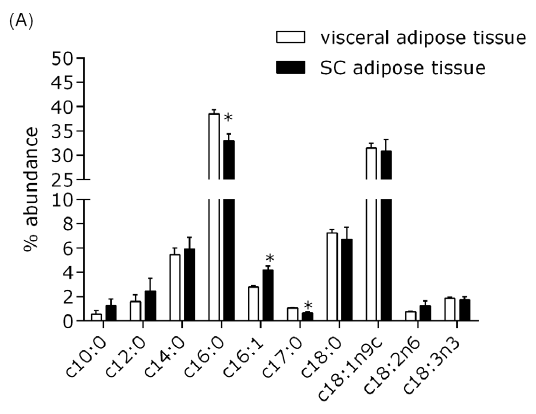
That looks a bit like around 1% LA and 2% ALA.
I'd eat that.
Peter
Subscribe to:
Posts (Atom)