Very briefly: I hit this by accident. Some time ago there was an exchange of comments about whether VLC eating might function as a management for Glycogen Storage Disease type I, von Gierke's disease. I think the question was firmly, and possibly incorrectly, settled by mnature pointing out that raw cornstarch was THE answer. No choice. I realise GSD type III is not GSD type I, but many of the clinical signs are the same, especially hypoglycaemia. There is choice in type III.
The group have tried a high protein diet to provide hepatic glucose from gluconeogenesis, a mildly ketogeneic diet to AVOID providing exogenous glucose because it just drops in to a bottomless pit of stored glycogen and some synthetic ketones à la Veech to provide some glucose-independent ATP.
Just a case report, it worked. So far so good. Interesting.
Peter
PS The new blogger format. I hate it. Can you make the links live in preview????
Monday, April 23, 2012


Tuesday, April 10, 2012
FIRKO-isation without all the hassle?
OK, I've treated myself to a few hours at the blog.
If we look at Veech's 2011 paper we can see that he is driving towards a drug which induces ketosis, side stepping all of that starvation or very low carbohydrate eating normally required, outstripping octanoate for carbohydrate defying ketosis. You can even FIRKO-ise your mice without all that standing around on a hill top in mid winter. It would, essentially, allow all of the benefits of ketosis on metabolic efficiency while still consuming a diet of utter crap. That's not something which interests me terribly much, though I can completely see where he is coming from. It will do some good but probably do very little to influence the underlying progress of the disease.
We had friends of friends round to supper the other day. They were interested (as Veech is) in ketosis as a tool to try and modify the progress of Parkinson's disease. So we had a baked mushroom each, filled with bacon and melted soft cheese with a smidge of fried onions and a micro smidge of spinach then topped with half a round of goat cheese for starters, belly pork goulash with soured cream, broccoli and asparagus for main course and Optimal ice cream (minimal dose of honey, no sugar) with a few raspberries for desert. Coffee and double cream. Modest red wine portions. The funniest part was trying to explain to them that serious researchers/nutritionists genuinely explained away the reduced appetite on LC diets as being due to either boredom or lack of palatability.
As Veech commented:
"Further, to achieve effective ketosis with KG diets, almost complete avoidance of carbohydrates is required to keep blood insulin levels low to maintain adipose tissue lipolysis. Such high-fat, no-carbohydrate diets are unpalatable, leading to poor patient compliance."
Eeeh, the stuff people come up with. Personally, I think Veech should sack his chef. Or stop eating F3666 and hire a chef.
The other gem from the paper was this line here, talking about his ketone ester fed mice:
"The ketone levels are similar to those found in humans during prolonged fasting (33, 34) and are 3- to 5-fold higher than the levels reported for mice fed KG diets (13, 15)."
It's the last section of that quote that really made me sit up. Both ref 13 and ref 15 are sitting on my hard drive. They use F3666, 8.6% protein, 3.2% carbs and lots of fat. They found ketone levels of 1.3mmol/l and 1.6mmol/l.
That is amazing. Amazingly pathetic ketosis. Nine percent protein, minimal carbs, the rest fat. If you or I ate this diet for more than a few days we would be peeing brilliant purple on our Ketostix.
What is really special about this Veech study and the other two mouse ketosis papers is not what they tell us about how to get in to ketosis (or not), it's much more what they tell us about C57BL/6 mice. That's right, C57BL/6 mice.
These mice are very special.
I've long thought that these poor rodents behave, when fed a high fat diet, rather like MSG lesioned, ventromedial hypothalamic lesioned or gold thioglucose lesioned animals. Their VMH breaks. They develop neuronally mediated acute insulin hypersensitivity in their adipocytes, they then abnormally store fat at low levels of insulin, increase eating to compensate for this calorie loss in to adipocytes and eventually develop adipocyte distention induced insulin resistance, which shows as metabolic syndrome.
It is impossible to over emphasise how important these ketosis studies are to C57BL/6 mice. Especially if you happen to be a C57BL/6 mouse.
BUT let's pretend none of us is a C57BL/6 mouse, just imagine you are a Wistar rat on 11% protein added to your traditional diet of neat Crisco (Mmmmm, Crisco, yumeeee). You will be in to ketosis with a beta hydroxybutyrate at 4.8mmol/l, and probably develop another mmol/l of AcA, within days and stay there. Are humans more like C57BL/6 mice or Wistar rats? I have no doubt that a human can damage their VMH by the same process by which they become obese. I doubt very much that this has anything to do with eating fat. Sucrose is much more likely. But even if you are obese and have damaged your VMH while becoming obese, you can still get your BHB over 7mmol/l. It may take some time, or even a little water fasting, but you can do it.
BTW Crisco induced ketosis is neuroprotective although I'd personally rather do the same with butter!
If you are a human looking to manage Parkinsons you can quite easily get to 6mmol/l of ketones in your bloodstream. You are not a C57BL/6 mouse. You don't even need Crisco, selected Food will do it.
The massive benefit of a ketogenic diet over the "SAD spiked with ketone esters" approach is that ketogenic diets avoid hyperglycaemic episodes. If you think hyperglycaemia is good for neurons you are probably well in to some nasty neurodegenerative disease!
Peter
BTW Apologies for the total lack of contribution to conversation in the comments. I have the choice between the occasional post or trying to get comments answered and a lot of the time neither gets done. Here's the occasional post. Obviously the next step, given time, is back to Veech 1995 where he talks electron transport chain, mitochondrial inner membrane voltages, proton leakage and a whole load more about very basic concepts, some of which are quite fascinating. Including the benefits of insulin. He then is talking in Nick Lane territory. And I hope everyone noticed that Stan has been to Nick Lane's website and has linked to this publication. I just loved this quote about the acetyl CoA pathway:
It's "a free lunch that you're paid to eat," in the words of Everett Shock.
My own light reading at the moment is this one, as a kid I thought tunnel diodes were cool.
If we look at Veech's 2011 paper we can see that he is driving towards a drug which induces ketosis, side stepping all of that starvation or very low carbohydrate eating normally required, outstripping octanoate for carbohydrate defying ketosis. You can even FIRKO-ise your mice without all that standing around on a hill top in mid winter. It would, essentially, allow all of the benefits of ketosis on metabolic efficiency while still consuming a diet of utter crap. That's not something which interests me terribly much, though I can completely see where he is coming from. It will do some good but probably do very little to influence the underlying progress of the disease.
We had friends of friends round to supper the other day. They were interested (as Veech is) in ketosis as a tool to try and modify the progress of Parkinson's disease. So we had a baked mushroom each, filled with bacon and melted soft cheese with a smidge of fried onions and a micro smidge of spinach then topped with half a round of goat cheese for starters, belly pork goulash with soured cream, broccoli and asparagus for main course and Optimal ice cream (minimal dose of honey, no sugar) with a few raspberries for desert. Coffee and double cream. Modest red wine portions. The funniest part was trying to explain to them that serious researchers/nutritionists genuinely explained away the reduced appetite on LC diets as being due to either boredom or lack of palatability.
As Veech commented:
"Further, to achieve effective ketosis with KG diets, almost complete avoidance of carbohydrates is required to keep blood insulin levels low to maintain adipose tissue lipolysis. Such high-fat, no-carbohydrate diets are unpalatable, leading to poor patient compliance."
Eeeh, the stuff people come up with. Personally, I think Veech should sack his chef. Or stop eating F3666 and hire a chef.
The other gem from the paper was this line here, talking about his ketone ester fed mice:
"The ketone levels are similar to those found in humans during prolonged fasting (33, 34) and are 3- to 5-fold higher than the levels reported for mice fed KG diets (13, 15)."
It's the last section of that quote that really made me sit up. Both ref 13 and ref 15 are sitting on my hard drive. They use F3666, 8.6% protein, 3.2% carbs and lots of fat. They found ketone levels of 1.3mmol/l and 1.6mmol/l.
That is amazing. Amazingly pathetic ketosis. Nine percent protein, minimal carbs, the rest fat. If you or I ate this diet for more than a few days we would be peeing brilliant purple on our Ketostix.
What is really special about this Veech study and the other two mouse ketosis papers is not what they tell us about how to get in to ketosis (or not), it's much more what they tell us about C57BL/6 mice. That's right, C57BL/6 mice.
These mice are very special.
I've long thought that these poor rodents behave, when fed a high fat diet, rather like MSG lesioned, ventromedial hypothalamic lesioned or gold thioglucose lesioned animals. Their VMH breaks. They develop neuronally mediated acute insulin hypersensitivity in their adipocytes, they then abnormally store fat at low levels of insulin, increase eating to compensate for this calorie loss in to adipocytes and eventually develop adipocyte distention induced insulin resistance, which shows as metabolic syndrome.
It is impossible to over emphasise how important these ketosis studies are to C57BL/6 mice. Especially if you happen to be a C57BL/6 mouse.
BUT let's pretend none of us is a C57BL/6 mouse, just imagine you are a Wistar rat on 11% protein added to your traditional diet of neat Crisco (Mmmmm, Crisco, yumeeee). You will be in to ketosis with a beta hydroxybutyrate at 4.8mmol/l, and probably develop another mmol/l of AcA, within days and stay there. Are humans more like C57BL/6 mice or Wistar rats? I have no doubt that a human can damage their VMH by the same process by which they become obese. I doubt very much that this has anything to do with eating fat. Sucrose is much more likely. But even if you are obese and have damaged your VMH while becoming obese, you can still get your BHB over 7mmol/l. It may take some time, or even a little water fasting, but you can do it.
BTW Crisco induced ketosis is neuroprotective although I'd personally rather do the same with butter!
If you are a human looking to manage Parkinsons you can quite easily get to 6mmol/l of ketones in your bloodstream. You are not a C57BL/6 mouse. You don't even need Crisco, selected Food will do it.
The massive benefit of a ketogenic diet over the "SAD spiked with ketone esters" approach is that ketogenic diets avoid hyperglycaemic episodes. If you think hyperglycaemia is good for neurons you are probably well in to some nasty neurodegenerative disease!
Peter
BTW Apologies for the total lack of contribution to conversation in the comments. I have the choice between the occasional post or trying to get comments answered and a lot of the time neither gets done. Here's the occasional post. Obviously the next step, given time, is back to Veech 1995 where he talks electron transport chain, mitochondrial inner membrane voltages, proton leakage and a whole load more about very basic concepts, some of which are quite fascinating. Including the benefits of insulin. He then is talking in Nick Lane territory. And I hope everyone noticed that Stan has been to Nick Lane's website and has linked to this publication. I just loved this quote about the acetyl CoA pathway:
It's "a free lunch that you're paid to eat," in the words of Everett Shock.
My own light reading at the moment is this one, as a kid I thought tunnel diodes were cool.
Sunday, March 18, 2012
Still not on line
Hi all,
People may realise that I don't really have any great interest in, or knowledge about, the blogging platform I use, so it's a real pain when Google changes odds and ends and I end up unable to even view comments using Firefox and with Safari I get access to comments but no ability to even delete spam from the blog itself. This is a bit of a pain and is markedly limiting.
Meantime the cutting and stitching business is taking rather a lot of our time and even deleting the spam is not looking like happening in the immediate future.
I'll get back on line properly when I get more sorted. At the moment our priority in the evenings is to try and get ahead of running the house so we can have a smidge of free time as a family at the weekends. Serious stuff for the blog is reverse transport of electrons through complex 1 as a major route to mitochondrial free radical generation in the ETC and why it might occur. Preliminary reading would be Lucas Tafur from a year ago here. A great post. I spent hours on Veech's 1995 paper before tripping over Lucas' rather tidy discussion!
All the best
Peter
People may realise that I don't really have any great interest in, or knowledge about, the blogging platform I use, so it's a real pain when Google changes odds and ends and I end up unable to even view comments using Firefox and with Safari I get access to comments but no ability to even delete spam from the blog itself. This is a bit of a pain and is markedly limiting.
Meantime the cutting and stitching business is taking rather a lot of our time and even deleting the spam is not looking like happening in the immediate future.
I'll get back on line properly when I get more sorted. At the moment our priority in the evenings is to try and get ahead of running the house so we can have a smidge of free time as a family at the weekends. Serious stuff for the blog is reverse transport of electrons through complex 1 as a major route to mitochondrial free radical generation in the ETC and why it might occur. Preliminary reading would be Lucas Tafur from a year ago here. A great post. I spent hours on Veech's 1995 paper before tripping over Lucas' rather tidy discussion!
All the best
Peter
Sunday, March 04, 2012
Fruit and vegetables
Still no net-time to speak of but life goes on. Look at these brightly coloured fruit and vegetables:

They look so good I just can't help myself. I just have to shred them

and feed them to the chickens

who can convert them to Food

Eggcellent (sorry)
Peter
OK, I do have to admit to eating the occasional vegetable as flavouring for Food.

They look so good I just can't help myself. I just have to shred them

and feed them to the chickens

who can convert them to Food

Eggcellent (sorry)
Peter
OK, I do have to admit to eating the occasional vegetable as flavouring for Food.
Thursday, February 16, 2012
NASH on a ketogenic diet
Just a brief post on the development of NASH in long term ketogenic fed mice because I've been side tracked by some other papers: Starvation (Ethan), metformin (tripped over this one myself, things are moving forward from PSS and Oxygen), UCPs and fat oxidation (kindke)...
NASH, it all comes down to this paper (thanks Liz).
Does sustained ketosis produce NASH? Well yes, or at least something like it. Just look at the picture:

The dark staining patch is made up of neutrophils. You don't want clumps of them aggregating in your liver.
That's what you get if you feed F3666 to C57BL/6 mice. It is, undoubtedly, intensely ketogenic. But is it anything else?

"These are typical amounts of nutrients calculated from
available information. Actual assay results may vary.
For more information contact Jaime Lecker, Ph.D."
The paper (and the F3666 pdf) specifies 16% of PUFA in the fat, which seems rather low considering that USA produced lard (the main ingredient) appears to have 32% PUFA (almost all omega 6) but, even at only 16%, these PUFA are 16% of 95% of your total calories. That's an awful lot of PUFA...
Do PUFA matter for the development of NASH? Probably. From this N and M paper:
"The lipid composition of the different diets which induce steatohepatitis (see Table 4) [19,20,51,52,54], were lard and corn oil, both oils rich in unsaturated fatty acids. We can observe that fat of all the diets inducing steatosis and inflammation (Table 4) were richer in MUFA and PUFA (>30% and >20% of total fat respectively) as compared to our diet (5% and 2%). The injurious effect of unsaturated fatty acids, and particularly n-6 polyunsaturated fatty acids, was associated with enhanced lipid peroxidation and decreased concentrations of antioxidant enzymes, implicating oxidative stress as a causal factor. Indeed, different studies showed the pro-inflammatory effect of polyunsaturated n-6 fatty acids which exacerbate liver oxidative stress [60,61] and promote the development of NASH."
So there is a message: If you are going to eat a very high fat diet in the long term, you should pay serious attention to PUFA creep. Having cirrhosis is not likely to help you make old bones in good shape. Perhaps go easy on the commercial mayonnaise and just spread some butter on your cheese... Actually I tend to add butter to my beef if it's too lean (only happens when eating out, no way we would choose lean beef to cook at home!)...
It makes me wonder about saturophobes who might be swilling PUFA to lower their LDL and triglycerides, with or without a LC diet... More potential victims of the cholesterol hypothesis I suppose.
Peter
NASH, it all comes down to this paper (thanks Liz).
Does sustained ketosis produce NASH? Well yes, or at least something like it. Just look at the picture:

The dark staining patch is made up of neutrophils. You don't want clumps of them aggregating in your liver.
That's what you get if you feed F3666 to C57BL/6 mice. It is, undoubtedly, intensely ketogenic. But is it anything else?

"These are typical amounts of nutrients calculated from
available information. Actual assay results may vary.
For more information contact Jaime Lecker, Ph.D."
The paper (and the F3666 pdf) specifies 16% of PUFA in the fat, which seems rather low considering that USA produced lard (the main ingredient) appears to have 32% PUFA (almost all omega 6) but, even at only 16%, these PUFA are 16% of 95% of your total calories. That's an awful lot of PUFA...
Do PUFA matter for the development of NASH? Probably. From this N and M paper:
"The lipid composition of the different diets which induce steatohepatitis (see Table 4) [19,20,51,52,54], were lard and corn oil, both oils rich in unsaturated fatty acids. We can observe that fat of all the diets inducing steatosis and inflammation (Table 4) were richer in MUFA and PUFA (>30% and >20% of total fat respectively) as compared to our diet (5% and 2%). The injurious effect of unsaturated fatty acids, and particularly n-6 polyunsaturated fatty acids, was associated with enhanced lipid peroxidation and decreased concentrations of antioxidant enzymes, implicating oxidative stress as a causal factor. Indeed, different studies showed the pro-inflammatory effect of polyunsaturated n-6 fatty acids which exacerbate liver oxidative stress [60,61] and promote the development of NASH."
So there is a message: If you are going to eat a very high fat diet in the long term, you should pay serious attention to PUFA creep. Having cirrhosis is not likely to help you make old bones in good shape. Perhaps go easy on the commercial mayonnaise and just spread some butter on your cheese... Actually I tend to add butter to my beef if it's too lean (only happens when eating out, no way we would choose lean beef to cook at home!)...
It makes me wonder about saturophobes who might be swilling PUFA to lower their LDL and triglycerides, with or without a LC diet... More potential victims of the cholesterol hypothesis I suppose.
Peter
Friday, February 03, 2012
FIRKO-ise
Question: How do you convert a C57BL/6 mouse in to a FIRKO mouse?
Answer: Easily.
First, break your mouse. Both the grey squares and white triangles represent C57BL/6 mice on good old "high fat" D12451, so beloved of obesity researchers. They get a broken brain and gain weight. You can also feed chow CIAB to get the black diamonds:

Now let's do a little magic and render all of the adipocytes of the white triangle D12451 injured mice insulin resistant, in both brown and white adipose tissue. This is slightly tricky. Are you all standing in a circle holding hands? On a hill top in mid winter? OK, say the magic words while turning withershins. You have to chant:
Calories-in, calories out, turn this stupid mouse about! FIRKO-ISE...

OK, well done, you can all put your clothes back on now and stop dreaming of UCP-1.
I guess everyone realises by now we've been talking about the graph from this paper

with the classic use of ketosis to normalise the bodyweight of D12451 injured mice. Ketosis renders adipocytes insulin resistant, just like those of FIRKO mice. Of course, because ketogenic dieted C57BL/6 mice are functionally FIRKO, they don't cut calories. They eat as many calories as the D12451 injured mice. But they produce more heat:
"Thus, total heat output was 15% higher, averaged over 24 h, in KD animals (KD 0.538 ± 0.01 kcal/h vs. HF 480 ± 0.01 kcal/h, P < 0.05, n = 4). Oxygen consumption was increased by 34% averaged over 24 h (KD 4.370 ± 0.062 ml·kg–1·h–1 vs. HF 3.248 ± 0.052 ml·kg–1·h–1, P < 0.01, n = 4; Fig. 6C). Weight and CLAMS results were replicated in two additional independent cohorts using the same paradigm. CLAMS analysis also revealed that spontaneous dark-phase locomotor activity in KD animals was ∼30% lower than in HF animals."
[*Brownie point for spotting the typo in the quote. Hot mice indeed!]
They also avoid the gym. Heard that before?
We know that simply not eating for a while induces whole body physiological insulin resistance. We also know we can do exactly the same thing, without all the pesky death involved in sustained not-eating, by simply going in to deep ketosis without cutting calories.
Ketogenic dieting is slightly controversial. I've heard it said that the weight loss in these ketogenic fed mice is not real weight loss. I've even heard the change described as organ shrinkage. Interesting. The ketogenic mice become relatively hypoinsulinaemic and glycogen depleted. Do these affect lean bodyweight directly?
I had the full text of this paper sent to me by a friend and it has a nice summary of the effects of carbohydrate restriction on fluid balance (excuse the rather condescending tone, it's written by a leading obesity researcher):
"...energy is stored in the body as protein, fat, and glycogen, which is a form of carbohydrate. Any imbalance between the intake and use of these macronutrients will lead to an alteration of body composition since the stored protein, fat, or glycogen must change to compensate the imbalance. The energy stored per unit mass of carbohydrate, fat, and protein varies considerably, especially when accounting for the intracellular water associated with stored glycogen and protein.7 Furthermore, dietary carbohydrates have an effect on renal sodium excretion via insulin,60 which results in concomitant changes of extracellular fluid."
As far as I can make out losing liver glycogen, muscle glycogen, excess sodium and, in particular, the water associated with these body components shows up as lean body mass loss on a DEXA scan. Reducing your insulin-induced sodium retention may be good or bad depending on many factors (such as your starting blood pressure!), but it will show as a non adipose tissue body deficit in Fig 2, graph B, second column. There might even be a little muscle reduction, I can't say...
We know from the DEXA scans in Table 5 that ketogenic dieted, post-obese mice had a significant deficit (by mouse standards) of fat compared to the D12451 injured mice and most of it showed up in the whole body scans rather than the hind limb scans. This would suggest to me that they lost central, probably visceral, fat. I think we all pretty well agree that visceral fat is Bad Fat (maybe). It's usually the first to go on ketogenic dieting in humans. I don't see fluid loss or visceral fat loss as big worries.
There seem to be a whole stack of benefits to sticking D12451 injured mice on to an extreme ketogenic diet.
Real FIRKO mice live about 18% longer than CIAB fed mice.
What about these ketogenic fed, pseudo-FIRKO mice? Alas the sad story of their premature demise will have to be left for the next post...
Peter
Answer: Easily.
First, break your mouse. Both the grey squares and white triangles represent C57BL/6 mice on good old "high fat" D12451, so beloved of obesity researchers. They get a broken brain and gain weight. You can also feed chow CIAB to get the black diamonds:

Now let's do a little magic and render all of the adipocytes of the white triangle D12451 injured mice insulin resistant, in both brown and white adipose tissue. This is slightly tricky. Are you all standing in a circle holding hands? On a hill top in mid winter? OK, say the magic words while turning withershins. You have to chant:
Calories-in, calories out, turn this stupid mouse about! FIRKO-ISE...

OK, well done, you can all put your clothes back on now and stop dreaming of UCP-1.
I guess everyone realises by now we've been talking about the graph from this paper

with the classic use of ketosis to normalise the bodyweight of D12451 injured mice. Ketosis renders adipocytes insulin resistant, just like those of FIRKO mice. Of course, because ketogenic dieted C57BL/6 mice are functionally FIRKO, they don't cut calories. They eat as many calories as the D12451 injured mice. But they produce more heat:
"Thus, total heat output was 15% higher, averaged over 24 h, in KD animals (KD 0.538 ± 0.01 kcal/h vs. HF 480 ± 0.01 kcal/h, P < 0.05, n = 4). Oxygen consumption was increased by 34% averaged over 24 h (KD 4.370 ± 0.062 ml·kg–1·h–1 vs. HF 3.248 ± 0.052 ml·kg–1·h–1, P < 0.01, n = 4; Fig. 6C). Weight and CLAMS results were replicated in two additional independent cohorts using the same paradigm. CLAMS analysis also revealed that spontaneous dark-phase locomotor activity in KD animals was ∼30% lower than in HF animals."
[*Brownie point for spotting the typo in the quote. Hot mice indeed!]
They also avoid the gym. Heard that before?
We know that simply not eating for a while induces whole body physiological insulin resistance. We also know we can do exactly the same thing, without all the pesky death involved in sustained not-eating, by simply going in to deep ketosis without cutting calories.
Ketogenic dieting is slightly controversial. I've heard it said that the weight loss in these ketogenic fed mice is not real weight loss. I've even heard the change described as organ shrinkage. Interesting. The ketogenic mice become relatively hypoinsulinaemic and glycogen depleted. Do these affect lean bodyweight directly?
I had the full text of this paper sent to me by a friend and it has a nice summary of the effects of carbohydrate restriction on fluid balance (excuse the rather condescending tone, it's written by a leading obesity researcher):
"...energy is stored in the body as protein, fat, and glycogen, which is a form of carbohydrate. Any imbalance between the intake and use of these macronutrients will lead to an alteration of body composition since the stored protein, fat, or glycogen must change to compensate the imbalance. The energy stored per unit mass of carbohydrate, fat, and protein varies considerably, especially when accounting for the intracellular water associated with stored glycogen and protein.7 Furthermore, dietary carbohydrates have an effect on renal sodium excretion via insulin,60 which results in concomitant changes of extracellular fluid."
As far as I can make out losing liver glycogen, muscle glycogen, excess sodium and, in particular, the water associated with these body components shows up as lean body mass loss on a DEXA scan. Reducing your insulin-induced sodium retention may be good or bad depending on many factors (such as your starting blood pressure!), but it will show as a non adipose tissue body deficit in Fig 2, graph B, second column. There might even be a little muscle reduction, I can't say...
We know from the DEXA scans in Table 5 that ketogenic dieted, post-obese mice had a significant deficit (by mouse standards) of fat compared to the D12451 injured mice and most of it showed up in the whole body scans rather than the hind limb scans. This would suggest to me that they lost central, probably visceral, fat. I think we all pretty well agree that visceral fat is Bad Fat (maybe). It's usually the first to go on ketogenic dieting in humans. I don't see fluid loss or visceral fat loss as big worries.
There seem to be a whole stack of benefits to sticking D12451 injured mice on to an extreme ketogenic diet.
Real FIRKO mice live about 18% longer than CIAB fed mice.
What about these ketogenic fed, pseudo-FIRKO mice? Alas the sad story of their premature demise will have to be left for the next post...
Peter
Wednesday, February 01, 2012
The books
As we all know, there is a spate of new books out at the moment. I see that Dr Briffa is on Jimmy Moore's LLVDLC.
John sent me a copy of Escape the Diet Trap and it almost immediately disappeared to my wife's mother, to be returned disappointingly rapidly a week later. She has, happily, bought her own copy. No one where she works believes a word of it. I like it.
Not had chance to read Richard's primer or Chris's Hillfit but I know neither need any help from me and I'm looking forward getting a chance to read both as I get a little more time...
Anyone who has moved from Scotland to East Anglia will know how envious you feel browsing http://cairn-in-the-mist.blogspot.com/.
Thanks guys.
Peter
John sent me a copy of Escape the Diet Trap and it almost immediately disappeared to my wife's mother, to be returned disappointingly rapidly a week later. She has, happily, bought her own copy. No one where she works believes a word of it. I like it.
Not had chance to read Richard's primer or Chris's Hillfit but I know neither need any help from me and I'm looking forward getting a chance to read both as I get a little more time...
Anyone who has moved from Scotland to East Anglia will know how envious you feel browsing http://cairn-in-the-mist.blogspot.com/.
Thanks guys.
Peter
Monday, January 23, 2012
FIRKO mice
Okay. I have an apology to make. I'm not sure there will be an MCQ test on the FIRKO mouse to parallel that on the LIRKO mouse. At this stage of the proceedings I'm not sure that I can muster the motivation which is needed to do justice to such an Herculean task of applied sarcasm. The difficulty is compounded by the loss of my trowel somewhere between Berkshire and Norfolk via Glasgow. You really do need a trowel. I know, excuses, excuses. Mea culpa.
With that apology, I think it's time to discuss this paper.
So now we have the FIRKO mouse. This mutant mouse has been cleverly engineered to fail to express insulin receptors on its adipocytes. Everything else is normal. Functionally the adipocytes are severely insulin resistant. It does not matter how much insulin the pancreas secretes, adipocytes will not, cannot, listen to it. You know the rules. The function of insulin is to store dietary fat in adipocytes. In the almost complete absence of any insulin receptors on any adipocytes, this just ain't gonna happen. So FIRKO mice stay slim, slightly slimmer than a control mouse, and live a bit longer. All on CIAB and without cutting calories of course.
They also fail to develop age related insulin resistance. Please note as a complete aside; those mice on F9, boring old low fat CIAB, do develop age related insulin resistance and glucose intolerance. Wanna stay as healthy as a mouse on F9 with age acquired insulin resistance? Go ahead and eat low fat, about 10% of your calories will do. Try not to get too bored.
I could stop here with this comment from the authors:
"Our data further show that insulin signalling in adipocytes is crucial for triglyceride storage and the development of obesity and its associated metabolic abnormalities"
It would be fun to just thumb your data at those fixated on the central effects of insulin but that would be leaving a whole can of worms unopened. You know how it ticks you off to get partial information on a given study. The selective information rationing typical an obesity researcher. The data are actually quite complex.
Let's get a tin opener.
Sooooooo, what if you take a FIRKO mouse and inject it with gold thioglucose? Obviously you will bust its VMH. You could equally use a electrical ice-pick or a big meal at a Chinese restaurant (jk).
To summarise the last post: This injury increases the ability of adipocytes to divert calories away from metabolism and in to storage, by an increase in their sensitivity to insulin. Fat should simply pour in to the adipocytes of a VMH injured rodent and they should start eating big time. You could be forgiven for thinking you had removed their brain satiety centre or upped their fat set-point.
But the FIRKO mouse has very few insulin receptors on its adipocytes. The brain can scream, shout and have a temper tantrum to demand fat storage. Adipocytes stay cool as a cucumber and don't even give the finger to the brain. Pure ignore-ance. The brain has lost its tool for fat storage. You know the one, the tool which stops you being hungry (snigger) and helps you lose weight (sigh). Insulin.
Now let's look at some of the graphs. We'll start with the supportive one:

We can ignore the middle two columns, they're from different knockout mice. FIRKO mice with a gold thioglucose brain injury (right hand column) weigh the same as, or even a non significant smidge less than, WT mice (or FIRKO mice) without a gold thioglucose injury. Now that's no surprise. Brain:Adipocyte:Insulin.
But there is a shock in store. Here's the next graph, the columns are the same:

FIRKO mice eat MORE if they are injured by gold thioglucose than if they aren't. They eat almost exactly the same extra food as a wild type gold thioglucose injured mouse. While staying slim, of course. But they do eat more.
Does this mean that the VMH really controls appetite rather than the ability to divert calories to fat storage?
FIRKO mice have markedly reduced insulin receptors on both white and brown adipose tissue. The consequence of this on white adipose tissue is simple, insulin causes fat storage, lack of receptors limits fat storage. BAT is more complex. We do have a BATIRKO mouse which has had the insulin receptors knocked out on its brown adipose tissue only. This leads to combined atrophy of BAT (the normal lipid droplets in BAT never form) with marked up regulation of UCP1 production. They stay slim compared to controls while being fed CIAB (aside: although slim they do eventually become diabetic, the reasons for which are utterly unclear to anyone, see the discussion). As the authors comment on "normal" BATIRKO mice:
"Interestingly, the lack of IR leads to the over expression of the UCP-1 and also UCP-2 in the remnant BAT from BATIRKO as compared with controls. These data could be interpreted as a form of compensatory mechanism for the brown fat lipid content and mass loss observed in BATIRKO and may result in a potential increase in the thermogenic capacity of the remnant BAT that may account for the lean phenotype of BATIRKO mice compared with controls"
A lack of insulin receptors on your BAT up regulates thermogenesis. This has nothing to do with the brain and everything to do with the periphery. Why should thermogenesis be increased by VMH injury? I don't know. The control of BAT is complex and I don't think the work has been done yet. There are hints that insulin reduces UCP1 production in mice, bringing us back to changes in insulin signalling and thermogenesis. You might expect a system which activates fat storage might turn off fat burning and vice versa.
At the moment, for FIRKO mice, it looks like an open question as to whether gold thioglucose VMH lesions really increase appetite directly or increases thermogenesis in BAT causing a calorie loss, with compensatory hyperphagia. You can imagine which option I think may be the case, but I do have certain biases.
It's frustrating that there is no information to follow through on this. The group's last publication on the FIRKO mouse was in 2007 and was interesting in its own right.
The FIRKO mouse has white adipose tissue which, with age, gets to have better and better mitochondria. Probably more of them too. The authors talk about increased whole body oxidative metabolism but don't seem to consider BAT seperately from WAT... But having your adipocytes live in [what to them is] an hypoinsulinaemic environment seems to be rather good for them. And the mouse
Anyway, summary:
Remember what is special about FIRKO mouse is that its adipocytes never see insulin, whatever the blood insulin level. Lacking IRs on all of your adipocytes keeps you slim, keeps your insulin levels low and extends your life expectancy by about 18%. It gives you shiny new mitochondria in your adipocytes as you age. If you are a mouse.
It it possible to mimic this state in non-FIRKO mice?
Perhaps it's time to revisit ketogenic diets in mice. Oh, and cirrhosis too.
Peter
With that apology, I think it's time to discuss this paper.
So now we have the FIRKO mouse. This mutant mouse has been cleverly engineered to fail to express insulin receptors on its adipocytes. Everything else is normal. Functionally the adipocytes are severely insulin resistant. It does not matter how much insulin the pancreas secretes, adipocytes will not, cannot, listen to it. You know the rules. The function of insulin is to store dietary fat in adipocytes. In the almost complete absence of any insulin receptors on any adipocytes, this just ain't gonna happen. So FIRKO mice stay slim, slightly slimmer than a control mouse, and live a bit longer. All on CIAB and without cutting calories of course.
They also fail to develop age related insulin resistance. Please note as a complete aside; those mice on F9, boring old low fat CIAB, do develop age related insulin resistance and glucose intolerance. Wanna stay as healthy as a mouse on F9 with age acquired insulin resistance? Go ahead and eat low fat, about 10% of your calories will do. Try not to get too bored.
I could stop here with this comment from the authors:
"Our data further show that insulin signalling in adipocytes is crucial for triglyceride storage and the development of obesity and its associated metabolic abnormalities"
It would be fun to just thumb your data at those fixated on the central effects of insulin but that would be leaving a whole can of worms unopened. You know how it ticks you off to get partial information on a given study. The selective information rationing typical an obesity researcher. The data are actually quite complex.
Let's get a tin opener.
Sooooooo, what if you take a FIRKO mouse and inject it with gold thioglucose? Obviously you will bust its VMH. You could equally use a electrical ice-pick or a big meal at a Chinese restaurant (jk).
To summarise the last post: This injury increases the ability of adipocytes to divert calories away from metabolism and in to storage, by an increase in their sensitivity to insulin. Fat should simply pour in to the adipocytes of a VMH injured rodent and they should start eating big time. You could be forgiven for thinking you had removed their brain satiety centre or upped their fat set-point.
But the FIRKO mouse has very few insulin receptors on its adipocytes. The brain can scream, shout and have a temper tantrum to demand fat storage. Adipocytes stay cool as a cucumber and don't even give the finger to the brain. Pure ignore-ance. The brain has lost its tool for fat storage. You know the one, the tool which stops you being hungry (snigger) and helps you lose weight (sigh). Insulin.
Now let's look at some of the graphs. We'll start with the supportive one:

We can ignore the middle two columns, they're from different knockout mice. FIRKO mice with a gold thioglucose brain injury (right hand column) weigh the same as, or even a non significant smidge less than, WT mice (or FIRKO mice) without a gold thioglucose injury. Now that's no surprise. Brain:Adipocyte:Insulin.
But there is a shock in store. Here's the next graph, the columns are the same:

FIRKO mice eat MORE if they are injured by gold thioglucose than if they aren't. They eat almost exactly the same extra food as a wild type gold thioglucose injured mouse. While staying slim, of course. But they do eat more.
Does this mean that the VMH really controls appetite rather than the ability to divert calories to fat storage?
FIRKO mice have markedly reduced insulin receptors on both white and brown adipose tissue. The consequence of this on white adipose tissue is simple, insulin causes fat storage, lack of receptors limits fat storage. BAT is more complex. We do have a BATIRKO mouse which has had the insulin receptors knocked out on its brown adipose tissue only. This leads to combined atrophy of BAT (the normal lipid droplets in BAT never form) with marked up regulation of UCP1 production. They stay slim compared to controls while being fed CIAB (aside: although slim they do eventually become diabetic, the reasons for which are utterly unclear to anyone, see the discussion). As the authors comment on "normal" BATIRKO mice:
"Interestingly, the lack of IR leads to the over expression of the UCP-1 and also UCP-2 in the remnant BAT from BATIRKO as compared with controls. These data could be interpreted as a form of compensatory mechanism for the brown fat lipid content and mass loss observed in BATIRKO and may result in a potential increase in the thermogenic capacity of the remnant BAT that may account for the lean phenotype of BATIRKO mice compared with controls"
A lack of insulin receptors on your BAT up regulates thermogenesis. This has nothing to do with the brain and everything to do with the periphery. Why should thermogenesis be increased by VMH injury? I don't know. The control of BAT is complex and I don't think the work has been done yet. There are hints that insulin reduces UCP1 production in mice, bringing us back to changes in insulin signalling and thermogenesis. You might expect a system which activates fat storage might turn off fat burning and vice versa.
At the moment, for FIRKO mice, it looks like an open question as to whether gold thioglucose VMH lesions really increase appetite directly or increases thermogenesis in BAT causing a calorie loss, with compensatory hyperphagia. You can imagine which option I think may be the case, but I do have certain biases.
It's frustrating that there is no information to follow through on this. The group's last publication on the FIRKO mouse was in 2007 and was interesting in its own right.
The FIRKO mouse has white adipose tissue which, with age, gets to have better and better mitochondria. Probably more of them too. The authors talk about increased whole body oxidative metabolism but don't seem to consider BAT seperately from WAT... But having your adipocytes live in [what to them is] an hypoinsulinaemic environment seems to be rather good for them. And the mouse
Anyway, summary:
Remember what is special about FIRKO mouse is that its adipocytes never see insulin, whatever the blood insulin level. Lacking IRs on all of your adipocytes keeps you slim, keeps your insulin levels low and extends your life expectancy by about 18%. It gives you shiny new mitochondria in your adipocytes as you age. If you are a mouse.
It it possible to mimic this state in non-FIRKO mice?
Perhaps it's time to revisit ketogenic diets in mice. Oh, and cirrhosis too.
Peter
Tuesday, January 17, 2012
Used brain for sale: One careful owner, only slightly broken
Let's start with the old Stranglers track, "No More Heros", take an ice pick to a rat's brain and make its ears burn. OK, chew up its ventromedial hypothalamus with an electrolysis needle. This French paper is a pdf.
Here's the interesting table from the results:

At week one, when weight gain has started but not gone very far, fasting insulin was unchanged but blood glucose was LOWER than that of control rats. These rats, with their brain injury, have increased whole body insulin sensitivity. Mostly prominently in their adipocytes. The paper mentions in the discussion that these rats also hyper secrete insulin in response to secretagogues. Now, as we all know, insulin is both anorexic and unimportant to weight control. But if you just imagined, as I do, for a second that insulin does have something to do with weight gain, what would you expect to happen if you dropped hyper-secreted insulin on to exquisitely insulin sensitive adipocytes? Their job is to store fat under the influence of insulin so...
They would store fat. They would hang on to it. As Taubes might comment, the rats then over-eat because they are losing calories in to their adipocytes. They over eat because they are becoming fat. How do you check this? Well, let's pair feed ice-picked rats with control rats. Limit their calories. Make them go to uncheatable Weight Watchers in a prison cage. From the discussion:
"However pair-feeding rats with controls does not prevent excessive lipogenesis, fat accumulation and hyperinsulinemia [48, 49], suggesting that the disturbances of metabolism and not hyperphagia are the primary factors leading to obesity."
You injure the brain, alter the adipocytes and they store fat. Hyperphagia is an epiphenomenon of calories lost to adipocytes. They store fat even WITHOUT hyperphagia. This was quite obvious in 1992.
Enough frivolity. Let's get slightly more up to date with some Spanish MSG rats.
You have to be a bit careful with MSG injured rats. MSG is a potent neurotoxin and kills or injures almost any cell sporting glutamate receptors. This includes large numbers of nerve cells in the VMH, the target of the electrical ice-pick. However it also blunts growth hormone production, shuts down thermogenesis from brown adipose tissue and, very interestingly, adipocytes themselves probably use glutamic acid for cross talk purposes, so it's hard to know exactly what we do to MSG treated rats in addition to busting their VMH. You have to wonder whether the adipocytes themselves are injured by MSG.
Anyway, at a month of age, MSG injured rats have highly insulin sensitive adipocytes. Before the rats have become visibly obese their fat cells are already somewhat swollen and ready for the off in to full blown blobby-ness, come puberty. So again, you bust the VMH, increase adipocyte insulin sensitivity, adipocytes suck in fat and your rat simply has to eat to maintain access to enough energy to stay alive and cart the inaccessible fat around its cage. It probably doesn't dream of going to the gym.
If adipocytes are hypersensitive to insulin, what would you expect fasting FFAs, glucose and insulin look like before obesity developed?

Eyeball the HOMA score! These rats are a picture of glucoregulatory health! Unfortunately you need an energy supply from somewhere and some extra FFAs might just sort that out. You really need to develop some adipocyte distension induced insulin resistance by becoming obese to get the FFAs up to an appropriate level for a fasting rat. That's just what they do...
Look at the numbers from some Slovakian MSG injured rats as adults.

Cool, huh? Unfortunately we don't have the FFA level in the paper but, looking at the adipocyte size, they will be leaking FFAs in defiance of their double-the-control-rat level of insulin.
Now, are these adult, distended adipocytes insulin sensitive or resistant?

Well, they do bugger all to increase glucose uptake with increasing insulin exposure. So yes, they are insulin resistant. But look at this:

What glucose they do take up is diverted to fat. Might we say they are behaving like muscle cells which lack metabolic flexibility? Mitochondrial injury?
So, as obesity becomes established we end up in the age old situation of insulin resistant distended adipocytes leading to more FFA leakage than appropriate for a given level of insulin and so hyperinsulinaemia develops to try to keep blood glucose normal in the face of chronically elevated FFAs. This is absolutely not the case in the very early days, but rapidly becomes so with time.
This is all quite straight forwards and nothing you wouldn't expect if you accept the importance of insulin in obesity, adipocyte hypertrophy induced insulin resistance and the fact that adipocytes have a nerve supply which regulates their insulin sensitivity. In fact there are interesting papers on the role of adrenal hormones and the vagus as well as the sympathetic nervous system in MSG injury induced obesity. The end result is always increased insulin sensitivity of adipocytes until they become over-distended.
You can, of course, do exactly the same with gold thioglucose. Getting bored with all this? I'd basically come to the conclusion that VMH injuries give the impression of causing hyperphagia when what they actually do is increase lipid loss in to adipocytes, under the influence of insulin.
Okaaaay.
Let's look at a Long-Evans rat. If you feed it on D12492, which has been described as a high fat diet, for just three days, its brain breaks.
What if it is the fat that breaks the brain?
Well, my brain is then going to be completely f*cked.
I really do think that it might just be the fat that does it. How do I know? God told me. Okay, okay, only kidding. About god.
No, James emailed me a link to the latest Schwartz offering. I suspect that Dr Schwartz does not like Gary Taubes. We can also skip to the blog of the 4th author, who certainly does not like Gary Taubes, load up on ondansetron and have a browse. The blog says:
"Based on previous studies, the dietary fat itself is probably an important component that makes D12492 fattening in rodents"
The man is correct.
If you have quite recovered from that, let's look at the simpler aspects of the study. We can come back to the superb electron micrographs of dying mitochondria some other time. BTW, they are very, very cool pictures. I've been looking for similar photomicrographs all over the place. Who would have thought I would have found them here? Anyhoo:
First off, let's look at Figure 1, skip to graph H.

Start some ratties on D12492 and they will immediately double their calorie intake, on day 1. After living your whole short life eating CIAB I can understand this. D12492 tastes so good you just can't help yourself and it must be quite easy to eat enough of it to break your brain. It must be very rewarding. Luckily your brain recovers a bit and soon, by day seven, you're not eating any more calories of D12492 than a rat on CIAB and that's how it stays for the full 28 day period. We can tell this from Graph G. Here the average 28d food consumption on D12492 is only just above the 14d average consumed as CIAB. This excess is mostly accounted for by the first seven days of hyperphagia.
The bit of the brain which breaks "in association" with the massive 60% of calories from fat is the good old VMH. If we go back to the ice-pick rats, the MSG rats and the gold thioglucose rats we might just develop the suspicion that breaking the brain of a Long-Evans rat might affect the insulin sensitivity of its adipocytes.
If it does, fat from the diet will simply pour in to the adipose tissue and the unfortunate rattie will then have to eat extra to supply some energy to run its metabolism on in addition to that used for filling its adipocytes. Initially twice the amount it ate on CIAB. As the adipocytes fill they will become intrinsically less sensitive to insulin and fat accumulation, with its necessary compensatory hyperphagia, will slow. But not stop, if they behave anything like adipocytes in other VMH injured rat models.
On a high fat diet there is plenty of fat to pour in to adipocytes, no lipogenesis is needed. Adipocytes can distend quickly and it would be interesting to see if the fasting hypoinsulinaemia seen in the MSG rats (fed on high carbohydrate CIAB) occurs in D12492 injured rats. Probably it would still occur but be very transient, but obviously no one in the Schwartz lab would be interested in insulin.
Of course, one has to wonder which component of the D12492 might injure a rat's VMH. We are all familiar with the conversation (scroll up to get to the text) between Chris Masterjohn and the good doctor, where the omega 6 PUFA content of D12492 was noted to be 32% of fat and the omega 6:3 ratio was 14 or 16:1. All fascinating background. But my favourite obesity researcher correctly thinks it is the fat, not the type of fat, which breaks the VMH.
You can do exactly the same with butter oil (plus a smidge of soybean oil), which I'm guessing is a bit like ghee. Which I rather like. This is what butter oil at 20g/100g of food does to a Long-Evans rat in this study:

In particular look at what happened to the group HF. They switched from non purified (NP) diet on day 1 on the graph, spiked their intake to about 50% extra calories by day 5ish and were almost back down to the NP group's caloric intake by day 10. Exactly the same pattern as the D12492 also produces in Long-Evans rats.
It is impossible to emphasise how important both studies are to you if you are a Long-Evans rat.
Does three days of high fat eating break your brain if you are a human being? I have to admit that I appear to have singularly failed to become obese on 80% of my calories as fat over nine years. Possibly because 80% of your calories from fat becomes protective? I dunno. I can't help but recall those chaps in Aberdeen eating 66% of their calories as fat and refusing to finish off their allotted 2000kcal/d...
I have to be open to the idea that humans may not respond to high fat feeding in quite the same way as Long-Evans rats do. OK, they just don't. Their VMH doesn't acutely break. The rat is in trouble on 60% of calories as any sort of fat. Humans just say "no thank you" to the extra slice of bacon, in Aberdeen anyway. Oh, and in Lowestoft too.
In summary: Injuring your VMH in any way (even by eating butter oil if you are a Long-Evans rat) does nasty things to your adipocytes. They will store fat even if you cut calories. You will then be very hungry and, unless you do eat more, you will chew up your muscles for energy, get cold and move as little as possible. Oh, and still get fat. People will say you lie about your calorie intake.
Now, is it possible to become obese without breaking your VMH? Of course it is. Does it matter? That depends.
I think the chronic changes in both the Long-Evans rats and the C57BL/6 mice are very important and are quite likely different from the initial fat induced injury to the VMH. They appear to be more related to the chronic hyperinsulinaemia and hyperglycaemia which follow on from adipocyte insulin resistance and elevated FFAs especially in the presence of a high dietary carbohydrate intake. That will lead us to back to mitochondrial injury (which is probably where all of this comes from, did I even mention that obesity is a mitochondrial problem?), free radicals and I might even throw in gliosis. Which is interesting.
Peter
Here's the interesting table from the results:

At week one, when weight gain has started but not gone very far, fasting insulin was unchanged but blood glucose was LOWER than that of control rats. These rats, with their brain injury, have increased whole body insulin sensitivity. Mostly prominently in their adipocytes. The paper mentions in the discussion that these rats also hyper secrete insulin in response to secretagogues. Now, as we all know, insulin is both anorexic and unimportant to weight control. But if you just imagined, as I do, for a second that insulin does have something to do with weight gain, what would you expect to happen if you dropped hyper-secreted insulin on to exquisitely insulin sensitive adipocytes? Their job is to store fat under the influence of insulin so...
They would store fat. They would hang on to it. As Taubes might comment, the rats then over-eat because they are losing calories in to their adipocytes. They over eat because they are becoming fat. How do you check this? Well, let's pair feed ice-picked rats with control rats. Limit their calories. Make them go to uncheatable Weight Watchers in a prison cage. From the discussion:
"However pair-feeding rats with controls does not prevent excessive lipogenesis, fat accumulation and hyperinsulinemia [48, 49], suggesting that the disturbances of metabolism and not hyperphagia are the primary factors leading to obesity."
You injure the brain, alter the adipocytes and they store fat. Hyperphagia is an epiphenomenon of calories lost to adipocytes. They store fat even WITHOUT hyperphagia. This was quite obvious in 1992.
Enough frivolity. Let's get slightly more up to date with some Spanish MSG rats.
You have to be a bit careful with MSG injured rats. MSG is a potent neurotoxin and kills or injures almost any cell sporting glutamate receptors. This includes large numbers of nerve cells in the VMH, the target of the electrical ice-pick. However it also blunts growth hormone production, shuts down thermogenesis from brown adipose tissue and, very interestingly, adipocytes themselves probably use glutamic acid for cross talk purposes, so it's hard to know exactly what we do to MSG treated rats in addition to busting their VMH. You have to wonder whether the adipocytes themselves are injured by MSG.
Anyway, at a month of age, MSG injured rats have highly insulin sensitive adipocytes. Before the rats have become visibly obese their fat cells are already somewhat swollen and ready for the off in to full blown blobby-ness, come puberty. So again, you bust the VMH, increase adipocyte insulin sensitivity, adipocytes suck in fat and your rat simply has to eat to maintain access to enough energy to stay alive and cart the inaccessible fat around its cage. It probably doesn't dream of going to the gym.
If adipocytes are hypersensitive to insulin, what would you expect fasting FFAs, glucose and insulin look like before obesity developed?

Eyeball the HOMA score! These rats are a picture of glucoregulatory health! Unfortunately you need an energy supply from somewhere and some extra FFAs might just sort that out. You really need to develop some adipocyte distension induced insulin resistance by becoming obese to get the FFAs up to an appropriate level for a fasting rat. That's just what they do...
Look at the numbers from some Slovakian MSG injured rats as adults.

Cool, huh? Unfortunately we don't have the FFA level in the paper but, looking at the adipocyte size, they will be leaking FFAs in defiance of their double-the-control-rat level of insulin.
Now, are these adult, distended adipocytes insulin sensitive or resistant?

Well, they do bugger all to increase glucose uptake with increasing insulin exposure. So yes, they are insulin resistant. But look at this:

What glucose they do take up is diverted to fat. Might we say they are behaving like muscle cells which lack metabolic flexibility? Mitochondrial injury?
So, as obesity becomes established we end up in the age old situation of insulin resistant distended adipocytes leading to more FFA leakage than appropriate for a given level of insulin and so hyperinsulinaemia develops to try to keep blood glucose normal in the face of chronically elevated FFAs. This is absolutely not the case in the very early days, but rapidly becomes so with time.
This is all quite straight forwards and nothing you wouldn't expect if you accept the importance of insulin in obesity, adipocyte hypertrophy induced insulin resistance and the fact that adipocytes have a nerve supply which regulates their insulin sensitivity. In fact there are interesting papers on the role of adrenal hormones and the vagus as well as the sympathetic nervous system in MSG injury induced obesity. The end result is always increased insulin sensitivity of adipocytes until they become over-distended.
You can, of course, do exactly the same with gold thioglucose. Getting bored with all this? I'd basically come to the conclusion that VMH injuries give the impression of causing hyperphagia when what they actually do is increase lipid loss in to adipocytes, under the influence of insulin.
Okaaaay.
Let's look at a Long-Evans rat. If you feed it on D12492, which has been described as a high fat diet, for just three days, its brain breaks.
What if it is the fat that breaks the brain?
Well, my brain is then going to be completely f*cked.
I really do think that it might just be the fat that does it. How do I know? God told me. Okay, okay, only kidding. About god.
No, James emailed me a link to the latest Schwartz offering. I suspect that Dr Schwartz does not like Gary Taubes. We can also skip to the blog of the 4th author, who certainly does not like Gary Taubes, load up on ondansetron and have a browse. The blog says:
"Based on previous studies, the dietary fat itself is probably an important component that makes D12492 fattening in rodents"
The man is correct.
If you have quite recovered from that, let's look at the simpler aspects of the study. We can come back to the superb electron micrographs of dying mitochondria some other time. BTW, they are very, very cool pictures. I've been looking for similar photomicrographs all over the place. Who would have thought I would have found them here? Anyhoo:
First off, let's look at Figure 1, skip to graph H.

Start some ratties on D12492 and they will immediately double their calorie intake, on day 1. After living your whole short life eating CIAB I can understand this. D12492 tastes so good you just can't help yourself and it must be quite easy to eat enough of it to break your brain. It must be very rewarding. Luckily your brain recovers a bit and soon, by day seven, you're not eating any more calories of D12492 than a rat on CIAB and that's how it stays for the full 28 day period. We can tell this from Graph G. Here the average 28d food consumption on D12492 is only just above the 14d average consumed as CIAB. This excess is mostly accounted for by the first seven days of hyperphagia.
The bit of the brain which breaks "in association" with the massive 60% of calories from fat is the good old VMH. If we go back to the ice-pick rats, the MSG rats and the gold thioglucose rats we might just develop the suspicion that breaking the brain of a Long-Evans rat might affect the insulin sensitivity of its adipocytes.
If it does, fat from the diet will simply pour in to the adipose tissue and the unfortunate rattie will then have to eat extra to supply some energy to run its metabolism on in addition to that used for filling its adipocytes. Initially twice the amount it ate on CIAB. As the adipocytes fill they will become intrinsically less sensitive to insulin and fat accumulation, with its necessary compensatory hyperphagia, will slow. But not stop, if they behave anything like adipocytes in other VMH injured rat models.
On a high fat diet there is plenty of fat to pour in to adipocytes, no lipogenesis is needed. Adipocytes can distend quickly and it would be interesting to see if the fasting hypoinsulinaemia seen in the MSG rats (fed on high carbohydrate CIAB) occurs in D12492 injured rats. Probably it would still occur but be very transient, but obviously no one in the Schwartz lab would be interested in insulin.
Of course, one has to wonder which component of the D12492 might injure a rat's VMH. We are all familiar with the conversation (scroll up to get to the text) between Chris Masterjohn and the good doctor, where the omega 6 PUFA content of D12492 was noted to be 32% of fat and the omega 6:3 ratio was 14 or 16:1. All fascinating background. But my favourite obesity researcher correctly thinks it is the fat, not the type of fat, which breaks the VMH.
You can do exactly the same with butter oil (plus a smidge of soybean oil), which I'm guessing is a bit like ghee. Which I rather like. This is what butter oil at 20g/100g of food does to a Long-Evans rat in this study:

In particular look at what happened to the group HF. They switched from non purified (NP) diet on day 1 on the graph, spiked their intake to about 50% extra calories by day 5ish and were almost back down to the NP group's caloric intake by day 10. Exactly the same pattern as the D12492 also produces in Long-Evans rats.
It is impossible to emphasise how important both studies are to you if you are a Long-Evans rat.
Does three days of high fat eating break your brain if you are a human being? I have to admit that I appear to have singularly failed to become obese on 80% of my calories as fat over nine years. Possibly because 80% of your calories from fat becomes protective? I dunno. I can't help but recall those chaps in Aberdeen eating 66% of their calories as fat and refusing to finish off their allotted 2000kcal/d...
I have to be open to the idea that humans may not respond to high fat feeding in quite the same way as Long-Evans rats do. OK, they just don't. Their VMH doesn't acutely break. The rat is in trouble on 60% of calories as any sort of fat. Humans just say "no thank you" to the extra slice of bacon, in Aberdeen anyway. Oh, and in Lowestoft too.
In summary: Injuring your VMH in any way (even by eating butter oil if you are a Long-Evans rat) does nasty things to your adipocytes. They will store fat even if you cut calories. You will then be very hungry and, unless you do eat more, you will chew up your muscles for energy, get cold and move as little as possible. Oh, and still get fat. People will say you lie about your calorie intake.
Now, is it possible to become obese without breaking your VMH? Of course it is. Does it matter? That depends.
I think the chronic changes in both the Long-Evans rats and the C57BL/6 mice are very important and are quite likely different from the initial fat induced injury to the VMH. They appear to be more related to the chronic hyperinsulinaemia and hyperglycaemia which follow on from adipocyte insulin resistance and elevated FFAs especially in the presence of a high dietary carbohydrate intake. That will lead us to back to mitochondrial injury (which is probably where all of this comes from, did I even mention that obesity is a mitochondrial problem?), free radicals and I might even throw in gliosis. Which is interesting.
Peter
Saturday, January 07, 2012
More of the 17% solution
There are various little one-liner papers which I've tripped over in the last few weeks which are probably worth a post although are not related to the main things I'm interested in at the moment.
The first is an isolated oddity. We all remember Dr Axen and the 17% trans fat diet for rats? Followed by the Complete Idiots with their 14.4% solution.
Of course, no one would ever suggest feeding this much trans fat to humans in a weight loss study. Would they? No, surely not. Except I guess it depends on what you have to prove...
How about this study:

Let's do the math. The ketogenic diet provided bulk calories as fat, 100g/d. A scrummy 35 grams were saturated fat, nice. Next comes 34 grams of OK-ish monounsaturated fat. The obligatory 14g/d of disgusting PUFA is included. Now, maths is complex subject.
One plus one is, err, about, I mean, err, somewhere about one and three quarters. About. I think
OK, let's simplify. 35+34+14=100
Wrong. Yea Gods, I always was bad at math. My worst A level grade. Let's try again
100-(35+34+14)= n, where n is the trans fat content of the fat in the ketogenic diet.
Congratulations Dr Sears. You get the Axen Prize for the maximum undeclared trans fat content of an experimental diet used on humans.
Peter
The first is an isolated oddity. We all remember Dr Axen and the 17% trans fat diet for rats? Followed by the Complete Idiots with their 14.4% solution.
Of course, no one would ever suggest feeding this much trans fat to humans in a weight loss study. Would they? No, surely not. Except I guess it depends on what you have to prove...
How about this study:

Let's do the math. The ketogenic diet provided bulk calories as fat, 100g/d. A scrummy 35 grams were saturated fat, nice. Next comes 34 grams of OK-ish monounsaturated fat. The obligatory 14g/d of disgusting PUFA is included. Now, maths is complex subject.
One plus one is, err, about, I mean, err, somewhere about one and three quarters. About. I think
OK, let's simplify. 35+34+14=100
Wrong. Yea Gods, I always was bad at math. My worst A level grade. Let's try again
100-(35+34+14)= n, where n is the trans fat content of the fat in the ketogenic diet.
Congratulations Dr Sears. You get the Axen Prize for the maximum undeclared trans fat content of an experimental diet used on humans.
Peter
Saturday, December 31, 2011
Cake and cream


Serving suggestions for soured cream not really needed...
The ginger cake (in the last post) isn't really low carb but it helps keep the children (and me) out of ketosis! Nice diluted with butter.
Ginger and Banana Cake ingredients:
3 medium or 2 large bananas
100g total of macadamias, almonds, walnuts
100g ground almonds
2 eggs
100g brown sugar
100g butter
4 tbsp black treacle
1 tbsp ground ginger
1 tbsp baking powder
2 tbsp yoghurt
150g rice flour
Happy New Year
Peter
Monday, December 19, 2011
Update
Danish butter is on offer in at least one UK supermarket, currently 10% less than economy butter. Surprise surprise. No better way to eat (gluten free, lowish carb) ginger cake:

Look at that bite. That's my catastrophic tooth organisation! That really is how my teeth developed as a youngster. Not much to be done about that nowadays...
On the baby front the carnivory continues:

And I've largely replaced creamy cocoa with chocolate butter:

One 100gm chocolate bar (85% or 90%), One 250gm block of economy butter, 45ml double cream, 15 or 30ml honey and some vanilla. Melt, pour in to an ice cube tray, freeze, pop out of tray while frozen, keep in fridge until consumed, not very long...
It partly settles out unless you are very careful with temperatures but tastes none the worse for that.
Reading wise it's still all mitochondria and there are a million things to check but it remains interesting in the extreme.
What with the children's birthdays, Solstice, Christmas etc there is not a lot of free time but I'll get some posts up sometime!
Happy mid Winter Festival time to all
Peter
Brings back memories of last year's Solstice, driving across the Acle marshes in to a brilliant dawn with a lunar eclipse in the rearview mirror. Lovely to live just above the adjoining marshes nowadays.

Look at that bite. That's my catastrophic tooth organisation! That really is how my teeth developed as a youngster. Not much to be done about that nowadays...
On the baby front the carnivory continues:

And I've largely replaced creamy cocoa with chocolate butter:

One 100gm chocolate bar (85% or 90%), One 250gm block of economy butter, 45ml double cream, 15 or 30ml honey and some vanilla. Melt, pour in to an ice cube tray, freeze, pop out of tray while frozen, keep in fridge until consumed, not very long...
It partly settles out unless you are very careful with temperatures but tastes none the worse for that.
Reading wise it's still all mitochondria and there are a million things to check but it remains interesting in the extreme.
What with the children's birthdays, Solstice, Christmas etc there is not a lot of free time but I'll get some posts up sometime!
Happy mid Winter Festival time to all
Peter
Brings back memories of last year's Solstice, driving across the Acle marshes in to a brilliant dawn with a lunar eclipse in the rearview mirror. Lovely to live just above the adjoining marshes nowadays.
Monday, November 21, 2011
Adipotide and the Bad Fat
Just a brief respite from mitochondria:
Adipotide is a drug which targets the blood vessels supplying adipose tissue. It causes impressive fat loss by killing fat cells. Anon posted these two links on the last post.
There are other processes which can produce adipocyte destruction. We've discussed both acquired and congenital lipodystrophes in the past. They produce whole body fat loss with progressively deteriorating glucose tolerance because fatty acids have no adipocytes to enter, so end up accumulating in all tissues, producing pathological insulin resistance and diabetes. This is basic physiology and exactly what you would expect.
Adipotide is different. It produces fat loss with improving metabolic conditions and decreased hunger. How come a dead adipocyte is good from Adipotide and bad from auto immune attack?
Alex emailed me the full text. Here is the snippet from the email conversation which was my initial take on what might be happening:
"How does the drug get any improvement? You'd need to see the data and how they generated it but if the drug preferentially targets abdominal fat there would be an improvement in systemic insulin resistance until enough total [whole body] fat cells were lost for the overall for deterioration in insulin sensitivity due to muscle lipid accumulation to precipitate diabetes.
Of course during lipolysis you would have FFA release acting like an obese fat cell becoming insulin resistant and sending FFAs systemically to most non CNS mitochondria... Reduced need for food and increased ATP for activity from the metabolic flexibility perspective..."
Look here: Surgical removal of visceral fat improves peripheral insulin sensitivity (there's a lot I could write about this paper but no time). This paper looks OK, other papers by this group are very dubious.
Visceral fat seems quite important, here's an early brief review.
And here is the only quote we need from the Adipotide paper (thank you Alex for the full text):
"MRI and DEXA imaging confirmed that weight loss in the rhesus monkeys occurred primarily because of visceral fat loss."
Now, that's all hunky dory. What is the question we need to ask? Actually, there are a few:
Why is visceral fat Bad Fat? Why do we make it? If we get rid of the Bad Fat, will health be Good for ever? Did we evolve Bad Fat to kill ourselves? Is there a survival benefit from Bad Fat if we continue to drink >30% of our calories from fructose based drinks? Would having our omentum removed do good or bad things long term if we continue to mainline fructose? Would we need to get rid of our Bad Fat if we poured the Fanta down the urinal rather than down our throats?
I rather like Bad Fat. It opens all sorts of avenues of thought. There's so much about it that fits together but no more time to blog at the moment.
Peter
Adipotide is a drug which targets the blood vessels supplying adipose tissue. It causes impressive fat loss by killing fat cells. Anon posted these two links on the last post.
There are other processes which can produce adipocyte destruction. We've discussed both acquired and congenital lipodystrophes in the past. They produce whole body fat loss with progressively deteriorating glucose tolerance because fatty acids have no adipocytes to enter, so end up accumulating in all tissues, producing pathological insulin resistance and diabetes. This is basic physiology and exactly what you would expect.
Adipotide is different. It produces fat loss with improving metabolic conditions and decreased hunger. How come a dead adipocyte is good from Adipotide and bad from auto immune attack?
Alex emailed me the full text. Here is the snippet from the email conversation which was my initial take on what might be happening:
"How does the drug get any improvement? You'd need to see the data and how they generated it but if the drug preferentially targets abdominal fat there would be an improvement in systemic insulin resistance until enough total [whole body] fat cells were lost for the overall for deterioration in insulin sensitivity due to muscle lipid accumulation to precipitate diabetes.
Of course during lipolysis you would have FFA release acting like an obese fat cell becoming insulin resistant and sending FFAs systemically to most non CNS mitochondria... Reduced need for food and increased ATP for activity from the metabolic flexibility perspective..."
Look here: Surgical removal of visceral fat improves peripheral insulin sensitivity (there's a lot I could write about this paper but no time). This paper looks OK, other papers by this group are very dubious.
Visceral fat seems quite important, here's an early brief review.
And here is the only quote we need from the Adipotide paper (thank you Alex for the full text):
"MRI and DEXA imaging confirmed that weight loss in the rhesus monkeys occurred primarily because of visceral fat loss."
Now, that's all hunky dory. What is the question we need to ask? Actually, there are a few:
Why is visceral fat Bad Fat? Why do we make it? If we get rid of the Bad Fat, will health be Good for ever? Did we evolve Bad Fat to kill ourselves? Is there a survival benefit from Bad Fat if we continue to drink >30% of our calories from fructose based drinks? Would having our omentum removed do good or bad things long term if we continue to mainline fructose? Would we need to get rid of our Bad Fat if we poured the Fanta down the urinal rather than down our throats?
I rather like Bad Fat. It opens all sorts of avenues of thought. There's so much about it that fits together but no more time to blog at the moment.
Peter
Thursday, November 10, 2011
LIRKO mice (3) The MCQ
**************EDIT - This is serious**************
It has been pointed out that this post is a deliberate intention to mislead. I would like to deny this categorically. The allegation is based around my personal error relating to the renal glycosuria threshold of rats. I have never treated a rat for diabetes. Apparently they do not become glycosuric until blood glucose exceeds around 400mg/dl, somewhat above the glycaemic level of LIRKO mice and waaaay above the cat, dog or human threshold.
They are still functionally diabetic, despite the lack of glycosuria, in terms of hyperglycaemia. But it appears that YOU CANNOT MAKE JAM from their urine.
I would really like to say I hope Dr Guyenet did not waste too much time trying to get his rather watery jam to set. But I just can't. I guess he spent a lot of hours.
Mea culpa.
Sorry to anyone other than Dr G who tried this. Better buy your jam ready made.
******************END EDIT******************
I see the LIRKO mouse has resurfaced as a destructor of the role of insulin in obesity yet again. I've posted on the LIRKO mouse in the past so this little quizz should be quite straight forward. I skipped the questions about leptin because I felt like it.
WARNING some of the questions may have more than one correct answer.
Q1. What is the blood glucose of a LIRKO mouse after a mouthfull of chow?
a. 400mg/dl
b. 400mg/dl
c. 400mg/dl
d. WTF, no one told me LIRKO mice are intensely diabetic.
Q2. What is the urine glucose concentration of a LIRKO mouse?
a. Some
b. Quite a lot
c. More than quite a lot
d. Obesity researchers boil it down to make jam.
Q3. The liver of a LIRKO mouse has no access to glucose. Where does it source it's energy?
a. Not from glucose
b. Definitely not from glucose
c. Absolutely, definitely not from glucose
d. Where's the fat?
Q4. How much fat is there in mouse diet F9?
a. Not a lot.
b. Not a lot
e. Not a lot
d. 10%, just about enough to run the liver on, rather badly, giving early onset cirrhosis and death.
Q5. How much de novo lipogenesis (DNL) from glucose is done in the liver of a LIRKO mouse?
a. None
b. Zero
c. Zilch
d. LIRKO mouse liver can't take up glucose for anything because it has no insulin receptors. Ha ha, gotcha, this is a trick question.
Q6. If the dietary fat is used to run the liver and there is no DNL, where does the fat in adipose tissue fat come from?
a. Thin air.
b. Spontaneous generation
c. Beamed in from The Enterprise
d. A small nuclear reactor
e. It doesn't, you can't put in what you haven't got. OK, there is a smidge of DNL in adipocytes.
Q7. If a LIRKO mouse at the gym is losing more calories down the urinals (where glucose is collected for making jam) than it burns on the treadmill, why doesn't it eat more?
a. Blood glucose is 400mg/dl
b. Blood insulin is 80ng/ml
c. Both.
d. Yeugh, is that really how they make jam?
Q8. The LIRKO mouse is hyperinsulinaemic. By how much does this lower plasma free fatty acids?
a. By 40%
b. By 40%
c. By 40%
d. By only 40% because adipocytes, like the rest of the mouse, are intensely insulin resistant.
e. WTF, no one told me they had depressed FFAs.
Q9. How would the LIRKO mouse cope with a saturated fat based, intensely ketogenic diet?
a. Well
b. Really well
c. Really, really well
d. Don't ask, don't even think about it.
Q10. Obesity researchers trot out the LIRKO mouse because:
a. They want to share
b. They want to share
c. They want to share
d. Shut up and eat your carbohydrate. You need insulin to get slim. Mmmm LIRKO jam...
Peter
It has been pointed out that this post is a deliberate intention to mislead. I would like to deny this categorically. The allegation is based around my personal error relating to the renal glycosuria threshold of rats. I have never treated a rat for diabetes. Apparently they do not become glycosuric until blood glucose exceeds around 400mg/dl, somewhat above the glycaemic level of LIRKO mice and waaaay above the cat, dog or human threshold.
They are still functionally diabetic, despite the lack of glycosuria, in terms of hyperglycaemia. But it appears that YOU CANNOT MAKE JAM from their urine.
I would really like to say I hope Dr Guyenet did not waste too much time trying to get his rather watery jam to set. But I just can't. I guess he spent a lot of hours.
Mea culpa.
Sorry to anyone other than Dr G who tried this. Better buy your jam ready made.
******************END EDIT******************
I see the LIRKO mouse has resurfaced as a destructor of the role of insulin in obesity yet again. I've posted on the LIRKO mouse in the past so this little quizz should be quite straight forward. I skipped the questions about leptin because I felt like it.
WARNING some of the questions may have more than one correct answer.
Q1. What is the blood glucose of a LIRKO mouse after a mouthfull of chow?
a. 400mg/dl
b. 400mg/dl
c. 400mg/dl
d. WTF, no one told me LIRKO mice are intensely diabetic.
Q2. What is the urine glucose concentration of a LIRKO mouse?
a. Some
b. Quite a lot
c. More than quite a lot
d. Obesity researchers boil it down to make jam.
Q3. The liver of a LIRKO mouse has no access to glucose. Where does it source it's energy?
a. Not from glucose
b. Definitely not from glucose
c. Absolutely, definitely not from glucose
d. Where's the fat?
Q4. How much fat is there in mouse diet F9?
a. Not a lot.
b. Not a lot
e. Not a lot
d. 10%, just about enough to run the liver on, rather badly, giving early onset cirrhosis and death.
Q5. How much de novo lipogenesis (DNL) from glucose is done in the liver of a LIRKO mouse?
a. None
b. Zero
c. Zilch
d. LIRKO mouse liver can't take up glucose for anything because it has no insulin receptors. Ha ha, gotcha, this is a trick question.
Q6. If the dietary fat is used to run the liver and there is no DNL, where does the fat in adipose tissue fat come from?
a. Thin air.
b. Spontaneous generation
c. Beamed in from The Enterprise
d. A small nuclear reactor
e. It doesn't, you can't put in what you haven't got. OK, there is a smidge of DNL in adipocytes.
Q7. If a LIRKO mouse at the gym is losing more calories down the urinals (where glucose is collected for making jam) than it burns on the treadmill, why doesn't it eat more?
a. Blood glucose is 400mg/dl
b. Blood insulin is 80ng/ml
c. Both.
d. Yeugh, is that really how they make jam?
Q8. The LIRKO mouse is hyperinsulinaemic. By how much does this lower plasma free fatty acids?
a. By 40%
b. By 40%
c. By 40%
d. By only 40% because adipocytes, like the rest of the mouse, are intensely insulin resistant.
e. WTF, no one told me they had depressed FFAs.
Q9. How would the LIRKO mouse cope with a saturated fat based, intensely ketogenic diet?
a. Well
b. Really well
c. Really, really well
d. Don't ask, don't even think about it.
Q10. Obesity researchers trot out the LIRKO mouse because:
a. They want to share
b. They want to share
c. They want to share
d. Shut up and eat your carbohydrate. You need insulin to get slim. Mmmm LIRKO jam...
Peter
Friday, November 04, 2011
Metabolic flexibility and the identical twins
This post is highly speculative. It doesn't have any answers. Here is a nice quote to begin with:
"If you want to retain your sanity, don't try to read a textbook on mitochondrial diseases"
This is from Nick Lane on page 281 of Power, Sex, Suicide. I was going to copy out the preceding paragraph but I guess everyone has their own copy of PSS. If not, you know what to do.
Now think about your sanity if you are dealing with a problem like obesity and you don't accept it's mitochondrial... Also think about the likelihood of successful intervention.
So I'm putting this up as a one-liner-which-grew because Liz dropped this paper me a few days ago and I got chance to open it today (OK, over a week ago!).
Enrol monozygotic twins in Finland. Hunt out BMI discordant identical twins (they are very rare) from the study, ie pairs of genetically identical people where one gets fat and one doesn't, despite their identical nuclear genes. Do lots of studies, get a Nature publication or ten out of it and decide obesity occurs because folks eat too much and move too little. Go to the top of the class as obesity researchers. There's a lot of it about.
Let's pick through the discussion and look at some of the conclusions from the metabolic flexibility point of view:
"a slightly higher birth weight (193 g) was observed for the twin that developed obesity during early adulthood, but this difference disappeared by age 6 months and the growth patterns of both twins were virtually identical until the age of 18 years, after which BMI differences between the co-twins became statistically significant (Figure 3)."
Pre-obese half of the pair of twins were heavier at birth, ie heavier in-utero. They must have been sneaking out to Macdonalds while telling their mother they were off to the gym. Amazing what some pregnant women will let their foetuses get up to. Next:
"After age 8, the pairs who later became discordant for obesity were heavier than the population mean, raising the possibility that genetic or environmental factors predisposing to obesity may be present in both co-twins of the discordant pairs. It therefore remains an open question as to whether the lean or the obese co-twin actually is more closely following the genetic predisposition."
Both twins have identical nuclear genes. These may or may not predispose to obesity, who knows? The obese twin has more defective mitochondrial genes than the one who remains slim. Each followed their need to produce adequate ATP. The one with worst mitochondria had to become obese to get there. Even the "slim" twin was heavier than average. His mitochondria might not have been so hot either, but not bad enough for serious malfunction. Next:
"The results suggested that physical inactivity in adolescence strongly predicted the risk for obesity (OR 3.9) and abdominal obesity (OR 4.8) at age 25, even after adjusting for baseline and current BMI."
Physical activity in adolescence is difficult if you have inadequate ATP production, so is minimised. At this age the affected twin is pre-obese. Obesity is necessary for elevation of FFAs to a level which will normalise ATP production to allow normal physical activity with sub normal mitochondria. Insulin will raise fat depots to an adequate size to elevate FFA supply due to adipocyte insulin resistance, once childhood growth has ended. Next:
"At age 25, the obese co-twins were only half as active compared with their lean co-twin as demonstrated in the 7-day accelerometer measurements.31 However, the total energy expenditure and activity-induced energy expenditure from the doubly labelled water did not differ between the co-twins. This discrepancy may be explained by the fact that the obese twins, while moving on average less, do expend more energy when they do because of their higher body weight."
THERE IS NO DIFFERENCE IN ACTIVITY OR CALORIE INTAKE BETWEEN TWINS ONCE OBESITY IS ESTABLISHED. An obese person moving from standing to sitting to standing again is doing a much weightier squat than the equally-idle-but-apparently-active skinny person with no fat to lift. Fatties may look idle because they don't get up from their chair if they don't have to but THERE IS NO DIFFERENCE in energy expenditure AT ALL compared to those equally "lazy" skinny twins who get up a few more times to burn the EXACTLY the same calories. OK, I've stopped shouting now. Doubly labelled water. Next:
"The basal metabolic rates (as measured by calorimetry) were considerably higher in the obese co-twins, presumably for the same reason."
Repeat shouting from previous paragraph. Plus, oops, they could have been talking about the Pima and forgot to mention that post prandial thermogenesis was depressed by almost exactly as much as BMR was increased.... Heard that before? I've not gone in to the logic of what is happening to BMR vs post prandial thermogenesis but it will undoubtedly come down to mitochondrial function. It just amused me that these established stars of obesity research were so familiar in their technique of citation. Next:
"The prospective Norfolk study of 20 000 men and women showed physical activity to attenuate the genetic predisposition to common obesity by 40%, as estimated by the number of risk alleles carried for 12 recently identified obesity predisposing loci.34 In the same study, the genetic risk score was positively associated with weight gain in inactive subjects, but negatively associated in physically active subjects."
No no no no. This appears to be saying that certain nuclear genes are associated with obesity if you are lazy. HOWEVER exactly the same genes are associated with you being THIN if you are active. I've not chased the EPIC paper because it's pure observational stuff but that's what this quote appears to claim EPIC is saying. Correct me if I am wrong. One explanation is that they are looking at the wrong set of genes. Obesity is a mitochondrial disease. It doesn't matter too much what your nuclear DNA says. You need good mitochondria to allow you to be physically active without needing you to be obese to improve ATP production. Duff mitochondria only allow you to be active if you have accumulated enough adipose tissue to trickle out FFAs. Next:
"However, the more objective measures via doubly labelled water revealed a substantial reporting bias by the obese co-twins: the under-reporting of energy intake (3.2±1.1 MJ per day) and over-reporting of physical activity (1.8±0.8 MJ per day) in the obese twins equalled to as much as one Big Mac hamburger, a 16-oz bottle of soft drink and almost 90 min of walking (3 m.p.h.), respectively. Interestingly, however, when asked to compare their own eating habits and physical activity to those of their co-twin, both co-twins openly reported that the obese co-twin had an unhealthier lifestyle with overeating, snacking and an irregular eating pattern as well as less physical exercise (Figure 4)."
This is a lovely paragraph. I think I have to accept from doubly labelled water that fatties lie about their caloric intake. This is very surprising. By doubly labelled water fattie twins do NOT eat any more than slim twins. They do not exercise less. Calories in and calories out are IDENTICAL in the obese and slim halves of the pair. Why should the fatties lie and claim to eat less than their skinny twin? Because they're fat...
I think it is also worth saying that the obesity-destined twin was noted, by all and sundry, to be "overeating, eating badly and eating irregularly" from an early age, with a preference for fatty foods. However I would comment that they did not even begin to become obese until 18 years of age and by 25 years of age doubly labelled water showed... etc etc etc. This moral failing as youngsters might just be translated as the pre-obese half of the pair were HUNGRY at that time. Life is hard when the world views your moral failings at the snack bar as evidence of your lack of will power. Being hungry is no fun. Being hungry because your adipocytes are not fat enough (yet) to ignore your hyperinsulinaemia and let you, grudgingly, have a few FFA molecules from their hoard is somewhat unfair. Your skinny twin is not hungry. He has mitochondrial ATP to spare. He sniggers at your third helping of pizza at your 18th birthday party because he has no gnawing hunger. He knows that you lie about how much you eat by your 25th birthday party. But by then he is eating EXACTLY the same as you are... At the gym, where he is well known, he only burns as many calories as you do walking up stairs. DOUBLY LABELLED water. Life is unfair. Next:
"Environmental influences independent from acquired obesity on liver fat were evaluated based on questionnaires and food diaries. Alcohol consumption from detailed questionnaires of the obese (3.7±0.9 doses per week) and non-obese (3.9±1.1 doses per week) co-twins did not differ and intra-pair differences in alcohol intake did not significantly correlate with differences in liver fat (r¼0.30, P¼0.14). Analysis of data from food diaries showed that the percentage of energy from fat (r¼0.37, P¼0.02) and saturated fat (r¼0.38, P¼0.005) did correlate with liver fat.5"
OMG it's the FAT (see end note), and it's the arterycloggingsaturatedfat (©Mary Eades) too. Phew. Fatty liver is due to (oops, I mean associated with) saturated fat intake. Not with Fanta. The ref for this is free to view. They, surprisingly, never did check the sucrose (or trans fat) intake against fatty liver. I don't suppose anyone thinks sugar has anything to do with fatty liver. Certainly it's not worth a line in the food breakdown table, even though it's probably just a click of the mouse away in the food analysis software... I seem to remember an obesity researcher pointing out that the obesity rise in the USA is associated with a fall in starch intake over 100 years and forgetting to mention the concurrent rise in sugar intake. There's a lot of it about. Excellence in obesity research, that is.
It gets better. The same group looked at fat preference. They really looked at fat preference. Not Fanta preference. They ONLY looked at fat preference. Perhaps there was no Fanta preference, it's not needed if the damage is already done. But the abstract gives no suggestion that they looked at anything other than fat... What answer did they set out to find? As I mentioned, there's a lot of it about.
Here's the scenario. Both twins get home from school. Pre-obese is hungry. Sneaks in to pantry and finds... Dadahhhh, a block of butter! You believe he skipped on the cookies sitting there?
Monozygotic twins have identical nuclear genes. They normally have very similar mitochondrial genes. But if there is mitochondrial heteroplasmy in the oocyst and one twin gets a bigger share of the decent mitochondria while the other gets a duff lot as they separate in-utero, things will be different. There will a discordance in BMI which develops in the attempt to normalise ATP production in the obese twin. The pre-obese twin is pre-obese in utero.
This would all be hunky dory if the mitochondrial heteroplasmy existed, with differing mitochondrial mutations between the twins. It doesn't, apparently. We find this snippet towards the end of the review paper:
"A novel finding of great interest in our obesity-discordant MZ pairs was the dramatic reduction of copies of mitochondrial DNA in the adipose tissue of the obese co-twin.12 Although the sequence of mitochondrial sequence was identical between the MZ twins (no evidence of heteroplasmy), the copy number of mitochondrial DNA in the obese co-twin’s adipose tissue was only 53% of that of the lean co-twin."
Sorry about the odd sentence in exactly the place where we want clarity, that's just how it is. Anyway, no evidence of heteroplasmy. But let's go and look up Ref 12.
This gives us this line:
"The mtDNA sequences of fat showed no evidence for heteroplasmy in co-twins, nor potentially obesity-associated sequence changes between obese and non-obese co-twins in fat or in leukocytes (Figure S1)."
I guess this might mean (as originally cited) that the sequences were identical between obese and normal twins, but it actually says there were no "potentially obesity-associated sequence changes between obese and non-obese co-twins", which may or may not be the same thing.
The next move is to another supplementary document which gives us this text (you don't have to read it if you don't want to):
"Analyses of mitochondrial sequence and copy-number
Known mitochondrial DNA sequence variants were extracted from MITOMAP database (www.mitomap.org) and variant information was annotated to the selected reference sequence AC000021.1 (GI:58615662) from GenBank. PCR primers were selected and re-optimized among those presented by Sigurdsson et al 7. Sequencing primers were designed to avoid known variant positions using The PCR Suite 8. The mitochondrial genome was PCR amplified in two overlapping ~9 kb fragments. PCR amplification was performed using 20-30 ng of DNA, 14 pmol each primer, 200 μM dNTP 1,4 U of DyNAzyme EXT DNA polymerase in 1X DyNAzyme EXT buffer (Finnzymes). Thermocycling consisted of denaturation of DNA template in 94ºC for 2 min followed by 30 cycles of 94ºC for 20s, 60ºC for 30s and of 72ºC for 4 min (extended for 10 s / cycle) and final extension of 72º for 15 min. Correct amplification was verified by agarose gel electrophoresis. PCR products were ExoI / SAP purified and sequencing was performed with BigDye3.1 chemistry on an ABI 3730xl DNA Analyzer. Mitochondrial consensus sequences and sequence variants were determined with SeqScape Software v2.5 (Applied Biosystems). Oligonucleotide sequences used in PCR and sequencing are presented in the Appendix of Supplementary Methods (vide infra)."
This is, to my rather limited experience, a standard PCR and sequencing protocol and is essentially guaranteed to produce mtDNA homoplasmy. Why? The number of abnormal mtDNA sequences is low amongst a huge number of normal copies. If you want to find heteroplasmy you have to individually sequence lots and lots and lots of mtDNA strands. Running a standard sequencing machine will not hack it.
The situation is clearly explained here. As they say:
"Here, we describe digital sequencing of mtDNA genomes using massively parallel sequencing-by-synthesis. Though the mtDNA of human cells is considered to be homogeneous, we found widespread heterogeneity (heteroplasmy) in the mtDNA of normal human cells. Moreover, the frequency of heteroplasmic variants among different tissues of the same individual varied considerably"
I've struggled with the methods to this paper and I'm not sure how many mtDNA strands they sampled from a given tissue. I think they might have done quite a few. This paper adopted a similar approach. Looking this hard you tend to find heteroplasmy if it is there.
It's there.
There are some interesting ideas in both papers about how heteroplasmy gets in to various tissues at various levels but they didn't go so far as to consider identical twins with mismatched phenotypes. A pity, because I think they know a great deal more about this than I do.
An obese twin has only 53% of the mtDNA of the slim one in their adipocytes. How about muscle cells? We know from the EMs of insulin resistant offspring of diabetic parents that their muscle mitochondria are grossly abnormal. We find from the twins study that lots of mtDNA (and presumably the mitochondria which might have originally contained it) simply isn't there.
It must be rather hard to find the mtDNA of mitochondria which are not there. Or mtDNA which is only there in very small copy numbers in the surviving mitochondria.
I personally doubt the mtDNA was homoplasmic in the obese twins. The unanswerable question is whether the heteroplasmy is responsible for the decreased mtDNA count...
There are a whole stack of ideas from the twins papers which need looking at from the mitochondrial selection pressure perspective, what controls mitochondrial number and how mitochondria control nuclear genes for their own synthesis...
Peter
BTW, compare these two abstracts, both from Finland Twins studies group:
Obese people love fat, always have done, 2002
Obese people now eat "avoiding fatty foods" while still indulging in "restrictive eating, frequent snacks, eating in the evening"... Same group 2007. Not snacking on blocks of butter after all then!
Both obese twins are considered, by these researchers, to have identical homoplasmic mtDNA in 2011. When will they change their minds on this? Soon I hope.
"If you want to retain your sanity, don't try to read a textbook on mitochondrial diseases"
This is from Nick Lane on page 281 of Power, Sex, Suicide. I was going to copy out the preceding paragraph but I guess everyone has their own copy of PSS. If not, you know what to do.
Now think about your sanity if you are dealing with a problem like obesity and you don't accept it's mitochondrial... Also think about the likelihood of successful intervention.
So I'm putting this up as a one-liner-which-grew because Liz dropped this paper me a few days ago and I got chance to open it today (OK, over a week ago!).
Enrol monozygotic twins in Finland. Hunt out BMI discordant identical twins (they are very rare) from the study, ie pairs of genetically identical people where one gets fat and one doesn't, despite their identical nuclear genes. Do lots of studies, get a Nature publication or ten out of it and decide obesity occurs because folks eat too much and move too little. Go to the top of the class as obesity researchers. There's a lot of it about.
Let's pick through the discussion and look at some of the conclusions from the metabolic flexibility point of view:
"a slightly higher birth weight (193 g) was observed for the twin that developed obesity during early adulthood, but this difference disappeared by age 6 months and the growth patterns of both twins were virtually identical until the age of 18 years, after which BMI differences between the co-twins became statistically significant (Figure 3)."
Pre-obese half of the pair of twins were heavier at birth, ie heavier in-utero. They must have been sneaking out to Macdonalds while telling their mother they were off to the gym. Amazing what some pregnant women will let their foetuses get up to. Next:
"After age 8, the pairs who later became discordant for obesity were heavier than the population mean, raising the possibility that genetic or environmental factors predisposing to obesity may be present in both co-twins of the discordant pairs. It therefore remains an open question as to whether the lean or the obese co-twin actually is more closely following the genetic predisposition."
Both twins have identical nuclear genes. These may or may not predispose to obesity, who knows? The obese twin has more defective mitochondrial genes than the one who remains slim. Each followed their need to produce adequate ATP. The one with worst mitochondria had to become obese to get there. Even the "slim" twin was heavier than average. His mitochondria might not have been so hot either, but not bad enough for serious malfunction. Next:
"The results suggested that physical inactivity in adolescence strongly predicted the risk for obesity (OR 3.9) and abdominal obesity (OR 4.8) at age 25, even after adjusting for baseline and current BMI."
Physical activity in adolescence is difficult if you have inadequate ATP production, so is minimised. At this age the affected twin is pre-obese. Obesity is necessary for elevation of FFAs to a level which will normalise ATP production to allow normal physical activity with sub normal mitochondria. Insulin will raise fat depots to an adequate size to elevate FFA supply due to adipocyte insulin resistance, once childhood growth has ended. Next:
"At age 25, the obese co-twins were only half as active compared with their lean co-twin as demonstrated in the 7-day accelerometer measurements.31 However, the total energy expenditure and activity-induced energy expenditure from the doubly labelled water did not differ between the co-twins. This discrepancy may be explained by the fact that the obese twins, while moving on average less, do expend more energy when they do because of their higher body weight."
THERE IS NO DIFFERENCE IN ACTIVITY OR CALORIE INTAKE BETWEEN TWINS ONCE OBESITY IS ESTABLISHED. An obese person moving from standing to sitting to standing again is doing a much weightier squat than the equally-idle-but-apparently-active skinny person with no fat to lift. Fatties may look idle because they don't get up from their chair if they don't have to but THERE IS NO DIFFERENCE in energy expenditure AT ALL compared to those equally "lazy" skinny twins who get up a few more times to burn the EXACTLY the same calories. OK, I've stopped shouting now. Doubly labelled water. Next:
"The basal metabolic rates (as measured by calorimetry) were considerably higher in the obese co-twins, presumably for the same reason."
Repeat shouting from previous paragraph. Plus, oops, they could have been talking about the Pima and forgot to mention that post prandial thermogenesis was depressed by almost exactly as much as BMR was increased.... Heard that before? I've not gone in to the logic of what is happening to BMR vs post prandial thermogenesis but it will undoubtedly come down to mitochondrial function. It just amused me that these established stars of obesity research were so familiar in their technique of citation. Next:
"The prospective Norfolk study of 20 000 men and women showed physical activity to attenuate the genetic predisposition to common obesity by 40%, as estimated by the number of risk alleles carried for 12 recently identified obesity predisposing loci.34 In the same study, the genetic risk score was positively associated with weight gain in inactive subjects, but negatively associated in physically active subjects."
No no no no. This appears to be saying that certain nuclear genes are associated with obesity if you are lazy. HOWEVER exactly the same genes are associated with you being THIN if you are active. I've not chased the EPIC paper because it's pure observational stuff but that's what this quote appears to claim EPIC is saying. Correct me if I am wrong. One explanation is that they are looking at the wrong set of genes. Obesity is a mitochondrial disease. It doesn't matter too much what your nuclear DNA says. You need good mitochondria to allow you to be physically active without needing you to be obese to improve ATP production. Duff mitochondria only allow you to be active if you have accumulated enough adipose tissue to trickle out FFAs. Next:
"However, the more objective measures via doubly labelled water revealed a substantial reporting bias by the obese co-twins: the under-reporting of energy intake (3.2±1.1 MJ per day) and over-reporting of physical activity (1.8±0.8 MJ per day) in the obese twins equalled to as much as one Big Mac hamburger, a 16-oz bottle of soft drink and almost 90 min of walking (3 m.p.h.), respectively. Interestingly, however, when asked to compare their own eating habits and physical activity to those of their co-twin, both co-twins openly reported that the obese co-twin had an unhealthier lifestyle with overeating, snacking and an irregular eating pattern as well as less physical exercise (Figure 4)."
This is a lovely paragraph. I think I have to accept from doubly labelled water that fatties lie about their caloric intake. This is very surprising. By doubly labelled water fattie twins do NOT eat any more than slim twins. They do not exercise less. Calories in and calories out are IDENTICAL in the obese and slim halves of the pair. Why should the fatties lie and claim to eat less than their skinny twin? Because they're fat...
I think it is also worth saying that the obesity-destined twin was noted, by all and sundry, to be "overeating, eating badly and eating irregularly" from an early age, with a preference for fatty foods. However I would comment that they did not even begin to become obese until 18 years of age and by 25 years of age doubly labelled water showed... etc etc etc. This moral failing as youngsters might just be translated as the pre-obese half of the pair were HUNGRY at that time. Life is hard when the world views your moral failings at the snack bar as evidence of your lack of will power. Being hungry is no fun. Being hungry because your adipocytes are not fat enough (yet) to ignore your hyperinsulinaemia and let you, grudgingly, have a few FFA molecules from their hoard is somewhat unfair. Your skinny twin is not hungry. He has mitochondrial ATP to spare. He sniggers at your third helping of pizza at your 18th birthday party because he has no gnawing hunger. He knows that you lie about how much you eat by your 25th birthday party. But by then he is eating EXACTLY the same as you are... At the gym, where he is well known, he only burns as many calories as you do walking up stairs. DOUBLY LABELLED water. Life is unfair. Next:
"Environmental influences independent from acquired obesity on liver fat were evaluated based on questionnaires and food diaries. Alcohol consumption from detailed questionnaires of the obese (3.7±0.9 doses per week) and non-obese (3.9±1.1 doses per week) co-twins did not differ and intra-pair differences in alcohol intake did not significantly correlate with differences in liver fat (r¼0.30, P¼0.14). Analysis of data from food diaries showed that the percentage of energy from fat (r¼0.37, P¼0.02) and saturated fat (r¼0.38, P¼0.005) did correlate with liver fat.5"
OMG it's the FAT (see end note), and it's the arterycloggingsaturatedfat (©Mary Eades) too. Phew. Fatty liver is due to (oops, I mean associated with) saturated fat intake. Not with Fanta. The ref for this is free to view. They, surprisingly, never did check the sucrose (or trans fat) intake against fatty liver. I don't suppose anyone thinks sugar has anything to do with fatty liver. Certainly it's not worth a line in the food breakdown table, even though it's probably just a click of the mouse away in the food analysis software... I seem to remember an obesity researcher pointing out that the obesity rise in the USA is associated with a fall in starch intake over 100 years and forgetting to mention the concurrent rise in sugar intake. There's a lot of it about. Excellence in obesity research, that is.
It gets better. The same group looked at fat preference. They really looked at fat preference. Not Fanta preference. They ONLY looked at fat preference. Perhaps there was no Fanta preference, it's not needed if the damage is already done. But the abstract gives no suggestion that they looked at anything other than fat... What answer did they set out to find? As I mentioned, there's a lot of it about.
Here's the scenario. Both twins get home from school. Pre-obese is hungry. Sneaks in to pantry and finds... Dadahhhh, a block of butter! You believe he skipped on the cookies sitting there?
Monozygotic twins have identical nuclear genes. They normally have very similar mitochondrial genes. But if there is mitochondrial heteroplasmy in the oocyst and one twin gets a bigger share of the decent mitochondria while the other gets a duff lot as they separate in-utero, things will be different. There will a discordance in BMI which develops in the attempt to normalise ATP production in the obese twin. The pre-obese twin is pre-obese in utero.
This would all be hunky dory if the mitochondrial heteroplasmy existed, with differing mitochondrial mutations between the twins. It doesn't, apparently. We find this snippet towards the end of the review paper:
"A novel finding of great interest in our obesity-discordant MZ pairs was the dramatic reduction of copies of mitochondrial DNA in the adipose tissue of the obese co-twin.12 Although the sequence of mitochondrial sequence was identical between the MZ twins (no evidence of heteroplasmy), the copy number of mitochondrial DNA in the obese co-twin’s adipose tissue was only 53% of that of the lean co-twin."
Sorry about the odd sentence in exactly the place where we want clarity, that's just how it is. Anyway, no evidence of heteroplasmy. But let's go and look up Ref 12.
This gives us this line:
"The mtDNA sequences of fat showed no evidence for heteroplasmy in co-twins, nor potentially obesity-associated sequence changes between obese and non-obese co-twins in fat or in leukocytes (Figure S1)."
I guess this might mean (as originally cited) that the sequences were identical between obese and normal twins, but it actually says there were no "potentially obesity-associated sequence changes between obese and non-obese co-twins", which may or may not be the same thing.
The next move is to another supplementary document which gives us this text (you don't have to read it if you don't want to):
"Analyses of mitochondrial sequence and copy-number
Known mitochondrial DNA sequence variants were extracted from MITOMAP database (www.mitomap.org) and variant information was annotated to the selected reference sequence AC000021.1 (GI:58615662) from GenBank. PCR primers were selected and re-optimized among those presented by Sigurdsson et al 7. Sequencing primers were designed to avoid known variant positions using The PCR Suite 8. The mitochondrial genome was PCR amplified in two overlapping ~9 kb fragments. PCR amplification was performed using 20-30 ng of DNA, 14 pmol each primer, 200 μM dNTP 1,4 U of DyNAzyme EXT DNA polymerase in 1X DyNAzyme EXT buffer (Finnzymes). Thermocycling consisted of denaturation of DNA template in 94ºC for 2 min followed by 30 cycles of 94ºC for 20s, 60ºC for 30s and of 72ºC for 4 min (extended for 10 s / cycle) and final extension of 72º for 15 min. Correct amplification was verified by agarose gel electrophoresis. PCR products were ExoI / SAP purified and sequencing was performed with BigDye3.1 chemistry on an ABI 3730xl DNA Analyzer. Mitochondrial consensus sequences and sequence variants were determined with SeqScape Software v2.5 (Applied Biosystems). Oligonucleotide sequences used in PCR and sequencing are presented in the Appendix of Supplementary Methods (vide infra)."
This is, to my rather limited experience, a standard PCR and sequencing protocol and is essentially guaranteed to produce mtDNA homoplasmy. Why? The number of abnormal mtDNA sequences is low amongst a huge number of normal copies. If you want to find heteroplasmy you have to individually sequence lots and lots and lots of mtDNA strands. Running a standard sequencing machine will not hack it.
The situation is clearly explained here. As they say:
"Here, we describe digital sequencing of mtDNA genomes using massively parallel sequencing-by-synthesis. Though the mtDNA of human cells is considered to be homogeneous, we found widespread heterogeneity (heteroplasmy) in the mtDNA of normal human cells. Moreover, the frequency of heteroplasmic variants among different tissues of the same individual varied considerably"
I've struggled with the methods to this paper and I'm not sure how many mtDNA strands they sampled from a given tissue. I think they might have done quite a few. This paper adopted a similar approach. Looking this hard you tend to find heteroplasmy if it is there.
It's there.
There are some interesting ideas in both papers about how heteroplasmy gets in to various tissues at various levels but they didn't go so far as to consider identical twins with mismatched phenotypes. A pity, because I think they know a great deal more about this than I do.
An obese twin has only 53% of the mtDNA of the slim one in their adipocytes. How about muscle cells? We know from the EMs of insulin resistant offspring of diabetic parents that their muscle mitochondria are grossly abnormal. We find from the twins study that lots of mtDNA (and presumably the mitochondria which might have originally contained it) simply isn't there.
It must be rather hard to find the mtDNA of mitochondria which are not there. Or mtDNA which is only there in very small copy numbers in the surviving mitochondria.
I personally doubt the mtDNA was homoplasmic in the obese twins. The unanswerable question is whether the heteroplasmy is responsible for the decreased mtDNA count...
There are a whole stack of ideas from the twins papers which need looking at from the mitochondrial selection pressure perspective, what controls mitochondrial number and how mitochondria control nuclear genes for their own synthesis...
Peter
BTW, compare these two abstracts, both from Finland Twins studies group:
Obese people love fat, always have done, 2002
Obese people now eat "avoiding fatty foods" while still indulging in "restrictive eating, frequent snacks, eating in the evening"... Same group 2007. Not snacking on blocks of butter after all then!
Both obese twins are considered, by these researchers, to have identical homoplasmic mtDNA in 2011. When will they change their minds on this? Soon I hope.
Wednesday, October 12, 2011
The Adipostat balloon
Right, back to links from Mary Rogge's paper on the role of impaired mitochondrial fatty acid oxidation in the obese.
She links to Ruderman's mini review, which we will come back to in some detail in future, and there we find this excellent graph:

I rather like this graph, although it could theoretically be reduced to one line of text. The bit I like best about it is that you can play Pin the Donkey Tail on it. We'll play later.
The graph shows that lipid oxidation, as indicated by respiratory quotient, is well below normal in both pre-obese and post-obese people.
But not in the obese.
No, the RQ of an obese person is, from the graph, somewhere around 0.825, ie an obese person actually runs their whole body metabolism slightly more using fat vs carbohydrate than a non obese person, who has their RQ at around 8.5 when on a mixed diet.
It is only the pre-obese or post-obese who run their metabolism on carbohydrate (poorly) and fail to oxidise fat, their RQ panning out up at 0.875.
If we ignore causes of mitochondrial dysfunction for the time being, we can look at these situations logically. I'm loathe to use analogies but they are useful on occasions. Here's one, highly factual and probably quite relevant:
Take a type 1 diabetic with complete failure to produce any pancreatic insulin. Ask them to volunteer to skip their exogenous insulin, become both profoundly hypoinsulinaemic and markedly hyperglycaemic. Then use a tracer to measure their glucose metabolism. Can they use glucose? Of course they can. This was done back in 1978 and the results are quite clear cut. Acute hypoinsulinaemia can be compensated for by acute hyperglycaemia.
Now, the question is whether there is a situation existing at the mitochondrial surface, as relates to fatty acids, which is analogous to that at the cell membrane surface as regards glucose. Glucose uptake is controlled at the cell surface. Fatty acid uptake is (predominantly) controlled at the mitochondrial surface.
Can we increase intracellular free fatty acid derivatives to the point where energy production can be forced back up to a semblance of normality in the abnormal mitochondria of a pre-obese person?
The graph of RQs suggests to me that this can indeed be done.
However it requires an increase in FFA delivery to the tissues well in excess of what a normal person might oxidise. There needs to be enough of an increase in FFA delivery to the tissues to reach the point where FFA derivatives can be "pushed" down an adequate concentration gradient in to mitochondria to restore adequate ATP production.
The cost of this maneuver is in increased FFA intermediary-derived insulin resistance and even greater failure to use glucose.
If you are having even more problems using glucose because you have managed to get your fat oxidation up by increased lipid derivatives within the cytosol, where would you expect your RQ to be compared to someone who has free choice in metabolic substrate utilisation? More fat, less glucose. So the RQ will be.....
Lower of course. Somewhere around 0.825 I would guess, looking at the graph.
You can see why I like this graph...
So we know that the pre-obese and post-obese have problems burning fatty acids in their mitochondria. We know the currently-obese have corrected this defect by increasing fatty acid delivery to their mitochondria at the cost of worsening insulin resistance.
How do we increase fatty acid delivery to the cytosol? Fatty acid delivery is primarily controlled at the adipocyte level. Insulin, acting on normal adipocytes, inhibits lipolysis. Have I ever said that before?
Adipocyte insulin resistance is the direct equivalent of relative hypoinsulinaemia. If we simply stretch our adipocytes to the point where they no longer listen adequately to insulin we can increase FFAs delivery to the blood stream and so increase their delivery to cytosol and get to work pushing them in to whatever mitochondria we have.
In the state of established obesity energy production is, in fact, normalised.
Let's just set this out:
Mitochondrial dysfunction leads to cytosolic fatty acid derivative accumulation.
This leads to chronic hyperinsulinaemia via insulin resistance.
This leads to adipocyte distension.
This leads to adipocyte insulin resistance.
This leads to increased plasma FFA delivery at a given level of insulin.
This leads to increased cytosolic FFA derivatives.
This leads to mitochondrial ATP production being normalised.
The cost is increased insulin resistance. Oh, and the MECHANISM for improved ATP production is OBESITY. Call this a cost if you wish.
BTW: Of course there is a second set of discussions related to adipocyte mitochondrial dysfunction but I'll leave that out to keep it simple here.
Okaaaaaay.
Time to play Pin the Donkey Tail.
Everybody needs a drawing pin (thumb tack?). And a piece of string attached to it to represent the donkey's tail. It is traditional to have a picture of a tail-less donkey taped to a cork board and to try and pin the tail in the correct place, while blindfolded. I'll let everyone off of the blindfold and we can have this nice blue balloon as a substitute for the picture of the tail-less donkey.
It would be very helpful, if you are doing this at home, to write "Adipostat Hypothesis" on the balloon, most easily done before you inflate it. I couldn't be *rsed to do this, as always.

Now pin the tail, using the thumb tack, on to the balloon.
Pop!
Oops. Did you just pop the set point hypothesis of obesity? Clumsy of you, but easily done.
Obesity is a method of normalising ATP production. The concept of an adipose tissue "set point" is an artefact of how much adipocyte distension-induced insulin resistance is needed to normalise tissue ATP production at a given level of mitochondrial dysfunction.
Confession time. I never meant anyone to pop a real balloon. You don't have to actually do it. What I really wanted everyone to do was to pin a hypothetical donkey tail to the graph at the top of the post.
You need to guess what the respiratory quotient is for a person who, for the last seven days, has been eating a diet which included less that 20 grams per day of carbohydrate, around 60 grams of protein and as much butter as they like.

All you have to oxidise outside of your brain is fat. Your RQ will plummet to the lowest value possible short of full starvation. FFA delivery to non neural tissue will rocket. Glucose delivery will be irrelevant and the role of insulin in energy production will be sidelined. Cytosolic FFA derivatives will sky rocket too, to keep you alive using physiological insulin resistance, dontcha-no.
Perhaps you will normalise your ATP production?
Might you normalise your appetite too as you normalise your ATP production? It happens for many who try it...
Peter
I think ATP, AMP and AMPK might be an interesting subject to move on to next.
She links to Ruderman's mini review, which we will come back to in some detail in future, and there we find this excellent graph:

I rather like this graph, although it could theoretically be reduced to one line of text. The bit I like best about it is that you can play Pin the Donkey Tail on it. We'll play later.
The graph shows that lipid oxidation, as indicated by respiratory quotient, is well below normal in both pre-obese and post-obese people.
But not in the obese.
No, the RQ of an obese person is, from the graph, somewhere around 0.825, ie an obese person actually runs their whole body metabolism slightly more using fat vs carbohydrate than a non obese person, who has their RQ at around 8.5 when on a mixed diet.
It is only the pre-obese or post-obese who run their metabolism on carbohydrate (poorly) and fail to oxidise fat, their RQ panning out up at 0.875.
If we ignore causes of mitochondrial dysfunction for the time being, we can look at these situations logically. I'm loathe to use analogies but they are useful on occasions. Here's one, highly factual and probably quite relevant:
Take a type 1 diabetic with complete failure to produce any pancreatic insulin. Ask them to volunteer to skip their exogenous insulin, become both profoundly hypoinsulinaemic and markedly hyperglycaemic. Then use a tracer to measure their glucose metabolism. Can they use glucose? Of course they can. This was done back in 1978 and the results are quite clear cut. Acute hypoinsulinaemia can be compensated for by acute hyperglycaemia.
Now, the question is whether there is a situation existing at the mitochondrial surface, as relates to fatty acids, which is analogous to that at the cell membrane surface as regards glucose. Glucose uptake is controlled at the cell surface. Fatty acid uptake is (predominantly) controlled at the mitochondrial surface.
Can we increase intracellular free fatty acid derivatives to the point where energy production can be forced back up to a semblance of normality in the abnormal mitochondria of a pre-obese person?
The graph of RQs suggests to me that this can indeed be done.
However it requires an increase in FFA delivery to the tissues well in excess of what a normal person might oxidise. There needs to be enough of an increase in FFA delivery to the tissues to reach the point where FFA derivatives can be "pushed" down an adequate concentration gradient in to mitochondria to restore adequate ATP production.
The cost of this maneuver is in increased FFA intermediary-derived insulin resistance and even greater failure to use glucose.
If you are having even more problems using glucose because you have managed to get your fat oxidation up by increased lipid derivatives within the cytosol, where would you expect your RQ to be compared to someone who has free choice in metabolic substrate utilisation? More fat, less glucose. So the RQ will be.....
Lower of course. Somewhere around 0.825 I would guess, looking at the graph.
You can see why I like this graph...
So we know that the pre-obese and post-obese have problems burning fatty acids in their mitochondria. We know the currently-obese have corrected this defect by increasing fatty acid delivery to their mitochondria at the cost of worsening insulin resistance.
How do we increase fatty acid delivery to the cytosol? Fatty acid delivery is primarily controlled at the adipocyte level. Insulin, acting on normal adipocytes, inhibits lipolysis. Have I ever said that before?
Adipocyte insulin resistance is the direct equivalent of relative hypoinsulinaemia. If we simply stretch our adipocytes to the point where they no longer listen adequately to insulin we can increase FFAs delivery to the blood stream and so increase their delivery to cytosol and get to work pushing them in to whatever mitochondria we have.
In the state of established obesity energy production is, in fact, normalised.
Let's just set this out:
Mitochondrial dysfunction leads to cytosolic fatty acid derivative accumulation.
This leads to chronic hyperinsulinaemia via insulin resistance.
This leads to adipocyte distension.
This leads to adipocyte insulin resistance.
This leads to increased plasma FFA delivery at a given level of insulin.
This leads to increased cytosolic FFA derivatives.
This leads to mitochondrial ATP production being normalised.
The cost is increased insulin resistance. Oh, and the MECHANISM for improved ATP production is OBESITY. Call this a cost if you wish.
BTW: Of course there is a second set of discussions related to adipocyte mitochondrial dysfunction but I'll leave that out to keep it simple here.
Okaaaaaay.
Time to play Pin the Donkey Tail.
Everybody needs a drawing pin (thumb tack?). And a piece of string attached to it to represent the donkey's tail. It is traditional to have a picture of a tail-less donkey taped to a cork board and to try and pin the tail in the correct place, while blindfolded. I'll let everyone off of the blindfold and we can have this nice blue balloon as a substitute for the picture of the tail-less donkey.
It would be very helpful, if you are doing this at home, to write "Adipostat Hypothesis" on the balloon, most easily done before you inflate it. I couldn't be *rsed to do this, as always.

Now pin the tail, using the thumb tack, on to the balloon.
Pop!
Oops. Did you just pop the set point hypothesis of obesity? Clumsy of you, but easily done.
Obesity is a method of normalising ATP production. The concept of an adipose tissue "set point" is an artefact of how much adipocyte distension-induced insulin resistance is needed to normalise tissue ATP production at a given level of mitochondrial dysfunction.
Confession time. I never meant anyone to pop a real balloon. You don't have to actually do it. What I really wanted everyone to do was to pin a hypothetical donkey tail to the graph at the top of the post.
You need to guess what the respiratory quotient is for a person who, for the last seven days, has been eating a diet which included less that 20 grams per day of carbohydrate, around 60 grams of protein and as much butter as they like.

All you have to oxidise outside of your brain is fat. Your RQ will plummet to the lowest value possible short of full starvation. FFA delivery to non neural tissue will rocket. Glucose delivery will be irrelevant and the role of insulin in energy production will be sidelined. Cytosolic FFA derivatives will sky rocket too, to keep you alive using physiological insulin resistance, dontcha-no.
Perhaps you will normalise your ATP production?
Might you normalise your appetite too as you normalise your ATP production? It happens for many who try it...
Peter
I think ATP, AMP and AMPK might be an interesting subject to move on to next.
Thursday, October 06, 2011
Adipocyte insulin resistance
It was in late 2007 that I first blogged about the concept of adipocyte insulin resistance and of course it is back in my mind while I work through ideas on metabolic flexibility and insulin resistance in general. It is a very simple concept that the fatter adipocytes become (using whatever delivery system you like, ASP if you must) the harder it becomes to push more fat in to them. And certainly the harder it becomes to keep it there once it is installed. So this idea of adipocyte insulin resistance limiting fat gain is very intuitive and probably correct. How big adipocytes can get is probably determined by how strong your pancreas is combined with how responsive your adipocytes are to insulin as they swell. A pancreas of steel and relatively insulin-resistance resistant (no typo) adipocytes combine to get you to the over 200kg mark. This came up in comments on the last post. Is this true?
A rather nice paper was published back in the 1960s showing this very clearly. I have seen it cited as purporting to show that elevated fasting insulin is a consequence of obesity, rather than a cause. This is a fascinating and rather counter intuitive concept, so you just have to go have a look see at the paper. Luckily it's free access.
It does show, very convincingly, that adipocyte size correlates with adipocyte insulin resistance on the adipocyte cellular level. I rather like that.
It also demonstrates quite clearly that forced, brutal adipocyte size reduction by a couple of months on a 600kcal/d diet improves adipocyte insulin sensitivity as adipocyte size shrinks.
There are two core concepts which need to be taken away from this paper.
The first is that as adipocytes swell they become progressively less able to respond to insulin. This obviously translates in to insulin resistance of adipocytes ultimately limiting fat gain within the limits of the pancreas to secrete or hypersecrete insulin. That is if you accept that insulin is in any way involved in fat storage.
Now. What does this mean for the carbohydrate hypothesis of fat gain?
It is the RESISTANCE of adipocytes to insulin which limits fat gain.
And the corollary is??? Sensitivity to insulin drives fat gain. You can't have one conclusion without the other.
Anyone telling you that adipocyte insulin resistance limits fat gain and yet insulin per se has nothing to do with fat gain... Well, you decide. I have.
Although the group measured many, many things the only information we get about fasting insulin levels and post challenge insulin levels are these five paired graphs:
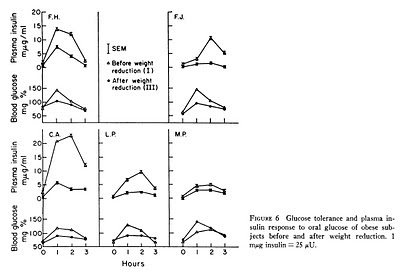
There is nothing in the text or tables giving any numeric data about insulin levels in obese individuals and no details at all from the normal groups. I don't mind this too much as the study was really aimed at adipocyte size and adipocyte glucose metabolism in response to exogenous insulin. This was the main drive of the paper. Note that they didn't look at adipocyte beta oxidation, no one had any idea this might be compromised back in the 1960s, so we get no idea about the ability of adipocytes to carry out this essential function.
Look, fasting insulin in five obese people is not generally elevated, it's reported as being only slightly elevated in two out of the five obese patients. This obviously implies that elevated fasting insulin does not predict weight gain. There we go. Time to pack up and go home.
Ah yes, but which fasting insulin are we looking at? Remember that group of starved obese folk we chatted about previously who had three different fasting insulin levels? One level on their normal (obesogenic) diet, one on a calorie and carbohydrate limited diet and another on the full starvation non-diet (ie complete carbohydrate restriction): 45 or 38 or 15-20 microIU/ml.
In obese people (but not in people who have normal metabolic flexibility) you can simply dial fasting insulin by carbohydrate intake. The question we cannot answer from Hirsch's study is what the fasting (and the 24h AUC) insulin values were for the five obese participants while they were free living on their normal obesogenic (high carbohydrate, you can bet) diet and slowly gaining weight? Remember we only need an average of 5g/d adipose tissue accumulation for long term obesity.
We are given an insulin value during phase I on a weight stability diet with a carbohydrate intake fixed at 45% of not-quite-enough-for-comfort calories. This is not what a given individual would normally choose to eat. In real life these people would not be on a weight stable diet. They certainly would not have been limiting their carbohydrate to 45% of calories. So we have no idea what their fasting insulin level would have been before stabilisation on phase I, but is certainly going to have been higher than the graphs show.
After massive weight loss during phase II of the study (on 600kcal/d for several months, probably only bearable because carbohydrate was limited to around 50-55g/d and the doors were locked [jk!]) we go in to phase III and get our second set of curves. Here we are now maintaining weight stability at a markedly reduced body weight with a smaller portion size of a still 45% carbohydrate diet, so total carbohydrate intake will be a bit lower. Hence the slightly reduced fasting insulin... But of course none of this represents the life which led to the enrolment in the study.
Subjects will be hungry.
While ever they stay hungry and limit carbohydrate to 45% of their never-quite-enough calorie intake, their insulin levels will stay low and they will, hungrily, stay slim.
Four of the five patients managed this for quite some time. Kudos to them and their willpower. You have to wonder about the fifth patient. Lost to follow up? Not lost to follow up but fatter than pre study? Just got fed up with people sticking needles in their butt?
How effective for long term weight control is chronic caloric restriction? Answers on a postage stamp to...
Are these people fixed? Their adipocytes certainly have scope to respond better to insulin and will inhibit lipolysis more effectively than during obesity. This limits FFA leakage due to insulin resistance which decreases FFA delivery to muscles and so allows muscles to take up glucose better, so both glucose and insulin curves improve. But are they really, really fixed? Will they will simply regain their lost weight, unless they enjoy being hungry all the time? Especially if they increase their total carbohydrate intake? And why are they hungry? Another post in this series there.
Addendum: Running through the methods section of Petersen's paper it is actually worth noting that fasting insulin and simple derivatives of fasting insulin plus glucose, such as the HOMA score, are rather blunt instruments for picking up insulin resistance. The more complex insulin sensitivity index is better but even this failed to pick out two out of twelve apparently insulin sensitive participants who turned out to be insulin resistant on the hyperinsulinaemic clamp, the current gold standard for picking out insulin resistant subjects. So, while insulin resistance is core, simple fasting insulin has to be accepted as a blunt instrument. Clamps, unfortunately, are not simple to perform. End addendum.
Of course you cannot dial fasting insulin by carbohydrate intake in normal individuals. So all you have to do is include enough normal people in your longditudinal studies and there will be no significant correlation between fasting insulin and subsequent weight gain. What would you expect?
Anyhoo, back to adipocyte insulin resistance. Stretching adipocytes appears to have effects on their sensitivity to insulin. As adipocytes stretch this translates in to progressive pathology as the adipocytes are running out of their ability to function normally. As they get fatter they leak more FFAs at a given level of insulin. This is important. Very important.
Before we go on to the next post: Is there any other form of adipocyte insulin resistance, other than that due to fat distension?
I rather like physiological insulin resistance. It keeps me alive. Simple carbohydrate restriction or a couple of days of frank starvation produces whole body insulin resistance to spare glucose for brain use. You know what I mean. Take a young fit healthy human and starve him for three days and he will immediately become intensely insulin resistant on a whole body basis. If not he would become intensely dead. Are adipocytes part of this physiological insulin resistance response, in the same way as muscle cells are?
We get a partial answer to this when Hirsch cites Tucker's study and suggests that the reason she found no difference between the adipocytes of obese and slim rats was because both were maximally insulin resistant after a 20 hour fast, even those from skinny rats...
"However, these studies were performed upon tissue from animals fasted for 20 hr, a manipulation known to decrease the insulin response of adipose tissue in vitro."
Ad hoc number 3523, but highly plausible. Every body knows this... Physiological insulin resistance mimics pathological insulin resistance. The mechanism through FFAs is likely to be the same.
This would again be logical as you do not want rats in starvation hanging on to their adipocyte energy stores or to be allowing precious glucose in to adipocytes (however little glucose adipocytes use) and so allowing it to be "wasted" when needed by the brain.
Is there a third factor affecting adipocyte insulin sensitivity?
Well, of course adipocytes have mitochondria. Are they breakable? Probably.
If you break them I would assume that they behave much like those in muscle tissue and they do the best they can with pyruvate while leaving the FFA derivatives in the cytosol, ie adipocytes should become insulin resistant if they have broken mitochondria. But this insulin resistance is not stretch related and it's not physiological. It's a mitochondrial break and could happen at any stage of distension of adipocytes. So mitochondrial failure should lead to adipocytes leaking FFAs when glucose and insulin are elevated. Possibly at minimal distension size, ie while you are still slim.
This would worsen whatever state of insulin resistance the muscles were in from their own mitochondrial problems. If the pancreas is not up to overcoming the supplementary FFA-induced insulin resistance (due to its own mitochondrial problems as suggested by Petersen et al) then hyperglycaemia will result and you get that label of T2DM... Possibly while still slim.
The plateau in your weight here might be mistakenly attributed to the satiating effects of insulin on your brain finally kicking in, somewhat belatedly, after 50 years or so of hunger.
If you have an unbroken pancreas of steel you can still argue with the broken adipocyte mitochondria and you can still get even fatter. Ditto if you have T2DM due to insulin resistance and some joker gives you a bottle of injectable insulin plus some syringes. Especially if they also tell you to eat a ton of bagels and cover the hyperglycaemia with a ton of exogenous insulin. And chide you for overeating.
Peter
Summary: Adipocytes become fatter under the influence of insulin. Resistance to insulin by adipocytes limits fat storage and hence eventually limits weight gain. It also elevates FFA supply. Important.
A rather nice paper was published back in the 1960s showing this very clearly. I have seen it cited as purporting to show that elevated fasting insulin is a consequence of obesity, rather than a cause. This is a fascinating and rather counter intuitive concept, so you just have to go have a look see at the paper. Luckily it's free access.
It does show, very convincingly, that adipocyte size correlates with adipocyte insulin resistance on the adipocyte cellular level. I rather like that.
It also demonstrates quite clearly that forced, brutal adipocyte size reduction by a couple of months on a 600kcal/d diet improves adipocyte insulin sensitivity as adipocyte size shrinks.
There are two core concepts which need to be taken away from this paper.
The first is that as adipocytes swell they become progressively less able to respond to insulin. This obviously translates in to insulin resistance of adipocytes ultimately limiting fat gain within the limits of the pancreas to secrete or hypersecrete insulin. That is if you accept that insulin is in any way involved in fat storage.
Now. What does this mean for the carbohydrate hypothesis of fat gain?
It is the RESISTANCE of adipocytes to insulin which limits fat gain.
And the corollary is??? Sensitivity to insulin drives fat gain. You can't have one conclusion without the other.
Anyone telling you that adipocyte insulin resistance limits fat gain and yet insulin per se has nothing to do with fat gain... Well, you decide. I have.
Although the group measured many, many things the only information we get about fasting insulin levels and post challenge insulin levels are these five paired graphs:

There is nothing in the text or tables giving any numeric data about insulin levels in obese individuals and no details at all from the normal groups. I don't mind this too much as the study was really aimed at adipocyte size and adipocyte glucose metabolism in response to exogenous insulin. This was the main drive of the paper. Note that they didn't look at adipocyte beta oxidation, no one had any idea this might be compromised back in the 1960s, so we get no idea about the ability of adipocytes to carry out this essential function.
Look, fasting insulin in five obese people is not generally elevated, it's reported as being only slightly elevated in two out of the five obese patients. This obviously implies that elevated fasting insulin does not predict weight gain. There we go. Time to pack up and go home.
Ah yes, but which fasting insulin are we looking at? Remember that group of starved obese folk we chatted about previously who had three different fasting insulin levels? One level on their normal (obesogenic) diet, one on a calorie and carbohydrate limited diet and another on the full starvation non-diet (ie complete carbohydrate restriction): 45 or 38 or 15-20 microIU/ml.
In obese people (but not in people who have normal metabolic flexibility) you can simply dial fasting insulin by carbohydrate intake. The question we cannot answer from Hirsch's study is what the fasting (and the 24h AUC) insulin values were for the five obese participants while they were free living on their normal obesogenic (high carbohydrate, you can bet) diet and slowly gaining weight? Remember we only need an average of 5g/d adipose tissue accumulation for long term obesity.
We are given an insulin value during phase I on a weight stability diet with a carbohydrate intake fixed at 45% of not-quite-enough-for-comfort calories. This is not what a given individual would normally choose to eat. In real life these people would not be on a weight stable diet. They certainly would not have been limiting their carbohydrate to 45% of calories. So we have no idea what their fasting insulin level would have been before stabilisation on phase I, but is certainly going to have been higher than the graphs show.
After massive weight loss during phase II of the study (on 600kcal/d for several months, probably only bearable because carbohydrate was limited to around 50-55g/d and the doors were locked [jk!]) we go in to phase III and get our second set of curves. Here we are now maintaining weight stability at a markedly reduced body weight with a smaller portion size of a still 45% carbohydrate diet, so total carbohydrate intake will be a bit lower. Hence the slightly reduced fasting insulin... But of course none of this represents the life which led to the enrolment in the study.
Subjects will be hungry.
While ever they stay hungry and limit carbohydrate to 45% of their never-quite-enough calorie intake, their insulin levels will stay low and they will, hungrily, stay slim.
Four of the five patients managed this for quite some time. Kudos to them and their willpower. You have to wonder about the fifth patient. Lost to follow up? Not lost to follow up but fatter than pre study? Just got fed up with people sticking needles in their butt?
How effective for long term weight control is chronic caloric restriction? Answers on a postage stamp to...
Are these people fixed? Their adipocytes certainly have scope to respond better to insulin and will inhibit lipolysis more effectively than during obesity. This limits FFA leakage due to insulin resistance which decreases FFA delivery to muscles and so allows muscles to take up glucose better, so both glucose and insulin curves improve. But are they really, really fixed? Will they will simply regain their lost weight, unless they enjoy being hungry all the time? Especially if they increase their total carbohydrate intake? And why are they hungry? Another post in this series there.
Addendum: Running through the methods section of Petersen's paper it is actually worth noting that fasting insulin and simple derivatives of fasting insulin plus glucose, such as the HOMA score, are rather blunt instruments for picking up insulin resistance. The more complex insulin sensitivity index is better but even this failed to pick out two out of twelve apparently insulin sensitive participants who turned out to be insulin resistant on the hyperinsulinaemic clamp, the current gold standard for picking out insulin resistant subjects. So, while insulin resistance is core, simple fasting insulin has to be accepted as a blunt instrument. Clamps, unfortunately, are not simple to perform. End addendum.
Of course you cannot dial fasting insulin by carbohydrate intake in normal individuals. So all you have to do is include enough normal people in your longditudinal studies and there will be no significant correlation between fasting insulin and subsequent weight gain. What would you expect?
Anyhoo, back to adipocyte insulin resistance. Stretching adipocytes appears to have effects on their sensitivity to insulin. As adipocytes stretch this translates in to progressive pathology as the adipocytes are running out of their ability to function normally. As they get fatter they leak more FFAs at a given level of insulin. This is important. Very important.
Before we go on to the next post: Is there any other form of adipocyte insulin resistance, other than that due to fat distension?
I rather like physiological insulin resistance. It keeps me alive. Simple carbohydrate restriction or a couple of days of frank starvation produces whole body insulin resistance to spare glucose for brain use. You know what I mean. Take a young fit healthy human and starve him for three days and he will immediately become intensely insulin resistant on a whole body basis. If not he would become intensely dead. Are adipocytes part of this physiological insulin resistance response, in the same way as muscle cells are?
We get a partial answer to this when Hirsch cites Tucker's study and suggests that the reason she found no difference between the adipocytes of obese and slim rats was because both were maximally insulin resistant after a 20 hour fast, even those from skinny rats...
"However, these studies were performed upon tissue from animals fasted for 20 hr, a manipulation known to decrease the insulin response of adipose tissue in vitro."
Ad hoc number 3523, but highly plausible. Every body knows this... Physiological insulin resistance mimics pathological insulin resistance. The mechanism through FFAs is likely to be the same.
This would again be logical as you do not want rats in starvation hanging on to their adipocyte energy stores or to be allowing precious glucose in to adipocytes (however little glucose adipocytes use) and so allowing it to be "wasted" when needed by the brain.
Is there a third factor affecting adipocyte insulin sensitivity?
Well, of course adipocytes have mitochondria. Are they breakable? Probably.
If you break them I would assume that they behave much like those in muscle tissue and they do the best they can with pyruvate while leaving the FFA derivatives in the cytosol, ie adipocytes should become insulin resistant if they have broken mitochondria. But this insulin resistance is not stretch related and it's not physiological. It's a mitochondrial break and could happen at any stage of distension of adipocytes. So mitochondrial failure should lead to adipocytes leaking FFAs when glucose and insulin are elevated. Possibly at minimal distension size, ie while you are still slim.
This would worsen whatever state of insulin resistance the muscles were in from their own mitochondrial problems. If the pancreas is not up to overcoming the supplementary FFA-induced insulin resistance (due to its own mitochondrial problems as suggested by Petersen et al) then hyperglycaemia will result and you get that label of T2DM... Possibly while still slim.
The plateau in your weight here might be mistakenly attributed to the satiating effects of insulin on your brain finally kicking in, somewhat belatedly, after 50 years or so of hunger.
If you have an unbroken pancreas of steel you can still argue with the broken adipocyte mitochondria and you can still get even fatter. Ditto if you have T2DM due to insulin resistance and some joker gives you a bottle of injectable insulin plus some syringes. Especially if they also tell you to eat a ton of bagels and cover the hyperglycaemia with a ton of exogenous insulin. And chide you for overeating.
Peter
Summary: Adipocytes become fatter under the influence of insulin. Resistance to insulin by adipocytes limits fat storage and hence eventually limits weight gain. It also elevates FFA supply. Important.
Subscribe to:
Posts (Atom)