This follow on study looking at fructose in people with type 2 diabetes was a bit of a disappointment.
TLDR: Fructose works pretty well in four out of five people with diabetes just as it does in "normal" people with a relatively poor OGTT result.
This is what the title of the study is describing:

It's clear that adding 7.5g of fructose to a 75g OGTT load improved both glucose and insulin curves. There is nothing exciting about this. What I thought might be interesting was that, in a study of five subjects, two of them were outliers of sorts.
I'd hoped these outliers might give more insight in to the state of ROS signalling within hepatocytes of people with severe diabetes. Not really, much of the data you need is not in the paper. For completeness here are the anomalous results:
Subject 2 failed to drop their systemic glucose in response to added fructose, like this

Not unsurprisingly they also failed to drop their insulin level, clearly insulin level follows exposure of the pancreas to systemic glucose, which didn't change, so neither did insulin.
Can we guess what might have been happening in hepatocytes to nullify the "beneficial" effects of fructose? Let's assume that fructose is being absorbed, entering hepatocytes and generating ROS via a NOX enzyme in proportion to the rate of fructose ingress. So the question becomes
"Under what circumstances does a modest increase in ROS fail to activate the insulin cascade?"
We have no idea what the fasting insulin level was, nor the fasting glucose, so this is a little difficult. We are told that subject 2 had an HbA1c of 9.0 or 10.1, one of the highest in the study, which implies the worst average glucose excursion over the last three months or so. We could choose extreme insulin resistance, failing beta cell function or a combination of both to explain this. The fact that they produced a minimal increase in AUC for insulin when presented with 75g of glucose with or without fructose suggests that beta cell function was limited and underlying hyperglycaemia might both be present. I favour this explanation.
Both hyperinsulinaemia -> NOX4 activation via G protein coupled signalling and hyperglycaemia -> NOX2 activation via calmodulin kinase signalling have the potential to spill ROS over from activating via phosphatase inhibition to being inhibitory via insulin receptor substrate inhibition. Adding a small increase in ROS from fructose to a maximally stimulated system may affect both aspects, producing no net change. That's my guess.
The second unusual result was from subject 5. They produced a perfectly reasonable drop in systemic glucose in response to fructose addition but had an unusual increased insulin response despite reduced systemic glucose.
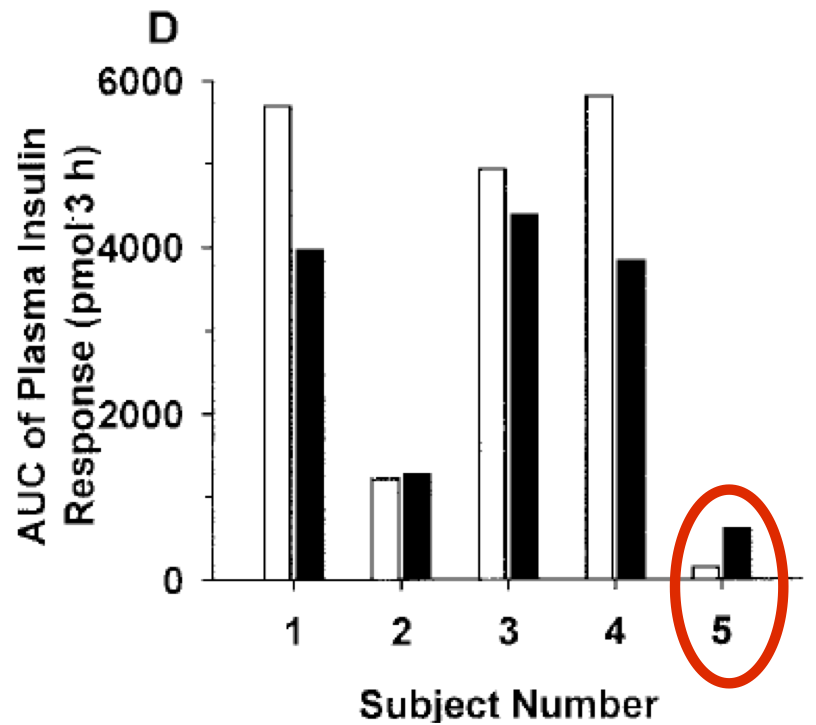
I struggle to explain this "paradoxical" rise in insulin despite a successful fructose induced fall in pancreatic exposure to systemic glucose. You could argue that the increase in insulin came first and this lowered the systemic glucose level but this would make quite an exception and need either a pancreatic response to a very small systemic fructose rise or a pancreatic effect derived from gut hormone signals, none of which were measured and none of which are needed for an explanation of the fructose effect in all other subjects.
If I had to guess I would suggest the fasting insulin level was very high in this person. We know from this 2011 study that OGTTs are reproducible on repeat testing (in "normal" people) over 3 days unless you have to be hyperinsulinaemic in order to be "normal":
"However, our cases of individuals who exhibited hyperinsulinaemia in order to maintain glucose homeostasis, suggest that repeated OGTT’s may not produce a reliable estimation of insulin sensitivity for people with pre-diabetes and diabetes."
Subject 5 was also an individual with very high HbA1c (9.0 or 10.1) suggesting poor control and compatible with high insulin levels. So the insulin anomaly may just be random finding in one person secondary to chronic hyperinsulinaemia... We'll never know.
Overall the fructose effect on hepatic glucose output seems to be genuinely maintained in patients with DMT2 unless they are approaching seriously poor levels of control.
Should individuals with more "mild" diabetes add a little fructose to each bowl of porridge they consume in real life?
Rhetorical question.
Peter