I hope everyone has forgotten this diagram

which I simplified to this:

Well, now it's time to butcher it further, to an even simpler diagram:

And now I can get rid of the background faint image and shift things around a little to make some more space. I've also converted all "carbohydrate" pathways to blue.

which leaves room to add in mitochondrial, saturated fat derived ROS, the physiological antagonist to the ROS signal which we name as the "insulin" response, though insulin is but a partial contributor to the genuine ROS signal. We can show the blockade like this:
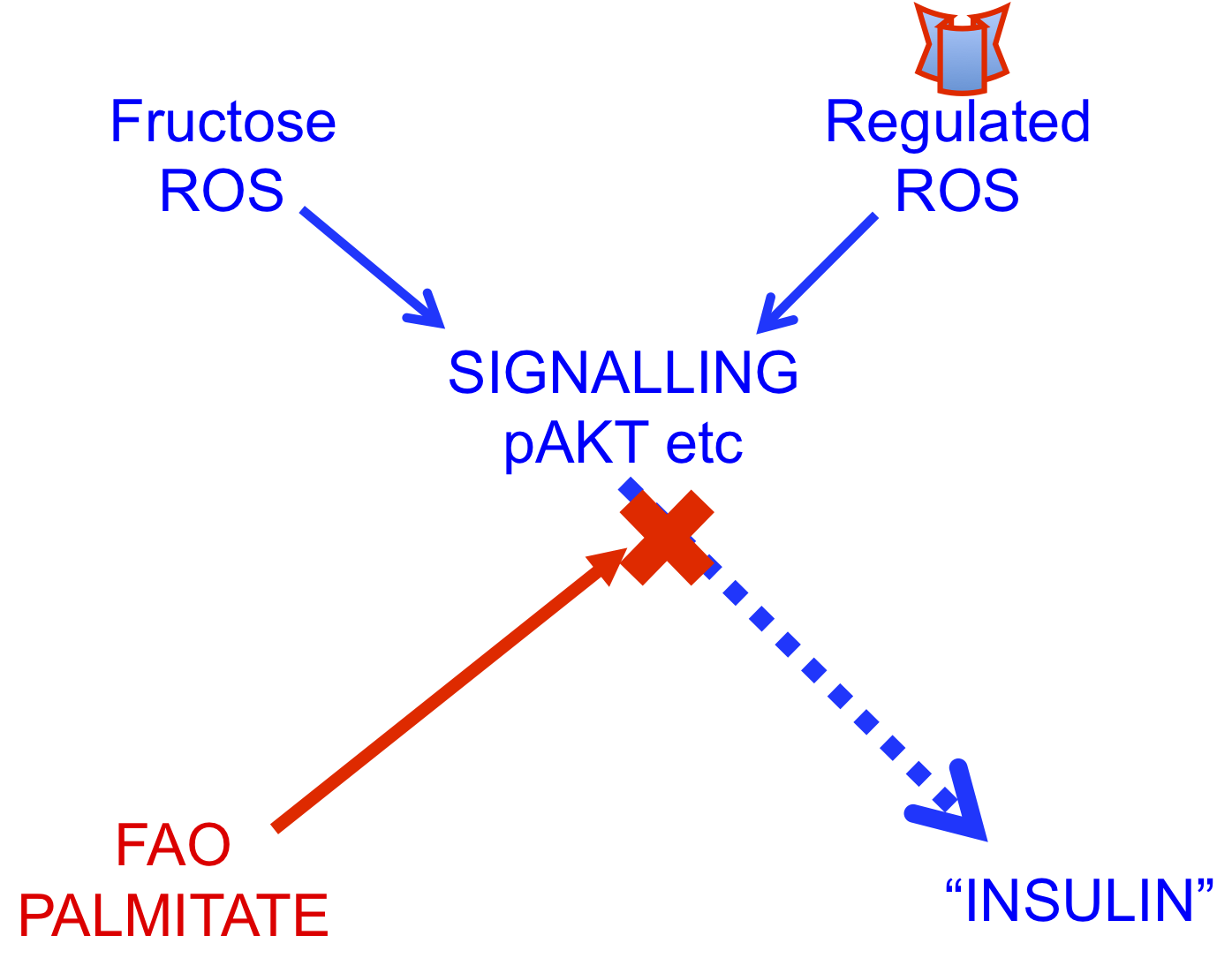
All very simple. Now lets look at the Surwit diet, 59% fat calories, mostly coconut oil, very low PUFA (~2% LA) and modest fructose (~6% of calories).
Aside. Oooh, look, the Surwit diet provides something very close to the 5% of calories as fructose which was used to augment glycogen formation in dogs. Neat. End aside.
I was going to get in to a deep morass at this point about why MCTs fail to generate an ROS signal in proportion to their chain length and degree of saturation. The aside became progressively larger and, not unexpectedly, more theoretical. For the sake of the discussion of the Surwit diet we just have to accept that coconut oil contains fatty acids which are dealt with differently to longer chain fatty acids and which generate a limited ROS signal.
So let's go back to the Surwit diet, 59% fat, mostly coconut, 13% sucrose, some maltodextrin and some casein.
First, at 6% fructose this will produce an insulin-augmenting level of ROS generation, solid blue arrow below. Next is the glucose from the sucrose and maltodextrin, generating a fairly low level of ROS, mostly via the insulin receptor, shown as a thin arrow because this diet is almost a low carbohydrate diet. Both the above generate ROS which signal "insulin" activation "downstream".
Next let's add in octanoate. For whatever reason this is a poor generator of ROS under physiological levels of exposure. It will do nothing to inhibit the "insulin" effector actions of the carbohydrate generated ROS:

I suppose you could even make a case that the relatively minor production of ROS from octanoate might actually produce an activation signal for the "insulin" effect. A possible explanation for this paper. Then you're really in trouble.

Or at least your liver is.
During the earlier posts on this thread about the actions of fructose I've cited papers which suggest that fructose derived ROS augment the formation of glycogen within hepatocytes. Very clever people are very welcome to look at which substrates change in which direction activating which enzyme pathways to generate this glycogen. It's complex.
To me it's much simpler. Augmented low level ROS -> "do what insulin does". One effect being glycogen accumulation.
In a Surwit type diet the directly supplied fatty acids are heavily slanted towards medium chain fatty acids. Mammals do not use MCTs for bulk caloric storage, the preference is toward a mix of palmitate +/- oleate. The liver is quite capable of converting caprylate to palmitate +/- oleate. In fact MCTs are segregated away from chylomicrons by the enterocytes in the gut and are diverted, as free fatty acids, to the portal vein and so directly to the liver for this to happen.
Given augmented hepatocyte insulin signalling combined with augmented access to free fatty acids, what is the likely effect of augmented "insulin cascade activating" ROS levels?
Could that be the accumulation of lipid in the cells subject to this combination of circumstances?
We call this fatty liver.
That's the first step of several.
Peter