I've been sent a link to this study:
Body fat loss and compensatory mechanisms in response to different doses of aerobic exercise—a randomized controlled trial in overweight sedentary males
Bottom line: Moderate exercise produces equal weight loss to greater exercise. I'll come back to this later.
I commented in the last post that I consider leaving food on your plate is a very reasonable surrogate for experiencing reduced hunger. This shows up as weight loss. When we look at the converse, long term "accidental" weight gain, my perspective is the same. Eating an extra portion is a surrogate for responding to hunger. Long term hunger = Long term weight gain.
Let's say that again:
Fat people are fat because they are affected by hunger. Not gluttons. Not lazy. Hungry.
If people are going to lose weight on a long term basis they can only do this if they are not hungry. If they are not hungry they will reject food, establish an energy deficit and lose weight.
I may believe in CICO, but that CICO is controlled by hunger.
Back to the study. As the authors, struggling for a moment of lucidity, say:
"However, on the basis of the present findings, we propose that the introduction of a moderate dose of exercise may actually lead to an increase in NEAT without any increase in EI resulting in a “bonus effect,” whereas a higher dose of exercise may lead to an increase in EI and, thereby, a degree of compensation and less than expected loss of FM"
As clear as mud. Let's translate and simplify:
“… a moderate dose of exercise may actually lead to an increase in CALORIES OUT without any increase in HUNGER ... whereas a higher dose of exercise may lead to an increase in HUNGER [ie more eating] and … less than expected loss of fat mass”.
Exercise makes you hungry, certainly if you over-do it.
This is the authors' conclusion. I think they are correct. Other explanations are possible but they if miss the hunger component they are not of a great deal of help to anyone who wishes to understand obesity, even if they happen to be factually correct.
Peter
Monday, August 31, 2015


Sunday, August 30, 2015
Confirmation Bias in my head
Sometimes you get a reminder that you suffer from Confirmation Bias.
I do.
This morning I went back and dug out the study from Aberdeen:
Which carried the phrases:
"…participants were offered a fixed energy intake of 2000 kcal/d"
"In the isocaloric study, despite being served food of the same energy content, intake was slightly lower (66 kcal/d) and weight loss greater (7.2 ± 2.3 vs. 4.7 ± 1.0 kg in 4 wk, P less than 0.05), on the HF-LC diet after correction for unconsumed food"
"In the isocaloric study, despite being served food of the same energy content, intake was slightly lower (66 kcal/d) and weight loss greater (7.2 ± 2.3 vs. 4.7 ± 1.0 kg in 4 wk, P less than 0.05), on the HF-LC diet after correction for unconsumed food"
Feed overweight men 2000kcal/d of a mixed diet and they eat it all. Feed the same men 2000kcal/d of a mildly ketogenic diet (roughly ++ on ketostix) and they refuse to eat all of the food. What they reject gives a weight loss surfeit compared to when they were on the mixed diet.
There's no evidence they went to the gym on the quiet but the study protocol probably asked them not to do this. Assuming they have gyms in Aberdeen.
I don't give a monkey's about appetite score by VAS, lack of metabolic advantage in a study using 140g/d of carbs etc. Food left on plate = Not hungry.
How much simpler can it be?
This was triggered by an article linked to by Rose Nunez Smith via FaceAche which piqued my interest and which I read right through to the end. The article kept saying things which made sense and fitted with my view of reality. There was no author on the end so I went up to the top only to find it was Gary Taubes.
Well, it made me laugh.
It's good there are people writing for the NYT Sunday Review who point out what really matters. Bugger any metabolic ward study.
BTW re Aberdeen, with ketones at ++ it would have been interesting to know what the FFA levels were like but the arithmetic cited in the study suggests we didn't have a lot of UCP activity during this few weeks of ++ ketostix eating.
Peter
Tuesday, August 25, 2015
Starchy stable isotopes? I don't think so!
Have a read at this statement from Hardy et al 2015:
“…stable isotope analyses indicate a mainly carnivorous diet for Neanderthals; a wider range of isotopic values have been observed in contemporary Middle Pleistocene H. sapiens (Richards and Trinkaus 2009), indicating that considerable differences in the levels of starch consumption existed between these two species.”
Now, if you read this I think you might be led to believe that stable isotope analysis indicates that Neanderthals were carnivores and H sapiens ate a different amount of starch to a carnivore. I feel the implication of this sentence is that H sapiens ate "more-than-zero starch" during the Middle Pleistocene.
You would believe wrongly. Did you check the reference? No? Naughty. Richards and Trinkaus (2009) actually say this:
“As the method only measures protein intake, many low-protein foods that may have been important to the diet (i.e., high caloric foods like honey, underground storage organs, and essential mineral and vitamin rich plant foods) are simply invisible to this method.”
The data do not deny starchivory. But the data equally do not in any way support its occurrence. Starch, fruit and honey are invisible on stable isotope analysis. This is a gross mis-citation of Richards and Trinkaus by Hardy et al. Never believe stuff like this without checking the refs. Easy when it is a freebie in PLOS. What do Richards and Trinkaus actually say about diets of carnivorous Neanderthals vs H sapiens? Try this:
“There are now enough isotopic data to see patterns in the data, and they show that the Neanderthals and early modern humans had similar dietary adaptations, obtaining most of their dietary protein from animals, although some of the early modern humans obtained significant amounts of their protein from aquatic, and not just terrestrial, sources.”
You can tell H sapiens ate fish because aquatic food chains are long. The longer the food chain the greater the effect visible in stable nitrogen isotopes. They make fish eating carnivores look like hyper-carnivores. That's how they show up in the paper. Had humans eaten any significant amount of protein rich plants (hazel nuts get cited as a possibility) it would show a lower stable nitrogen ratio. There is no evidence for this.
Did early humans consume starch to grow their brain size? Stop laughing! No one knows, certainly to the point where a starchivorous paper has to mis-cite a completely non-supportive paper as being actually supportive of their rubbish hypothesis.
I love it.
Did you hear the one about Jennie Brand-Miller? Passthecream linked to this gem in the comments of the last post. Some things are just too funny not to share. Have a giggle. J B-M is second author on the starch-is-needed-to-grow-brains paper...
Peter
“…stable isotope analyses indicate a mainly carnivorous diet for Neanderthals; a wider range of isotopic values have been observed in contemporary Middle Pleistocene H. sapiens (Richards and Trinkaus 2009), indicating that considerable differences in the levels of starch consumption existed between these two species.”
Now, if you read this I think you might be led to believe that stable isotope analysis indicates that Neanderthals were carnivores and H sapiens ate a different amount of starch to a carnivore. I feel the implication of this sentence is that H sapiens ate "more-than-zero starch" during the Middle Pleistocene.
You would believe wrongly. Did you check the reference? No? Naughty. Richards and Trinkaus (2009) actually say this:
“As the method only measures protein intake, many low-protein foods that may have been important to the diet (i.e., high caloric foods like honey, underground storage organs, and essential mineral and vitamin rich plant foods) are simply invisible to this method.”
The data do not deny starchivory. But the data equally do not in any way support its occurrence. Starch, fruit and honey are invisible on stable isotope analysis. This is a gross mis-citation of Richards and Trinkaus by Hardy et al. Never believe stuff like this without checking the refs. Easy when it is a freebie in PLOS. What do Richards and Trinkaus actually say about diets of carnivorous Neanderthals vs H sapiens? Try this:
“There are now enough isotopic data to see patterns in the data, and they show that the Neanderthals and early modern humans had similar dietary adaptations, obtaining most of their dietary protein from animals, although some of the early modern humans obtained significant amounts of their protein from aquatic, and not just terrestrial, sources.”
You can tell H sapiens ate fish because aquatic food chains are long. The longer the food chain the greater the effect visible in stable nitrogen isotopes. They make fish eating carnivores look like hyper-carnivores. That's how they show up in the paper. Had humans eaten any significant amount of protein rich plants (hazel nuts get cited as a possibility) it would show a lower stable nitrogen ratio. There is no evidence for this.
Did early humans consume starch to grow their brain size? Stop laughing! No one knows, certainly to the point where a starchivorous paper has to mis-cite a completely non-supportive paper as being actually supportive of their rubbish hypothesis.
I love it.
Did you hear the one about Jennie Brand-Miller? Passthecream linked to this gem in the comments of the last post. Some things are just too funny not to share. Have a giggle. J B-M is second author on the starch-is-needed-to-grow-brains paper...
Peter
Monday, August 17, 2015
Sweden's dietitian advice? No thank you.
Hot off the press from Uppsala and Stockholm:
A high energy intake from dietary fat among middle-aged and older adults is associated with increased risk of malnutrition 10 years later.
"Contrary to what was expected, a high energy intake from total fat, saturated fat and monounsaturated fat among middle-aged and older adults increased the risk of exhibiting malnutrition 10 years later. However, this applied only to individuals with a BMI < 25 kg/m2 at the baseline. In conclusion, these findings suggest that preventive actions to counteract malnutrition in older adults should focus on limiting the intake of total fat in the diet by reducing consumption of food with a high content of saturated and monounsaturated fat."
Repeat after me. Association does not prove causation. How anyone dare suggest an experimental intervention on a large subpopulation of their nation based on an observational association within a subgroup of the target population is beyond me. How dare they?
It must be embarrassing to be a dietitian in Sweden nowadays but this sort of intervention recommendation is not going to decrease the stupidity index of mainstream dietary advice.
Hopefully sensible people will continue to ignore them!
Peter
A high energy intake from dietary fat among middle-aged and older adults is associated with increased risk of malnutrition 10 years later.
"Contrary to what was expected, a high energy intake from total fat, saturated fat and monounsaturated fat among middle-aged and older adults increased the risk of exhibiting malnutrition 10 years later. However, this applied only to individuals with a BMI < 25 kg/m2 at the baseline. In conclusion, these findings suggest that preventive actions to counteract malnutrition in older adults should focus on limiting the intake of total fat in the diet by reducing consumption of food with a high content of saturated and monounsaturated fat."
Repeat after me. Association does not prove causation. How anyone dare suggest an experimental intervention on a large subpopulation of their nation based on an observational association within a subgroup of the target population is beyond me. How dare they?
It must be embarrassing to be a dietitian in Sweden nowadays but this sort of intervention recommendation is not going to decrease the stupidity index of mainstream dietary advice.
Hopefully sensible people will continue to ignore them!
Peter
Methyltransferase in methanogens
The archaea developed rather differently from the Ech driven bacteria. I want to look at them from the energetic point of view so it seems reasonable to start with this image from the first of the Life series posts, back in February:

This has CH3-SH (used at two points in the process) driving acetate formation for cell carbon generation. We know this works because Huber and Wächtershäuser demonstrated the abiotic generation of activated acetate from CO and CH3-SH in the presence of an FeS/NiS slurry. No enzymes, no cofactors, no structure. Energetically, it works. I now want to speculate wildly about other uses of CH3-SH in the development of methanogens and the evolution of methyltranseferase, the archaeal alternative to Ech. Let's get rid of the carbon fixation doodles. The location of CH3-SH might need to change as ideas develop:

In the background to the following speculation we still have a FeNi hydrogenase "visiting" a proton channeling pore to generate reduced ferredoxin using a localised low pH region just inside the cell. In the archaea I'm assuming there is no preformed Na+ pump because the protein translocating precursor never jammed up so never pumped Na+ ions. There was no drop in intracellular Na+ and the FeNi hydrogenase never attached firmly to the proton pore in the membrane. Interestingly the methanogens do still have a cytoplasmic FeNi hydrogenase (or NiFe in this illustration) passing electrons down FeS wires. Instead of dropping them straight on to ferredoxin to generate reduced Fd2- using the proton gradient of the cell wall conducted through a membrane pore (as per proto Ech), pairs of electrons are split at an FAD. Half do the up hill job of generating Fd2- and the other half tumble down hill to the easy target of heterodisulphide. Energy from the latter down hill reaction is used to allow the up hill Fd reduction and gets you out of the need for a membrane proton gradient. I do wonder if this is the same FeNi hydrogenase of proto Ech but here diverted to electron bifurcation. This is from Buckel and Thauer's fantastic paper Energy conservation via electron bifurcating ferredoxin reduction and proton/Na+ translocating ferredoxin oxidation:

That's what happens today. What might have been the core process when metabolism was less refined? Here's a scheme with FeNi hydrogenase (in Hdr, heterodisulphide reductase) using CH3-SH as the electron acceptor for a crude version of electron bifurcation:

Under circumstances of freely available CH3-SH there is no need to conserve sulphur.
The Ni is shown associated with the enzyme which generates all of the biological methane ever produced on earth, methyl coenzyme-M reductase. Nowadays the Ni is bound in the lovely and highly complex coenzyme F430 (an interesting read if you have access):

Here it is in the step producing methane:

Sulphur is no longer a disposable commodity and it is recycled via CoM as a loop in combination with another sulphydryl based coenzyme, CoB.

CoM provides the -CH3 and CoB provides the -H to generate methane. The reaction joins the two coenzymes together to give the mixed, disulphide bridged, heterodisulphide. This is the modern electron acceptor in the Hdr electron bifurcating hydrogenase. It actually accepts a pair of electrons to give CoM-SH and CoB-SH:

The CoM-SH is regenerated to CH3-S-CoM by the methyltransferase shifting a -CH3 from CH3-H4MPT. Ultimately the energetics of the cell is determined by the availability of CH3-SH analogue CH3-S-CoM controlling electron bifurcation at Hdr:

Next let's take out the electron bifurcation system having established a central role for CH3-S-CoM to energetics control and add in the proton port being used to generate Fd2- using the vent H+ gradient:

And add in the antiporter for Na+ ions:

At this point there is some benefit to converting a protein-translocase to a Na+ driven ATP synthase. Consider that it is Na+ ions that are stabilising the membrane section of the translocase so it seems logical to accept a sudden Na+ gradient as the force pushing inwards to reverse the translocase to generate ATP. So we need the A1-A0 ATP synthase adding in to the diagram:
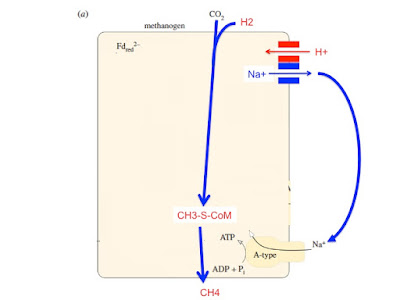
Now a proton gradient is once again driving a Na+ coupled ATP synthase and all is hunky dory for the cell. Excess ATP synthesis can be regulated by CH3-S-CoM inhibiting Na+ antiporting:

When the vent proton gradient fails all that is needed is for CH3-H4MPT to take over from the vent proton gradient. The transfer of the methyl group from H4MPT to CoM is exergonic and is used to drive a conformation change in B12 which ejects the Na+ ion. Lots of detail from Thauer again at The Na‡-translocating methyltransferase complex from methanogenic archaea.

Which simplifies to this:

Giving a speculative journey leading to how we might have ended up here:

In modern methanogenic archaea Na+ energetics have been carried forward to today. Protons still look like an add on to me. Of course the question posed from here is how similar is the Na+/H+ antiporter of the methanogens to the NouH and NuoL combination in the bacteria, incorporated in to the base of complex I.
Not surprisingly I haven't found anyone crazy enough to float this idea. This is what Thauer has to say about Na+ translocating pores and aspartic acid within the pore channel:
"The second reason for the proposal is that only MtrE has a transmembrane helix with an aspartate residue (Fig. 1), the sequence of this helix in the MtrE subunit from all methanogens being highly conserved: 168-IWGITIGAIGSSTGDVHYGAER-191. An aspartate residue in a transmembrane helix has been shown to be essential for sodium ion translocation as catalyzed by the L-subunit of oxaloacetate decarboxylase from Klebsiella pneumoniae [62]. An aspartate residue is also conserved in the transmembrane helix of the sodium ion-translocating glutaconyl-CoA decarboxylase from Acidaminococcus fermentans and of the sodium ion-translocating methylmalonyl-CoA decarboxylase from Veillonella parva and Propionigenium modestum [63]".
Here is NuoH from complex I with the aspartic acid at D213 picked out in red:

Which rather implies that NuoH, rather than NuoL, was the Na+ part of the antiporter, assuming the membrane portions of methyltransferase and Ech derivatives are distant relatives of the same ancestral protein...
Peter

This has CH3-SH (used at two points in the process) driving acetate formation for cell carbon generation. We know this works because Huber and Wächtershäuser demonstrated the abiotic generation of activated acetate from CO and CH3-SH in the presence of an FeS/NiS slurry. No enzymes, no cofactors, no structure. Energetically, it works. I now want to speculate wildly about other uses of CH3-SH in the development of methanogens and the evolution of methyltranseferase, the archaeal alternative to Ech. Let's get rid of the carbon fixation doodles. The location of CH3-SH might need to change as ideas develop:

In the background to the following speculation we still have a FeNi hydrogenase "visiting" a proton channeling pore to generate reduced ferredoxin using a localised low pH region just inside the cell. In the archaea I'm assuming there is no preformed Na+ pump because the protein translocating precursor never jammed up so never pumped Na+ ions. There was no drop in intracellular Na+ and the FeNi hydrogenase never attached firmly to the proton pore in the membrane. Interestingly the methanogens do still have a cytoplasmic FeNi hydrogenase (or NiFe in this illustration) passing electrons down FeS wires. Instead of dropping them straight on to ferredoxin to generate reduced Fd2- using the proton gradient of the cell wall conducted through a membrane pore (as per proto Ech), pairs of electrons are split at an FAD. Half do the up hill job of generating Fd2- and the other half tumble down hill to the easy target of heterodisulphide. Energy from the latter down hill reaction is used to allow the up hill Fd reduction and gets you out of the need for a membrane proton gradient. I do wonder if this is the same FeNi hydrogenase of proto Ech but here diverted to electron bifurcation. This is from Buckel and Thauer's fantastic paper Energy conservation via electron bifurcating ferredoxin reduction and proton/Na+ translocating ferredoxin oxidation:

That's what happens today. What might have been the core process when metabolism was less refined? Here's a scheme with FeNi hydrogenase (in Hdr, heterodisulphide reductase) using CH3-SH as the electron acceptor for a crude version of electron bifurcation:

Under circumstances of freely available CH3-SH there is no need to conserve sulphur.
The Ni is shown associated with the enzyme which generates all of the biological methane ever produced on earth, methyl coenzyme-M reductase. Nowadays the Ni is bound in the lovely and highly complex coenzyme F430 (an interesting read if you have access):

Here it is in the step producing methane:

Sulphur is no longer a disposable commodity and it is recycled via CoM as a loop in combination with another sulphydryl based coenzyme, CoB.

CoM provides the -CH3 and CoB provides the -H to generate methane. The reaction joins the two coenzymes together to give the mixed, disulphide bridged, heterodisulphide. This is the modern electron acceptor in the Hdr electron bifurcating hydrogenase. It actually accepts a pair of electrons to give CoM-SH and CoB-SH:

The CoM-SH is regenerated to CH3-S-CoM by the methyltransferase shifting a -CH3 from CH3-H4MPT. Ultimately the energetics of the cell is determined by the availability of CH3-SH analogue CH3-S-CoM controlling electron bifurcation at Hdr:

Next let's take out the electron bifurcation system having established a central role for CH3-S-CoM to energetics control and add in the proton port being used to generate Fd2- using the vent H+ gradient:

And add in the antiporter for Na+ ions:

At this point there is some benefit to converting a protein-translocase to a Na+ driven ATP synthase. Consider that it is Na+ ions that are stabilising the membrane section of the translocase so it seems logical to accept a sudden Na+ gradient as the force pushing inwards to reverse the translocase to generate ATP. So we need the A1-A0 ATP synthase adding in to the diagram:

Now a proton gradient is once again driving a Na+ coupled ATP synthase and all is hunky dory for the cell. Excess ATP synthesis can be regulated by CH3-S-CoM inhibiting Na+ antiporting:

When the vent proton gradient fails all that is needed is for CH3-H4MPT to take over from the vent proton gradient. The transfer of the methyl group from H4MPT to CoM is exergonic and is used to drive a conformation change in B12 which ejects the Na+ ion. Lots of detail from Thauer again at The Na‡-translocating methyltransferase complex from methanogenic archaea.

Which simplifies to this:

Giving a speculative journey leading to how we might have ended up here:

In modern methanogenic archaea Na+ energetics have been carried forward to today. Protons still look like an add on to me. Of course the question posed from here is how similar is the Na+/H+ antiporter of the methanogens to the NouH and NuoL combination in the bacteria, incorporated in to the base of complex I.
Not surprisingly I haven't found anyone crazy enough to float this idea. This is what Thauer has to say about Na+ translocating pores and aspartic acid within the pore channel:
"The second reason for the proposal is that only MtrE has a transmembrane helix with an aspartate residue (Fig. 1), the sequence of this helix in the MtrE subunit from all methanogens being highly conserved: 168-IWGITIGAIGSSTGDVHYGAER-191. An aspartate residue in a transmembrane helix has been shown to be essential for sodium ion translocation as catalyzed by the L-subunit of oxaloacetate decarboxylase from Klebsiella pneumoniae [62]. An aspartate residue is also conserved in the transmembrane helix of the sodium ion-translocating glutaconyl-CoA decarboxylase from Acidaminococcus fermentans and of the sodium ion-translocating methylmalonyl-CoA decarboxylase from Veillonella parva and Propionigenium modestum [63]".
Here is NuoH from complex I with the aspartic acid at D213 picked out in red:

Which rather implies that NuoH, rather than NuoL, was the Na+ part of the antiporter, assuming the membrane portions of methyltransferase and Ech derivatives are distant relatives of the same ancestral protein...
Peter
Cholesterol reflectivity at 400nm
I'm interested in paleobiology at the moment, readers might have noticed. Mostly how we might have gotten to where we are now without a Sky Pixie. The ancient past is fascinating. Not only single carbon chemistry under far from equilibrium conditions but big stuff like dinosaurs and cardiologists.
People love dinosaurs. If it's not LDLc levels, it's particle counts or apoB numbers. Am I going to die (yes!)? Will it be from CDV or cancer? Let us examine the entrails of a lipid hypothesis which lies eviscerated here before us. Messy.
How many apoBs can I see???? Do they have purple spots (i.e. does the apoB particle under the microscope have focal regions which are hyper-reflective to photons of 400nm wavelength when irradiated by full spectrum bullshit?).
I think we have to think have to respect the views of the president of the ACC. ACC is the American College of Cardiologists. These folks are wildly intelligent, free thinking, adventurous, swashbuckling promoters of new ideas. The newest idea on view from the president of the ACC is this one:
‘Some prominent cardiologists have questioned the 2013 guidelines, but the ACC and AHA have shown little appetite to return to LDL targets. “LDL may or may not correlate to cardiovascular outcomes,” Dr. Kim Allan Williams, president of the ACC, told Reuters last week1.’
Malcolm Kendrick has an excellent post up on this quote. But let's just say it again, it really is so good:
“LDL may or may not correlate to cardiovascular outcomes”
By whom?
Dr. Kim Allan Williams.
Who is?
President of the ACC.
Which is?
The American College of Cardiologists.
Of course, the statement does leave open the possibility that cardiovascular outcomes MAY correlate to LDL levels. More likely not.
Peter
People love dinosaurs. If it's not LDLc levels, it's particle counts or apoB numbers. Am I going to die (yes!)? Will it be from CDV or cancer? Let us examine the entrails of a lipid hypothesis which lies eviscerated here before us. Messy.
How many apoBs can I see???? Do they have purple spots (i.e. does the apoB particle under the microscope have focal regions which are hyper-reflective to photons of 400nm wavelength when irradiated by full spectrum bullshit?).
I think we have to think have to respect the views of the president of the ACC. ACC is the American College of Cardiologists. These folks are wildly intelligent, free thinking, adventurous, swashbuckling promoters of new ideas. The newest idea on view from the president of the ACC is this one:
‘Some prominent cardiologists have questioned the 2013 guidelines, but the ACC and AHA have shown little appetite to return to LDL targets. “LDL may or may not correlate to cardiovascular outcomes,” Dr. Kim Allan Williams, president of the ACC, told Reuters last week1.’
Malcolm Kendrick has an excellent post up on this quote. But let's just say it again, it really is so good:
“LDL may or may not correlate to cardiovascular outcomes”
By whom?
Dr. Kim Allan Williams.
Who is?
President of the ACC.
Which is?
The American College of Cardiologists.
Of course, the statement does leave open the possibility that cardiovascular outcomes MAY correlate to LDL levels. More likely not.
Peter
Sunday, August 16, 2015
When low fat wins
I think I’ve said before, I’m a calories-in, calories-out sort of person. Nothing as simple as losing a kilo of stored fat for every 9000kcal deficit in dietary consumption (or increase in exercise) of course. This is, as we all know, incorrect and of absolutely no use whatsoever in planning an attempt to generate a normal bodyweight.
I am also very aware that, outside a metabolic ward, it is very difficult to even approximately assess a given person’s level of energy output, assuming they are fully compliant with a fixed composition, fixed caloric input. Which they probably aren’t, much of the time. But calories out will be reflected in many more outputs than can achieved by the limited exercise opportunities afforded during the restrictions of an in-patient metabolic ward study.
As Hall commented, the repeated superiority of weight loss by carbohydrate restriction has always been achieved in outpatient studies, never in tightly controlled metabolic ward studies. He didn’t mention that the advantages from carbohydrate restriction were always achieved under calorically unrestricted circumstances in comparison to calorically restricted alternative diets. I’ll just mention that now.
We can also say, with some degree of certainly, that under very tightly controlled in-patient conditions, extreme dietary fat restriction (less than 8% of calories) produced more stored fat loss than a modest reduction in carbohydrate restriction, provided both groups are rigidly forced to cut calories and to limit their exercise to a specified level, for six days. My own feeling is that this is probably true under the circumstances of the study. It provides a very small piece of data of very limited application to the real world. As Hall writes:
"Translation of our results to real-world weight-loss diets for treatment of obesity is limited since the experimental design [and model simulations] relied on strict control of food intake, which is unrealistic in free-living individuals".
I am very lucky.
I don’t live in a metabolic ward. If the weather is cool outside and I feel warm enough to not need my jacket when I let the chickens out in the morning, so be it. If both the air and water temp are 4degC but there is a four foot swell with clean waves shaping up in First Bay I’m going to be thinking about the roof rack, my playboating kayak and my drysuit. I’m guessing that there are few near freezing surf opportunities in a metabolic ward.
People might also be aware that I rather like fatty acids, especially free fatty acids. These uncouple respiration. Uncoupled respiration, at the mitochondrial level, generates heat and so increases metabolic rate. For people with a heathy interest in cold water kayaking, this has its advantages. Sitting in a metabolic ward eating 140g of carbohydrate per day is not going to increase my free fatty acids to a level were uncoupling is going to feature in my metabolism.
The average person with a BMI of 35 is probably going to be running their metabolism under the Crabtree effect. Increased dependence on glycolysis at the expense of reduced utilisation of mitochondrial beta oxidation. While it is quite possible to immediately and markedly increase fatty acid oxidation, there are limits set by how many mitochondria a given cell possesses. The moderate carbohydrate group did increase their fatty acid oxidation, but not enough to compensate for the loss of carbohydrate available from the diet. This is perhaps most clearly seen in Table 3 where a significant drop in sleeping metabolic rate occurred in the moderate carb group and an actual increase was seen in the very fat restricted group. It's probably why the moderate carbohydrate group had a suggestion of increased protein degradation compared to the very low fat group.
Even thought it was nearly 15 years ago, I can still recall Atkins Flu™ as I switched to deeply ketogenic eating from a fairly reasonable modern diet. The "flu" lasted about 6 days (apologies for exactifying my recall to fit with the study duration!) with further acclimatisation over the next few months. There should be no such problem with increasing glycolysis in the very low fat group if you are already running your metabolism on starch combined with HFCS. It is no major problem to up regulate carbohydrate metabolism when it is your normal metabolic fuel source.
So for the first six days of an enforced, calorically restricted, non-ketogenic diet, cutting fat rules provided the restriction is very, very extreme. Do this long term and you will, of course, fail.
Peter
I am also very aware that, outside a metabolic ward, it is very difficult to even approximately assess a given person’s level of energy output, assuming they are fully compliant with a fixed composition, fixed caloric input. Which they probably aren’t, much of the time. But calories out will be reflected in many more outputs than can achieved by the limited exercise opportunities afforded during the restrictions of an in-patient metabolic ward study.
As Hall commented, the repeated superiority of weight loss by carbohydrate restriction has always been achieved in outpatient studies, never in tightly controlled metabolic ward studies. He didn’t mention that the advantages from carbohydrate restriction were always achieved under calorically unrestricted circumstances in comparison to calorically restricted alternative diets. I’ll just mention that now.
We can also say, with some degree of certainly, that under very tightly controlled in-patient conditions, extreme dietary fat restriction (less than 8% of calories) produced more stored fat loss than a modest reduction in carbohydrate restriction, provided both groups are rigidly forced to cut calories and to limit their exercise to a specified level, for six days. My own feeling is that this is probably true under the circumstances of the study. It provides a very small piece of data of very limited application to the real world. As Hall writes:
"Translation of our results to real-world weight-loss diets for treatment of obesity is limited since the experimental design [and model simulations] relied on strict control of food intake, which is unrealistic in free-living individuals".
I am very lucky.
I don’t live in a metabolic ward. If the weather is cool outside and I feel warm enough to not need my jacket when I let the chickens out in the morning, so be it. If both the air and water temp are 4degC but there is a four foot swell with clean waves shaping up in First Bay I’m going to be thinking about the roof rack, my playboating kayak and my drysuit. I’m guessing that there are few near freezing surf opportunities in a metabolic ward.
People might also be aware that I rather like fatty acids, especially free fatty acids. These uncouple respiration. Uncoupled respiration, at the mitochondrial level, generates heat and so increases metabolic rate. For people with a heathy interest in cold water kayaking, this has its advantages. Sitting in a metabolic ward eating 140g of carbohydrate per day is not going to increase my free fatty acids to a level were uncoupling is going to feature in my metabolism.
The average person with a BMI of 35 is probably going to be running their metabolism under the Crabtree effect. Increased dependence on glycolysis at the expense of reduced utilisation of mitochondrial beta oxidation. While it is quite possible to immediately and markedly increase fatty acid oxidation, there are limits set by how many mitochondria a given cell possesses. The moderate carbohydrate group did increase their fatty acid oxidation, but not enough to compensate for the loss of carbohydrate available from the diet. This is perhaps most clearly seen in Table 3 where a significant drop in sleeping metabolic rate occurred in the moderate carb group and an actual increase was seen in the very fat restricted group. It's probably why the moderate carbohydrate group had a suggestion of increased protein degradation compared to the very low fat group.
Even thought it was nearly 15 years ago, I can still recall Atkins Flu™ as I switched to deeply ketogenic eating from a fairly reasonable modern diet. The "flu" lasted about 6 days (apologies for exactifying my recall to fit with the study duration!) with further acclimatisation over the next few months. There should be no such problem with increasing glycolysis in the very low fat group if you are already running your metabolism on starch combined with HFCS. It is no major problem to up regulate carbohydrate metabolism when it is your normal metabolic fuel source.
So for the first six days of an enforced, calorically restricted, non-ketogenic diet, cutting fat rules provided the restriction is very, very extreme. Do this long term and you will, of course, fail.
Peter
Wednesday, July 29, 2015
Ech
When I draw my doodles of early energetics my standard protocol is to have low pH, high H+, oceanic region at the top. The ocean is above.... I have the vent derived, geothermal, low H+ region at the bottom, that's were the rocks are.
Once people start looking at modern membrane complexes there is no need for such conventions and figures are usually produced the other way up. So when we want to look at modern Ech and derivatives I think I have to turn my proto-Ech doodle upside down like this:

I have, very naughtily, butchered a cartoon of a modern Ech (out of the lovely paper from Efremov and Sazanov) to produce this image of my concept of proto-Ech. As in the doodle, this must use a geothermal proton (not Na+) gradient and does not look to be reversible:

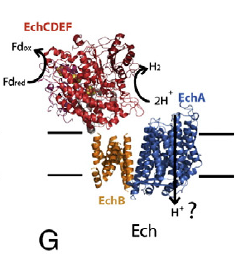
Note that I've altered the black arrows to match my red arrows, showing the generation of reduced ferredoxin from oxidised ferredoxin and the consumption of (primordial) H2 under the influence of oceanic proton flow through the brown membrane protein labelled EchB but which I will refer to from here onwards as NuoH, or a homologue there-of. Their original image of a modern Ech on which I based my proto-Ech is this one:

Again, for various reasons, I will refer to the blue subunit EchA as NuoL. This modern Ech is energy converting, it pumps protons through the blue anti porter homologous to NuoL. All of the arrows are now in their modern pumping direction. The pump is powered by reduced ferredoxin (from elsewhere in the cell) and produces hydrogen as waste. Typical bacteria using this Ech might be E coli, to produce flammable flatus. The source of reduced ferredoxin is any catabolic process. Fermenting starch in the anaerobic colon has predictable results in this department.
An understanding of the initial role for this antiporter is crucial to any logical approach to bioenergetic evolution. Equally interesting are the adaptions of subunit EchB (homologous to NuoH) to changing the activity of NuoL from antiporting to Na+ pumping.
We can now look at a NuoL type antiporter embedded in a membrane without any power supply. It will consume membrane proton potential by allowing protons to move inwards and expel Na+ ions outwards in exchange, like this:
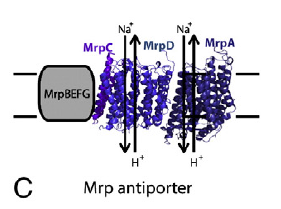
It can do this in a modern bacterium because there is a proton gradient, created by complex I (or any other energy converting complex/hydrogenase), i.e. protons are available to travel down a concentration gradient in to the cell, much as they might have done in primordial times. Na+ ions are forced out against a concentration gradient, in this case because this particular microbe lives in an extremely high Na+ environment. If you delete the Mrp genes for subunits MrpD and MrpA you cripple its antiporting ability. Engineering back in homologous proton translocators from a modern complex I restores the full antiporting ability.This tells us that the modern proton translocators of complex I are still antiporters but their antiporting is kept suppressed. I would suggest by NuoH. Note that the Mrp antiporting complex has no NuoH subunit.
NuoL does appear to be distantly related to NuoH, possibly by very ancient gene duplication. The conservation of form can be seen in these lovely images from Marrreiro et al. The gold ribbon is NuoH and the grey one is NuoL. The channel form is clearly visible. I consider NuoH to be homologous to the original proton ion channel from my proto-Ech doodle and its relative NuoL to be homologous to a prototypical Na+/H+ antiporting derivative.

I think that the initial gene duplication/modification would probably have produced an uncontrolled antiporter which would have produced a dramatic fall in intracellular Na+ concentration. This activated ATP synthase, making it function as an ATP generating rotor turned by Na+ re-entering the cell. This would generate ATP as fast as the proton gradient could produce a Na+ gradient. Very fast.
Possibly the first priority after the generation of a Na+/H+ antiporter would be to work out how to stop it. Here's how:
Proto-Ech is essentially sidelined as a source of high energy compounds by the novel Na+ energetics system. Mutations in NuoH or the NiFe hydrogenase would no longer be fatal, so there is the scope for the now redundant proto-Ech to be converted to a metabolic sensor and switch.
Excess reduced ferredoxin indicates a surplus of energy supply, almost certainly driven by over zealous antiporting. If this excess reduced ferredoxin is allowed to drive through proto-Ech, pushing electrons towards the FeNi centre and beyond to reduce protons to H2, this sign of excess could easily be adapted to produce a conformational change in NuoH.
NuoL is stuck on the side of NuoH. Changes in the shape of NuoH produce changes in both shape and function in NuoL. All that is needed is for excess reduced ferredoxin to produce a conformation change in NuoH and it could shut off the antiporting in NuoL. Having the antiporter (NuoL) glued to the side of NuoH allows the switch to function effectively.
Summary so far: Excess reduced ferredoxin stops/reduces antiporting and so controls ATP over-synthesis derived from exuberant Na+ energetics.
So here is the next question: What happens when the geothermal proton gradient fails? For a start, the free lunch from antiporting disappears. We still have the back up of ferredoxin energetics from electron bifurcation but nothing to compare to the glut of ATP from the now diminishing Na+ energetics.
What is needed is some way of pumping Na+ out of the cell which could replace the simple and exceedingly easy antiporting system. I've already got reduced ferredoxin acting through redundant proto-Ech as a brake on antiporting, as part of a control system on Na+ energetics. If we were to generate a change with allowed us to "over-apply" the ferredoxin brake we could, plausibly, go so far as to do more than simply stopping Na+ entering the cell, we might actually start to reverse Na+ ion flow and pump it outwards. Na+ pumping by using the energy derived from reduced ferredoxin.
Proto-Ech is now running in reverse and pumping Na+ ions. It is conserving energy as a Na+ gradient and so is now a true Ech, there no longer anything "proto" about it. It's reversible. Na+ energetics are restored and the core power supply to the cell is electron bifurcation supplying power to drive Na+ energetics.
That's how it stays until cytochromes come along.
Peter
Once people start looking at modern membrane complexes there is no need for such conventions and figures are usually produced the other way up. So when we want to look at modern Ech and derivatives I think I have to turn my proto-Ech doodle upside down like this:

I have, very naughtily, butchered a cartoon of a modern Ech (out of the lovely paper from Efremov and Sazanov) to produce this image of my concept of proto-Ech. As in the doodle, this must use a geothermal proton (not Na+) gradient and does not look to be reversible:

Note that I've altered the black arrows to match my red arrows, showing the generation of reduced ferredoxin from oxidised ferredoxin and the consumption of (primordial) H2 under the influence of oceanic proton flow through the brown membrane protein labelled EchB but which I will refer to from here onwards as NuoH, or a homologue there-of. Their original image of a modern Ech on which I based my proto-Ech is this one:
Again, for various reasons, I will refer to the blue subunit EchA as NuoL. This modern Ech is energy converting, it pumps protons through the blue anti porter homologous to NuoL. All of the arrows are now in their modern pumping direction. The pump is powered by reduced ferredoxin (from elsewhere in the cell) and produces hydrogen as waste. Typical bacteria using this Ech might be E coli, to produce flammable flatus. The source of reduced ferredoxin is any catabolic process. Fermenting starch in the anaerobic colon has predictable results in this department.
An understanding of the initial role for this antiporter is crucial to any logical approach to bioenergetic evolution. Equally interesting are the adaptions of subunit EchB (homologous to NuoH) to changing the activity of NuoL from antiporting to Na+ pumping.
We can now look at a NuoL type antiporter embedded in a membrane without any power supply. It will consume membrane proton potential by allowing protons to move inwards and expel Na+ ions outwards in exchange, like this:

It can do this in a modern bacterium because there is a proton gradient, created by complex I (or any other energy converting complex/hydrogenase), i.e. protons are available to travel down a concentration gradient in to the cell, much as they might have done in primordial times. Na+ ions are forced out against a concentration gradient, in this case because this particular microbe lives in an extremely high Na+ environment. If you delete the Mrp genes for subunits MrpD and MrpA you cripple its antiporting ability. Engineering back in homologous proton translocators from a modern complex I restores the full antiporting ability.This tells us that the modern proton translocators of complex I are still antiporters but their antiporting is kept suppressed. I would suggest by NuoH. Note that the Mrp antiporting complex has no NuoH subunit.
NuoL does appear to be distantly related to NuoH, possibly by very ancient gene duplication. The conservation of form can be seen in these lovely images from Marrreiro et al. The gold ribbon is NuoH and the grey one is NuoL. The channel form is clearly visible. I consider NuoH to be homologous to the original proton ion channel from my proto-Ech doodle and its relative NuoL to be homologous to a prototypical Na+/H+ antiporting derivative.

I think that the initial gene duplication/modification would probably have produced an uncontrolled antiporter which would have produced a dramatic fall in intracellular Na+ concentration. This activated ATP synthase, making it function as an ATP generating rotor turned by Na+ re-entering the cell. This would generate ATP as fast as the proton gradient could produce a Na+ gradient. Very fast.
Possibly the first priority after the generation of a Na+/H+ antiporter would be to work out how to stop it. Here's how:
Proto-Ech is essentially sidelined as a source of high energy compounds by the novel Na+ energetics system. Mutations in NuoH or the NiFe hydrogenase would no longer be fatal, so there is the scope for the now redundant proto-Ech to be converted to a metabolic sensor and switch.
Excess reduced ferredoxin indicates a surplus of energy supply, almost certainly driven by over zealous antiporting. If this excess reduced ferredoxin is allowed to drive through proto-Ech, pushing electrons towards the FeNi centre and beyond to reduce protons to H2, this sign of excess could easily be adapted to produce a conformational change in NuoH.
NuoL is stuck on the side of NuoH. Changes in the shape of NuoH produce changes in both shape and function in NuoL. All that is needed is for excess reduced ferredoxin to produce a conformation change in NuoH and it could shut off the antiporting in NuoL. Having the antiporter (NuoL) glued to the side of NuoH allows the switch to function effectively.
Summary so far: Excess reduced ferredoxin stops/reduces antiporting and so controls ATP over-synthesis derived from exuberant Na+ energetics.
So here is the next question: What happens when the geothermal proton gradient fails? For a start, the free lunch from antiporting disappears. We still have the back up of ferredoxin energetics from electron bifurcation but nothing to compare to the glut of ATP from the now diminishing Na+ energetics.
What is needed is some way of pumping Na+ out of the cell which could replace the simple and exceedingly easy antiporting system. I've already got reduced ferredoxin acting through redundant proto-Ech as a brake on antiporting, as part of a control system on Na+ energetics. If we were to generate a change with allowed us to "over-apply" the ferredoxin brake we could, plausibly, go so far as to do more than simply stopping Na+ entering the cell, we might actually start to reverse Na+ ion flow and pump it outwards. Na+ pumping by using the energy derived from reduced ferredoxin.
Proto-Ech is now running in reverse and pumping Na+ ions. It is conserving energy as a Na+ gradient and so is now a true Ech, there no longer anything "proto" about it. It's reversible. Na+ energetics are restored and the core power supply to the cell is electron bifurcation supplying power to drive Na+ energetics.
That's how it stays until cytochromes come along.
Peter
Sunday, July 26, 2015
Proto-Ech
Let's begin with electron micrographs of the structure of the precipitates in Nick Lane's hydrothermal vent simulating bench top reactor.
At low power by scanning EM we have:

At high magnification by transmission EM we have:

I've sketched what I think might be happening within the latticework of these amorphous precipitates. As the fluids mix it's not simply linear. There will be channels, eddies and incomplete barriers.
You have to bear in mind that this is all completely made up. It's a thought experiment. This might be true, it might not be. Here's my guess:

What we do know is that this reaction is taking place:

We know because the CO goes on to reduce to formate and Nick Lane picked this up in respectable amounts from the fluids flowing through the structures shown in the electron micrographs.
The horrible slide below is the above reaction turned on its side to fit in with the first sketch:

The green ovoid shows the sort of place where I think the reaction might be taking place, but actually all over the doodle I've produced:

I would suggest the precipitate might be rather high in FeS and only doped with Ni in places. The structures in the micrographs are a lot bigger than one Fe atom across. Let's show an FeS crystal structure doped with Ni. This allows the low redox potential electrons from H2 at pH 10 from one FeNi cluster to be conducted through FeS clusters to another FeNi cluster on the other side of the crystal, where a second catalytic reaction can take place. CO2 was common in the ocean and vents so we can have step two as CO2 reduction:

I would view the second FeNi cluster on the right hand side as the potential origin of CODH/ACS, separated off in to the cytoplasm and of no further interest in the development of a proto-Ech. I've flipped back on to a more normal orientation for the rest of the pictures as reading on one side does horrible things to my brain. In the next picture I've got the first FeNi centre accepting low potential electrons from H2 at pH 10 and donating them, not to a structural FeS cluster as previously but to a ferredoxin, a soluble version of FeS, at pH 6 to give a an FeS moiety with a redox potential capable to reducing CO2 to CO, but in transportable form. Able to wander off elsewhere in the cytoplasm as the core power unit of the cell, to where ever CODH/ACS has ended up. Ferredoxin is one of the most ancient and simple peptides, possibly worth a post in its own right. Below shows the need for a low pH region close to the FeNi moiety to allow this conservation of reducing power:

The above diagram is getting rather cluttered so I thought it would be useful to simplify matters in to an enzyme based around a (not shown) catalytic centre converting the energy of H2 to reduced ferredoxin using a localised area of pH 6. This is the logical origin of the type 4 FeNi hydrogenases which are still in ubiquitous use today:

The hydrogenase is core to Ech but we need another step to get us from a hydrogenase using the pH gradient to a true proto-Ech. That step is the formation of a protomembrane. The protomembrane is freely conductive to both protons and hydroxyl ions but will stop the FeNi hydrogenase getting close enough to the inorganic cell wall structure to get a decent look at a pH of 6, needed get ferredoxin reduced.

What is needed is a protein structure within the protomembrane which can channel protons tightly through from the inorganic wall across the leaky protomembrane to allow the FeNi hydrogenase to get a decent look at a pH close to that of the ocean:

By this time the inorganic cell wall is no longer strictly needed but the protocell is clearly still completely dependent on an external pH gradient to generate reduced ferredoxin. I would call this port/enzyme combination a proto-Ech:

I think it is a reasonable assumption, if this thought train is correct, that there is no way that a gradient of Na+ ions can replace a gradient of H+ ions, you simply wouldn't get the pH 6 within the enzyme by translocating Na+ ions. The modern Ech has a second membrane protein built in to its structure, an anti porter. That will transport Na+ ions, and is reversible.
Peter
PS, for Passthecream: One way H+ but no Demon in the channel!
At low power by scanning EM we have:

At high magnification by transmission EM we have:

I've sketched what I think might be happening within the latticework of these amorphous precipitates. As the fluids mix it's not simply linear. There will be channels, eddies and incomplete barriers.
You have to bear in mind that this is all completely made up. It's a thought experiment. This might be true, it might not be. Here's my guess:

What we do know is that this reaction is taking place:

We know because the CO goes on to reduce to formate and Nick Lane picked this up in respectable amounts from the fluids flowing through the structures shown in the electron micrographs.
The horrible slide below is the above reaction turned on its side to fit in with the first sketch:

The green ovoid shows the sort of place where I think the reaction might be taking place, but actually all over the doodle I've produced:

I would suggest the precipitate might be rather high in FeS and only doped with Ni in places. The structures in the micrographs are a lot bigger than one Fe atom across. Let's show an FeS crystal structure doped with Ni. This allows the low redox potential electrons from H2 at pH 10 from one FeNi cluster to be conducted through FeS clusters to another FeNi cluster on the other side of the crystal, where a second catalytic reaction can take place. CO2 was common in the ocean and vents so we can have step two as CO2 reduction:

I would view the second FeNi cluster on the right hand side as the potential origin of CODH/ACS, separated off in to the cytoplasm and of no further interest in the development of a proto-Ech. I've flipped back on to a more normal orientation for the rest of the pictures as reading on one side does horrible things to my brain. In the next picture I've got the first FeNi centre accepting low potential electrons from H2 at pH 10 and donating them, not to a structural FeS cluster as previously but to a ferredoxin, a soluble version of FeS, at pH 6 to give a an FeS moiety with a redox potential capable to reducing CO2 to CO, but in transportable form. Able to wander off elsewhere in the cytoplasm as the core power unit of the cell, to where ever CODH/ACS has ended up. Ferredoxin is one of the most ancient and simple peptides, possibly worth a post in its own right. Below shows the need for a low pH region close to the FeNi moiety to allow this conservation of reducing power:

The above diagram is getting rather cluttered so I thought it would be useful to simplify matters in to an enzyme based around a (not shown) catalytic centre converting the energy of H2 to reduced ferredoxin using a localised area of pH 6. This is the logical origin of the type 4 FeNi hydrogenases which are still in ubiquitous use today:

The hydrogenase is core to Ech but we need another step to get us from a hydrogenase using the pH gradient to a true proto-Ech. That step is the formation of a protomembrane. The protomembrane is freely conductive to both protons and hydroxyl ions but will stop the FeNi hydrogenase getting close enough to the inorganic cell wall structure to get a decent look at a pH of 6, needed get ferredoxin reduced.

What is needed is a protein structure within the protomembrane which can channel protons tightly through from the inorganic wall across the leaky protomembrane to allow the FeNi hydrogenase to get a decent look at a pH close to that of the ocean:

By this time the inorganic cell wall is no longer strictly needed but the protocell is clearly still completely dependent on an external pH gradient to generate reduced ferredoxin. I would call this port/enzyme combination a proto-Ech:

I think it is a reasonable assumption, if this thought train is correct, that there is no way that a gradient of Na+ ions can replace a gradient of H+ ions, you simply wouldn't get the pH 6 within the enzyme by translocating Na+ ions. The modern Ech has a second membrane protein built in to its structure, an anti porter. That will transport Na+ ions, and is reversible.
Peter
PS, for Passthecream: One way H+ but no Demon in the channel!
Saturday, July 25, 2015
Two timelines
This is for Raphi. It's a slightly rough version of the post I lost yesterday. I've been through Nick Lane's timeline for the evolution of bioenergetics in The Vital Question as carefully as I can and it's set out below. I've coloured in green the lines which are unchanged in the timeline that I would suggest and in red the sections of both timelines which I have some trouble with. Here we go:
**************************************************************
TIMELINE FROM THE VITAL QUESTION
There is a proton gradient, FeNi catalysis, activated acetate, ATP (via SLP), no membrane.
Permeable membrane develops, Ech and ATP synthase develop and use the gradient across this membrane, both run on the vent H+ gradient
Membrane tightens to Na+.
Antiporter invented while membrane still proton permeable but Na+ opaque.
Antiporter provides a Na+ gradient in addition to the H+ gradient, this helps because Na+ (along with H+) can drive ATP synthase to produce ATP and Na+ (along with H+) can drive Ech (TVQ p144, line 10 and line 23) to produce reduced ferredoxin.
This is a pre adaptation to proton pumping, because a pumped proton drives the antiporter which maintains the Na+ gradient whenever the natural proton gradient of the vents diminishes. i.e. with an antiporter plus pumped protons a much smaller vent gradient is needed. A proton pump is developed, not specified where from but probably from Ech/antiporter.
Membrane progressively tightens to H+ and so Na+ pumping becomes progressively less important, it’s pumped protons which now return through ATP synthase.
No longer any benefit from Na+ pumping so everything uses pumped protons and these are pumped via Ech using reduced Fd- from electron bifurcation (acetogens) or via a modified anti porter powered by methylene-H4MPT (methanogens).
**************************************************************
As I have commented before, I have trouble with the very early development of ATP synthase as a very complex nano machine providing ATP for a cell in the earliest periods of crude membrane formation. However, that does leave Ech, energy converting hydrogenase. The next few posts are on Ech but for now it is a primordial supplier of reduced ferredoxin to the protocell. It is very simple and works perfectly well on the primordial proton gradient.
However, having rejected ATP synthase I am left with the problem of ascribing the benefits of Na+ antiporting to the use of Na+ energetics by the developing Ech, this won't work. Ech, as a generator of reduced ferredoxin, is dependent on the pH gradient provided by the vents. It's a matter of redox potentials for H2 converting to 2H+ and 2e-. See next post, you can't do this with a Na+ gradient.
So that leaves me with energetic problems, no ATP synth and Ech needing a pH gradient. Hence the time line cobbled together below:
**************************************************************
There is a proton gradient, FeNi catalysis, activated acetate, ATP (via SLP), no membrane.
Permeable membrane develops. This forces proto-Ech to develop as a protein encrusted FeNi enzyme, it runs on vent gradient to generate Fd- to generate activated acetate and ATP (still via SLP).
Any membrane forces the development of an ATP driven translocase to allow spread of RNA/proteins through vents through membrane barriers.
Membrane tightens to Na+.
The translocase jams and ends up using ATP to pump Na+ ions rather than to translocate a protein. Modestly lowered intracellular Na+ improves proto-Ech function.
Antiporter invented while membrane still proton permeable but Na+ opaque.
The antiporter causes a marked drop in intracellular Na+ which forces the translocase-derived Na+ pump to flip in to reverse and so generate ATP from the suddenly hugely increased Na+ gradient. This is the origin of ATP synthase.
To leave the vents proto-Ech is adapted as a power supply to the antiporter (so that H+ gradient driven antiporting is no longer needed), becomes the true Ech at this stage. It always pumps Na+ outwards using Fd- from electron bifurcation either directly or indirectly via methylene-H4MPT.
Everything runs on Na+ energetics, there is no rush to generate a proton tight membrane, but no problem if/when it happens.
Cytochromes demand H+ energetics, most organisms convert to cytochromes at various different evolutionary times. Non-cytochrome microbes continue to run on Na+, even today.
**************************************************************
The problems in this timeline, also in red, are the benefits to a protocell from lowered Na+, the limitation of Ech to pumping Na+ only, certainly until much latter and the evolution of cytochromes, and the idea that Methyltransferase, which pumps Na+ in methanogens, is a derivative of Ech. These are the subjects of my next couple of posts, along with where Ech came from and why it must have a proton gradient.
Peter
EDIT Methyltransferase is much more complex than an Ech derivative!
EDIT Methyltransferase is much more complex than an Ech derivative!
Friday, July 24, 2015
Wednesday, July 22, 2015
What's wrong with Na+ ions?
Raphi asked a very interesting question in the comments section of the last post:
"Could you please expand on why you *think* Nick Lane might think what he does here?"
"[...] he seems wedded to proton translocation as being physically related to ferredoxin reduction, which I doubt is needed. It's not a "reduced FeS synthase-like" machine, as far as I can see. The generation of formate under simulated vent conditions needs nothing other than a completely randomly structured amorphous Fe/NiS matrix, nothing cell-like or translocating is required for this aspect in Lane's bench top reactor."
There are two aspects to this. One is the specificity of early life for protons, i.e. do we have to have a gradient of protons, and the other is what sort of process is involved in the generation of the thioester which is the precursor of acetyl CoA. Is there an "FeS-synthase" machine?
This current post is about the Na+ gradient aspect.
Nick Lane’s basic objection to the use of Na+ ions is that the the concentration of the ocean is very high, so to make a difference at the membrane you have to pump a lot more Na+ than H+. His exact footnote from The Vital Question is:
“The alert reader may be wondering why the cells don't just pump Na+? Indeed it is better to pump Na+ across a leaky membrane than to pump H+, but as the membrane becomes less permeable, that advantage is lost. The reason is esoteric. The power available to a cell depends on the concentration difference between the two sides of the membrane, not on the absolute concentration of ions. Because Na+ concentration is so high in the oceans, to maintain an equivalent three orders of magnitude difference between the inside and outside of the cell requires pumping a lot more Na+ than H+, undermining the advantage of pumping Na+ if the membrane is relatively impermeable to both ions”.
I have a lot of problems with this standpoint. First is that you are not trying to increase the extra cellular Na+. A few extra Na+ ions in the ocean, perhaps already at a sodium ion concentration of 450mmol/l in the region of a protocell, are hardly going to change the Na+ concentration around that protocell. I would regard the primordial extra cellular Na+ concentration as fixed. What you actually have to do is to drop the intra cellular Na+ concentration to 1/1000th the ocean concentration and you would then get those three orders of magnitude in to the gradient. Somewhere just under 0.5mmol/l within a cell versus an ocean at 450mmol/l outside the cell would do this.
This leads directly to the second problem I see. This is the concept that you might remotely need a 10^3 Na+ gradient.
The function of the 10^3 proton gradient provided by the vents, in the beginning and in Nick Lane’s reactor, is to provide FeS at a redox potential to reduce CO2 to CO using H2. That needs a big proton gradient.
Pumping Na+ ions is completely different. No one is talking about reducing FeS using Na+ ions. All the Na+ gradient is doing is trying to store energetic loose change to make a few ATP molecules. This does not need a 10^3 Na+ gradient. Acetobacterium woodii will grow with an extracellular Na+ concentration of about 50mmol/l, well below the speculated 450mmol/l of the primordial ocean. There is no way A woodii can generate a 10^3 Na+ gradient with 50mmol/l extracellular Na+ and A woodii grows quite nicely on very modest Na+ energetics. These energetics are completely dependent on an ATP synthase driven by a gradient of Na+ ions but this doesn't need a 10^3 Na+ gradient.
My third problem is that all of this only applies once ATP synthase becomes active as a synthase. I can't visualise a complex rotator stator evolving to run on a primordial H+ gradient. While both the pore-like structure and the ATP consuming helicase component appear to be very highly conserved across the archaea-bacterial divide, the method of joining these two common subunits together to form an ATP synthase is certainly not conserved. My conclusion from this is that while the precursor of ATP synthase was a component of LUCA, ATP synthase itself was not. If ATP synthase is not primordial there is no specific need for it to be running off of the primordial proton gradient. I described Koonin's idea that ATP synthase develop from a translocase in a previous post.
If we accept Koonin's concept as correct about the pore/helicase scenario and the functional role of Na+ ions in stabilising the pore structure, this naturally leads to the expulsion of Na+ ions from the cell without any clear cut benefit other than lowering the intracellular Na+ concentration.
I initially had no idea what the the benefit of a low intracellular Na+ concentration might be. Obviously ATP synthase would not be retained as a pump of Na+ ions unless there was some immediate benefit to the cell. Now I might have found a potential benefit to lowering intracellular Na+ which applies to the primordial generation of acetyl thioester which is core to substrate level phosphorylation at the start of life and has direct relevance to the use of the proton gradient.
The more I think about it the more it seems likely that there actually was a molecular machine running off of the proton gradient soon after the start of "life". But I do not think it was anything like ATP synthase, i.e. there are no molecular mechanics, no protons pushing bits of protein around in the way protons do in a modern ATP synthase.
How it all came together is an interesting area to speculate on. Perhaps in the next post.
Peter
"Could you please expand on why you *think* Nick Lane might think what he does here?"
"[...] he seems wedded to proton translocation as being physically related to ferredoxin reduction, which I doubt is needed. It's not a "reduced FeS synthase-like" machine, as far as I can see. The generation of formate under simulated vent conditions needs nothing other than a completely randomly structured amorphous Fe/NiS matrix, nothing cell-like or translocating is required for this aspect in Lane's bench top reactor."
There are two aspects to this. One is the specificity of early life for protons, i.e. do we have to have a gradient of protons, and the other is what sort of process is involved in the generation of the thioester which is the precursor of acetyl CoA. Is there an "FeS-synthase" machine?
This current post is about the Na+ gradient aspect.
Nick Lane’s basic objection to the use of Na+ ions is that the the concentration of the ocean is very high, so to make a difference at the membrane you have to pump a lot more Na+ than H+. His exact footnote from The Vital Question is:
“The alert reader may be wondering why the cells don't just pump Na+? Indeed it is better to pump Na+ across a leaky membrane than to pump H+, but as the membrane becomes less permeable, that advantage is lost. The reason is esoteric. The power available to a cell depends on the concentration difference between the two sides of the membrane, not on the absolute concentration of ions. Because Na+ concentration is so high in the oceans, to maintain an equivalent three orders of magnitude difference between the inside and outside of the cell requires pumping a lot more Na+ than H+, undermining the advantage of pumping Na+ if the membrane is relatively impermeable to both ions”.
I have a lot of problems with this standpoint. First is that you are not trying to increase the extra cellular Na+. A few extra Na+ ions in the ocean, perhaps already at a sodium ion concentration of 450mmol/l in the region of a protocell, are hardly going to change the Na+ concentration around that protocell. I would regard the primordial extra cellular Na+ concentration as fixed. What you actually have to do is to drop the intra cellular Na+ concentration to 1/1000th the ocean concentration and you would then get those three orders of magnitude in to the gradient. Somewhere just under 0.5mmol/l within a cell versus an ocean at 450mmol/l outside the cell would do this.
This leads directly to the second problem I see. This is the concept that you might remotely need a 10^3 Na+ gradient.
The function of the 10^3 proton gradient provided by the vents, in the beginning and in Nick Lane’s reactor, is to provide FeS at a redox potential to reduce CO2 to CO using H2. That needs a big proton gradient.
Pumping Na+ ions is completely different. No one is talking about reducing FeS using Na+ ions. All the Na+ gradient is doing is trying to store energetic loose change to make a few ATP molecules. This does not need a 10^3 Na+ gradient. Acetobacterium woodii will grow with an extracellular Na+ concentration of about 50mmol/l, well below the speculated 450mmol/l of the primordial ocean. There is no way A woodii can generate a 10^3 Na+ gradient with 50mmol/l extracellular Na+ and A woodii grows quite nicely on very modest Na+ energetics. These energetics are completely dependent on an ATP synthase driven by a gradient of Na+ ions but this doesn't need a 10^3 Na+ gradient.
My third problem is that all of this only applies once ATP synthase becomes active as a synthase. I can't visualise a complex rotator stator evolving to run on a primordial H+ gradient. While both the pore-like structure and the ATP consuming helicase component appear to be very highly conserved across the archaea-bacterial divide, the method of joining these two common subunits together to form an ATP synthase is certainly not conserved. My conclusion from this is that while the precursor of ATP synthase was a component of LUCA, ATP synthase itself was not. If ATP synthase is not primordial there is no specific need for it to be running off of the primordial proton gradient. I described Koonin's idea that ATP synthase develop from a translocase in a previous post.
If we accept Koonin's concept as correct about the pore/helicase scenario and the functional role of Na+ ions in stabilising the pore structure, this naturally leads to the expulsion of Na+ ions from the cell without any clear cut benefit other than lowering the intracellular Na+ concentration.
I initially had no idea what the the benefit of a low intracellular Na+ concentration might be. Obviously ATP synthase would not be retained as a pump of Na+ ions unless there was some immediate benefit to the cell. Now I might have found a potential benefit to lowering intracellular Na+ which applies to the primordial generation of acetyl thioester which is core to substrate level phosphorylation at the start of life and has direct relevance to the use of the proton gradient.
The more I think about it the more it seems likely that there actually was a molecular machine running off of the proton gradient soon after the start of "life". But I do not think it was anything like ATP synthase, i.e. there are no molecular mechanics, no protons pushing bits of protein around in the way protons do in a modern ATP synthase.
How it all came together is an interesting area to speculate on. Perhaps in the next post.
Peter
Tuesday, June 23, 2015
Why sodium ions?
I will now try and shut up about the origins of life. But first I have to summarise the idea which threw itself at me as I tidied up the last post, before I can desist:
As a follow on to their ideas relating to the development of the ATP synthase complex, Koonin and his group have a paper suggesting that sodium bioenergetics were primordial to the origin of life. Happily, like their ATP synthase paper, it's free full text so people can make their own minds up as to how good the arguments appear. I think they may be correct.
They go on to suggest that the precursor to the ATP synthase complex used Na+ ions to stabilise the structure of its intra membrane section, derived from the membrane pore, and that it was these Na+ ions which were extruded as the changes occurred when a translocase became an ATP driven Na+ extruding motor.
I like this idea.
Koonin rejects a deep ocean origin of life scenario, largely on the premise that a high K+ environment within modern cells indicates that life started in a K+ rich environment. This has led him to land based geothermal ideas, foramide and Zn based photosynthesis. This is un necessary if we use his own Na+ pump to surmise a very early reduction in intracellular Na+ driven by ATP. No need for mud bubbles and foramide around a K+ rich geothermal vent...
Lane rejects Na+ only bioenergetics in a footnote on pages 146-8 of his latest book. The rejection is the weakest page in the whole text and he doesn't really explain it, excepting he seems wedded to proton translocation as being physically related to ferredoxin reduction, which I doubt is needed. It's not a "reduced FeS synthase-like" machine, as far as I can see. The generation of formate under simulated vent conditions needs nothing other than a completely randomly structured amorphous Fe/NiS matrix, nothing cell-like or translocating is required for this aspect in Lane's bench top reactor.
It dawned on me during the pre-posting tidy-up of the last post that you could use both ideas together.
Take Lane's ideas about a sustained source of reduced carbon compounds based on a pH differential, with a proton gradient being utterly essential for redox conditions but reject H+ translocation as being a mechanical essential for FeS reduction. What is needed is reduced FeS. This is available immediately, certainly within four hours, in the group's bench top reactor. Energetics would be based on formate and acetate, the later giving substrate level phosphorylation capable of yielding ATP. For this scenario you have to reject a role for any sort of primordial H+ powered ATP synthase. This suits me.
What is then needed is some sort of support (I have none) for the idea that nascent metabolism occurs more effectively with a reduced sodium level within the cell. This might be testable. Quite how I don't know, but there are clever people out there that might have some ideas.
Assuming there is some net benefit to a cell from having lower Na+ levels within, then there is some benefit of the "accidental" generation of a sodium pump based on Koonin's scenario of ATP synthase formation. This makes ATP synthase in to the primordial Na+ pump, at the cost of ATP consumption. That's OK in a vent as ATP is fairly free, provided by the H+ gradient via acetyl phosphate. Though there might be better uses for the ATP if ATP-consuming pumping wasn't needed.
Subsequent development of a Na+/H+ anti porter would radically drop the Na+ concentration within the protocell, and it would do it completely for free, without needing to divert ATP to pumping. The rapid drop in intracellular Na+ then reverses the outward pumping of Na+ by ATP synthase which then allows ATP generation at the cost of allowing Na+ back in to the cell. This can be continuously corrected by the anti porter. The low Na+ intracellular environment then becomes beneficial in its own right and drives subsequent evolution to tailor protein function to run best run in a high K+, high Mg2+ and low Na+ environment.
To escape the vent H+ gradient the anti porter then needs to be converted to be driven by reduced ferredoxin from electron bifurcation rather than from a proton gradient based redox potential and away we go.
Just thinking. Makes sense of both camps.
I'll try and shut up about the origins of life now.
Peter
PS Conversion from Na+ to H+ pumping has occurred on several different occasions in microbial evolution. It's quite easy to drive ATP synthase by either ion, given the similarity in size and charge between the Na+ ion and the hydrated H+ ion, H3O+. The drive for H+ energetics appears to have been the development of redox chains with cytochromes, which are totally proton dependent. Nick Lane's ideas that Na+ energetics are limited to extremophile or acetate rich environments does not hold true for Na+ pumpers in the anoxic deep mud of Woods Bay. Simply evolving without cytochromes seems to be enough to preserve Na+ bioenergetics. Cytochromes are so powerful most organisms went that route. But not all.
Must. Shut. Up.
Peter
As a follow on to their ideas relating to the development of the ATP synthase complex, Koonin and his group have a paper suggesting that sodium bioenergetics were primordial to the origin of life. Happily, like their ATP synthase paper, it's free full text so people can make their own minds up as to how good the arguments appear. I think they may be correct.
They go on to suggest that the precursor to the ATP synthase complex used Na+ ions to stabilise the structure of its intra membrane section, derived from the membrane pore, and that it was these Na+ ions which were extruded as the changes occurred when a translocase became an ATP driven Na+ extruding motor.
I like this idea.
Koonin rejects a deep ocean origin of life scenario, largely on the premise that a high K+ environment within modern cells indicates that life started in a K+ rich environment. This has led him to land based geothermal ideas, foramide and Zn based photosynthesis. This is un necessary if we use his own Na+ pump to surmise a very early reduction in intracellular Na+ driven by ATP. No need for mud bubbles and foramide around a K+ rich geothermal vent...
Lane rejects Na+ only bioenergetics in a footnote on pages 146-8 of his latest book. The rejection is the weakest page in the whole text and he doesn't really explain it, excepting he seems wedded to proton translocation as being physically related to ferredoxin reduction, which I doubt is needed. It's not a "reduced FeS synthase-like" machine, as far as I can see. The generation of formate under simulated vent conditions needs nothing other than a completely randomly structured amorphous Fe/NiS matrix, nothing cell-like or translocating is required for this aspect in Lane's bench top reactor.
It dawned on me during the pre-posting tidy-up of the last post that you could use both ideas together.
Take Lane's ideas about a sustained source of reduced carbon compounds based on a pH differential, with a proton gradient being utterly essential for redox conditions but reject H+ translocation as being a mechanical essential for FeS reduction. What is needed is reduced FeS. This is available immediately, certainly within four hours, in the group's bench top reactor. Energetics would be based on formate and acetate, the later giving substrate level phosphorylation capable of yielding ATP. For this scenario you have to reject a role for any sort of primordial H+ powered ATP synthase. This suits me.
What is then needed is some sort of support (I have none) for the idea that nascent metabolism occurs more effectively with a reduced sodium level within the cell. This might be testable. Quite how I don't know, but there are clever people out there that might have some ideas.
Assuming there is some net benefit to a cell from having lower Na+ levels within, then there is some benefit of the "accidental" generation of a sodium pump based on Koonin's scenario of ATP synthase formation. This makes ATP synthase in to the primordial Na+ pump, at the cost of ATP consumption. That's OK in a vent as ATP is fairly free, provided by the H+ gradient via acetyl phosphate. Though there might be better uses for the ATP if ATP-consuming pumping wasn't needed.
Subsequent development of a Na+/H+ anti porter would radically drop the Na+ concentration within the protocell, and it would do it completely for free, without needing to divert ATP to pumping. The rapid drop in intracellular Na+ then reverses the outward pumping of Na+ by ATP synthase which then allows ATP generation at the cost of allowing Na+ back in to the cell. This can be continuously corrected by the anti porter. The low Na+ intracellular environment then becomes beneficial in its own right and drives subsequent evolution to tailor protein function to run best run in a high K+, high Mg2+ and low Na+ environment.
To escape the vent H+ gradient the anti porter then needs to be converted to be driven by reduced ferredoxin from electron bifurcation rather than from a proton gradient based redox potential and away we go.
Just thinking. Makes sense of both camps.
I'll try and shut up about the origins of life now.
Peter
PS Conversion from Na+ to H+ pumping has occurred on several different occasions in microbial evolution. It's quite easy to drive ATP synthase by either ion, given the similarity in size and charge between the Na+ ion and the hydrated H+ ion, H3O+. The drive for H+ energetics appears to have been the development of redox chains with cytochromes, which are totally proton dependent. Nick Lane's ideas that Na+ energetics are limited to extremophile or acetate rich environments does not hold true for Na+ pumpers in the anoxic deep mud of Woods Bay. Simply evolving without cytochromes seems to be enough to preserve Na+ bioenergetics. Cytochromes are so powerful most organisms went that route. But not all.
Must. Shut. Up.
Peter
Monday, June 22, 2015
On the bench top
In the beginning there was an acidic ocean, alkaline hydrothermal fluid and a precipitated Fe/Ni sulphide catalytic interface.
You can do this in a bench top reactor which simulates such conditions, a modern version of the Miller Urey experiments from the 1950s. The atmosphere is 98%nitrogen with 2% hydrogen. It's strictly anoxic. The FeCl2, NiCl2 and Na2S in the perfusates are at millimolar concentrations and the yield of formic acid is in the region of 50 micromol/l, sampled in the fluid close to the precipitated Fe/NiS tubes. The equipment looks like this:

That, to me, is a pretty good start. The full paper is here and can be downloaded for free.
Below is what the reactor is simulating and what it is probably doing. It's a simplified reaction pathway compared to the one I talked about back in February. It doesn't supply a HS-CH3 source so generates formate rather than acetate:

The pH gradient across the FeS layer generates a reduced FeS moiety:

Reduced FeS provides the conditions for hydrogen to reduce carbon dioxide to carbon monoxide:

Carbon monoxide reacts with hydrogen to give formaldehyde and formic acid:

This much can be demonstrated on the bench top. It relies on far-from-equilibrium conditions modelled on those found at alkaline hydrothermal vents. These vent systems are not volcanic in origin, they are generated by the conversion of olivine to serpentine by water and are stable over geological time scales. This is a source of carbon, produced on a continuous basis, which can react further to give many organic compounds essential to life. No further energy input is required.
The next step needs us to get much more speculative and to consider the situation in a microporous FeS structure like the one fossilised at Tynagh in Ireland.
Imagine that we have a porous honeycomb of FeS which allows protons from the ocean to combine with hydroxyl ions from the vent fluid within a hollow vesicle. This neutralisation of protons allows continuous flow of more protons in to the protocell.

As protons pass in to the vesicle they continue to provide a source of reduced FeS which drives the reduction of CO2 in to assorted prebiotic chemicals, lumped together here as "metabolism":

Sufficient "metabolism" could plausibly produce a lining of assorted organic compounds, here described as "crud". Forming a protomembrane which is somewhat impermeable to Na+ is relatively simple. Making one proton-proof (or hydroxyl proof) is far more difficult:

Once we have a protomembrane which is opaque to Na+ ions we have the possibility of a Na+/H+ anti porter using the continued passage of H+:

I don't see the need for an antiporter to be specifically generating a Na+ ion gradient per se, pumping a few Na+ ions out of a cell will not alter the Na+ ion concentration outside the protomembrane. This is "locked" at the Na+ concentration of the ocean. No, all we need is some functional benefit from having a lower Na+ level within the protocell and there is then a benefit from Na+ expulsion. That might be because the residual Mg2+ and K+ are more effective for catalysis of the on-going nascent biochemistry with lower Na+ concentrations. So the Na+ gradient is generated by a reduced intracellular Na+ concentration. It can be maintained by a Na+ opaque membrane which is still proton permeable:

However, once it is there, the gradient becomes a source of useful potential in its own right. Recall that ATP synthase probably started as an ATP consuming, sodium extruding, modified protein translocase. It is very plausible that this initial usage of ATP to lower intracellular Na+ as a supplement to the anti porter. When the vent fluids are providing Na+ lowering for free, the lowered intracellular Na+ level makes it increasing difficulty for ATP synthase to further expel Na+ ions and provides an increasing pressure for it to run in reverse and convert the Na+ gradient in to ATP, especially under conditions reduced availability of ATP. This gives bulk ATP production coupled indirectly to the H+ gradient of the vent via a biologically generated Na+ gradient across a relatively non sophisticated membrane.
[The more I think about this the more ATP synthase may well have been acting as a Na+ pump BEFORE the Na+/H+ anti porter developed, i.e. a reduced intracellular Na+ was being paid for with ATP from substrate level phosphorylation via acetyl phosphate derivatives until the anti porter developed. The anti ported suddenly out stripped ATP synthase's ability to expel Na+, did it for free so long as the vent fluid was there, and so could reverse ATP synthase to make an actual synthase rather than a consumer of ATP. Makes sense, to me anyway].

For a cell to leave the proton gradient provided by the hydrothermal vent it must continue to expel Na+ without assistance from said proton gradient. This problem was solved in the same way by the archaea and the bacteria but using different techniques, i.e. it is unlikely to have been a core process in LUCA. Both techniques are based around electron bifurcation:

Hyd stands for soluble hydrogenase and Hdr is heterosulphide reductase. These take H2 and split the pair of electrons available. One electron goes steeply down-potential and the free energy of this reaction is coupled to getting the second electron to a potential where it can manage the generation of the reduced FeS which was originally provided by the proton gradient. Ferredoxin is a very primordial FeS containing protein. It stores low potential electrons on an FeS group and moves them around to places where they are needed. To a Na+ ion pump for one.
Electron bifurcation replaces proton gradient derived reduced FeS with biochemically derived reduced ferredoxin. Given sources of H2 and CO2 a cell is then potentially independent of the vent conditions:

From previous posts the archaeal and bacterial lineages have already divided before leaving the vents. The technique for electron bifurcation is different and the locking mechanism for ATP synthase is also different. The problems are the same, the solutions are clearly related but not quite identical. We can overlay this set of ideas on to the metabolism of modern Na+ pumping methanogens and acetogens by modifying the diagrams from Sousa et al's Early bioenergetic evolution.
First the acetogen:

This is the basic plan of bioenergetics in a Na+ pumping acetogen. If we highlight the core reactions of activated acetate formation we have reduced ferredoxin converting CO2 to CO (using H2, omitted for clarity) and combining with HS-CH3 to give a precursor to acetyl phosphate:

As an alternative to providing ATP the acetyl phosphate can be diverted to cell carbon synthesis:

The soluble hydrogenase (Hyd) is using electron bifurcation to generate the Fd- to drive the reduction of CO2, replacing the vent proton gradient. This Fd- is also being used to drive Na+ expulsion via Rnf, a Na+/H+ antiporter modified to use Fd- to replace the proton gradient. Rnf is the ancient ancestor of complex I. Complex I still carries the anti porter component of Rnf.

So in acetogens both carbon fixation and Na+ pumping are driven by electron bifurcation which replaces the vent proton gradient. What about methanogens? Here we go, this is the basic plan:

[I've not bothered correcting the small typo in Sousa's diagram].
So, the first thing we have to draw in is the components of the acetyl phosphate generating limb. This was omitted from the original diagram as it is only used for carbon fixation, not Na+ pumping or ATP synthesis. Note that ATP synthesis is now based on ATP synthase, not acetyl phosphate derived substrate level phosphorylation:

So let's overlay the primordial CO2 fixation pathway again:

In methanogens electron bifurcation is carried out by heterodisulphide reductase (Hdr) which is supplying a reduced Fd- pool to the cell to drive CO2 reduction as before:

but the Fd- pool also supplies the electrons to reduce CO2 to
CHO-MFR down to the Methyl-H4MPT, which I have over written with HS-CH3:

This pathway is a modern cofactor stabilised version of Nick Lane's bench top reactor driven formaldehyde formation. It goes like this:
CHO-MF is formaldehyde safely stored on the cofactor MFR.
CHO-H4MPT is simply a change of the cofactor used for storing the formaldehyde (formyl-H4MPT).
Removal of the oxygen atom of CHO reduces the formaldehyde to a CH moiety triple bonded to the cofactor (methenyl-H4MPT).
More reduction gives CH2 double bonded to the cofactor (methylene-H4MPT).
Next reduction gives a methyl group attached to the cofactor.
This (CH3-H4MPT) is over written by the HS-CH3 in the diagram as they are doing essentially the same job.
This methyl donor can be used for carbon fixation via acetyl phosphate or to drive Na+ expulsion via the MtrA-H complex. The later is probably based around the same Na+/H+ anti porter as Rnf but has a different module, methyl derivative powered, added to replace the proton gradient.
We can follow through from the very basic acetyl phosphate pathway, plus a Na+/H+ anti porter, plus a power source to replace the H+ gradient component of the anti porter, plus an ATP synthase, to give us a picture of the pathways giving rise to those acetogens and methanogens which have developed the origin of life pathways to highly sophisticated modern derivatives but with minimal changes to the general principles.
This is the logical picture which other origin of life scenarios are up against. I like simple logic. I like this hypothesis. It may be incorrect, but I hope not.
Peter
You can do this in a bench top reactor which simulates such conditions, a modern version of the Miller Urey experiments from the 1950s. The atmosphere is 98%nitrogen with 2% hydrogen. It's strictly anoxic. The FeCl2, NiCl2 and Na2S in the perfusates are at millimolar concentrations and the yield of formic acid is in the region of 50 micromol/l, sampled in the fluid close to the precipitated Fe/NiS tubes. The equipment looks like this:

That, to me, is a pretty good start. The full paper is here and can be downloaded for free.
Below is what the reactor is simulating and what it is probably doing. It's a simplified reaction pathway compared to the one I talked about back in February. It doesn't supply a HS-CH3 source so generates formate rather than acetate:

The pH gradient across the FeS layer generates a reduced FeS moiety:

Reduced FeS provides the conditions for hydrogen to reduce carbon dioxide to carbon monoxide:

Carbon monoxide reacts with hydrogen to give formaldehyde and formic acid:

This much can be demonstrated on the bench top. It relies on far-from-equilibrium conditions modelled on those found at alkaline hydrothermal vents. These vent systems are not volcanic in origin, they are generated by the conversion of olivine to serpentine by water and are stable over geological time scales. This is a source of carbon, produced on a continuous basis, which can react further to give many organic compounds essential to life. No further energy input is required.
The next step needs us to get much more speculative and to consider the situation in a microporous FeS structure like the one fossilised at Tynagh in Ireland.
Imagine that we have a porous honeycomb of FeS which allows protons from the ocean to combine with hydroxyl ions from the vent fluid within a hollow vesicle. This neutralisation of protons allows continuous flow of more protons in to the protocell.

As protons pass in to the vesicle they continue to provide a source of reduced FeS which drives the reduction of CO2 in to assorted prebiotic chemicals, lumped together here as "metabolism":

Sufficient "metabolism" could plausibly produce a lining of assorted organic compounds, here described as "crud". Forming a protomembrane which is somewhat impermeable to Na+ is relatively simple. Making one proton-proof (or hydroxyl proof) is far more difficult:

Once we have a protomembrane which is opaque to Na+ ions we have the possibility of a Na+/H+ anti porter using the continued passage of H+:

I don't see the need for an antiporter to be specifically generating a Na+ ion gradient per se, pumping a few Na+ ions out of a cell will not alter the Na+ ion concentration outside the protomembrane. This is "locked" at the Na+ concentration of the ocean. No, all we need is some functional benefit from having a lower Na+ level within the protocell and there is then a benefit from Na+ expulsion. That might be because the residual Mg2+ and K+ are more effective for catalysis of the on-going nascent biochemistry with lower Na+ concentrations. So the Na+ gradient is generated by a reduced intracellular Na+ concentration. It can be maintained by a Na+ opaque membrane which is still proton permeable:

However, once it is there, the gradient becomes a source of useful potential in its own right. Recall that ATP synthase probably started as an ATP consuming, sodium extruding, modified protein translocase. It is very plausible that this initial usage of ATP to lower intracellular Na+ as a supplement to the anti porter. When the vent fluids are providing Na+ lowering for free, the lowered intracellular Na+ level makes it increasing difficulty for ATP synthase to further expel Na+ ions and provides an increasing pressure for it to run in reverse and convert the Na+ gradient in to ATP, especially under conditions reduced availability of ATP. This gives bulk ATP production coupled indirectly to the H+ gradient of the vent via a biologically generated Na+ gradient across a relatively non sophisticated membrane.
[The more I think about this the more ATP synthase may well have been acting as a Na+ pump BEFORE the Na+/H+ anti porter developed, i.e. a reduced intracellular Na+ was being paid for with ATP from substrate level phosphorylation via acetyl phosphate derivatives until the anti porter developed. The anti ported suddenly out stripped ATP synthase's ability to expel Na+, did it for free so long as the vent fluid was there, and so could reverse ATP synthase to make an actual synthase rather than a consumer of ATP. Makes sense, to me anyway].

For a cell to leave the proton gradient provided by the hydrothermal vent it must continue to expel Na+ without assistance from said proton gradient. This problem was solved in the same way by the archaea and the bacteria but using different techniques, i.e. it is unlikely to have been a core process in LUCA. Both techniques are based around electron bifurcation:

Hyd stands for soluble hydrogenase and Hdr is heterosulphide reductase. These take H2 and split the pair of electrons available. One electron goes steeply down-potential and the free energy of this reaction is coupled to getting the second electron to a potential where it can manage the generation of the reduced FeS which was originally provided by the proton gradient. Ferredoxin is a very primordial FeS containing protein. It stores low potential electrons on an FeS group and moves them around to places where they are needed. To a Na+ ion pump for one.
Electron bifurcation replaces proton gradient derived reduced FeS with biochemically derived reduced ferredoxin. Given sources of H2 and CO2 a cell is then potentially independent of the vent conditions:

From previous posts the archaeal and bacterial lineages have already divided before leaving the vents. The technique for electron bifurcation is different and the locking mechanism for ATP synthase is also different. The problems are the same, the solutions are clearly related but not quite identical. We can overlay this set of ideas on to the metabolism of modern Na+ pumping methanogens and acetogens by modifying the diagrams from Sousa et al's Early bioenergetic evolution.
First the acetogen:

This is the basic plan of bioenergetics in a Na+ pumping acetogen. If we highlight the core reactions of activated acetate formation we have reduced ferredoxin converting CO2 to CO (using H2, omitted for clarity) and combining with HS-CH3 to give a precursor to acetyl phosphate:

As an alternative to providing ATP the acetyl phosphate can be diverted to cell carbon synthesis:

The soluble hydrogenase (Hyd) is using electron bifurcation to generate the Fd- to drive the reduction of CO2, replacing the vent proton gradient. This Fd- is also being used to drive Na+ expulsion via Rnf, a Na+/H+ antiporter modified to use Fd- to replace the proton gradient. Rnf is the ancient ancestor of complex I. Complex I still carries the anti porter component of Rnf.

So in acetogens both carbon fixation and Na+ pumping are driven by electron bifurcation which replaces the vent proton gradient. What about methanogens? Here we go, this is the basic plan:

[I've not bothered correcting the small typo in Sousa's diagram].
So, the first thing we have to draw in is the components of the acetyl phosphate generating limb. This was omitted from the original diagram as it is only used for carbon fixation, not Na+ pumping or ATP synthesis. Note that ATP synthesis is now based on ATP synthase, not acetyl phosphate derived substrate level phosphorylation:

So let's overlay the primordial CO2 fixation pathway again:

In methanogens electron bifurcation is carried out by heterodisulphide reductase (Hdr) which is supplying a reduced Fd- pool to the cell to drive CO2 reduction as before:

but the Fd- pool also supplies the electrons to reduce CO2 to
CHO-MFR down to the Methyl-H4MPT, which I have over written with HS-CH3:

This pathway is a modern cofactor stabilised version of Nick Lane's bench top reactor driven formaldehyde formation. It goes like this:
CHO-MF is formaldehyde safely stored on the cofactor MFR.
CHO-H4MPT is simply a change of the cofactor used for storing the formaldehyde (formyl-H4MPT).
Removal of the oxygen atom of CHO reduces the formaldehyde to a CH moiety triple bonded to the cofactor (methenyl-H4MPT).
More reduction gives CH2 double bonded to the cofactor (methylene-H4MPT).
Next reduction gives a methyl group attached to the cofactor.
This (CH3-H4MPT) is over written by the HS-CH3 in the diagram as they are doing essentially the same job.
This methyl donor can be used for carbon fixation via acetyl phosphate or to drive Na+ expulsion via the MtrA-H complex. The later is probably based around the same Na+/H+ anti porter as Rnf but has a different module, methyl derivative powered, added to replace the proton gradient.
We can follow through from the very basic acetyl phosphate pathway, plus a Na+/H+ anti porter, plus a power source to replace the H+ gradient component of the anti porter, plus an ATP synthase, to give us a picture of the pathways giving rise to those acetogens and methanogens which have developed the origin of life pathways to highly sophisticated modern derivatives but with minimal changes to the general principles.
This is the logical picture which other origin of life scenarios are up against. I like simple logic. I like this hypothesis. It may be incorrect, but I hope not.
Peter
Subscribe to:
Posts (Atom)