So the glycerophosphate shuttle should mediate both insulin signalling and insulin resistance, essentially controlled by the redox state of the CoQ couple. If CoQH2:CoQ is moderate ROS are still adequate to activate insulin signalling, if CoQH2:CoQ ratio is high ROS will also be high and insulin signalling will be curtailed.
Metformin blunts insulin signalling, in addition to reducing hepatic glucose output, by blockade of the glycerophosphate shuttle at mtG3Pdh.
Finding evidence to confirm this bias is not easy. I hope we all recall the poor Polish girl with SHORT syndrome who fell in to the hands of the endocrinologists who "treated" her insulin "resistance" with metformin. That ended well...
Metformin (11) a SHORT paradox
Metformin (11) a SHORT paradox
However, I tripped over this next paper while looking for something else. Oddly enough when I saved it it turned out I had already got a copy and had put up a one liner post about it
and here we go as to why I like it.
These are the results of treating either DMT2 people or people with a family history of DMT2 using metformin. There is an almost infinite supply of such responses in Pubmed, metformin is clearly insulin sensitising. If you wanted to you could say that metformin reduces insulin resistance. And then blanche at the thought of trying to define exactly what you mean by "insulin resistance".

I guess the first small fly in the ointment is the fasting FFAs, as I've highlighted here

It looks like the rise in FFAs was not statistically significant but it must have come damned close. Increased insulin sensitivity should suppress FFAs.
So if we consider the insulin and glucose responses to be a direct result of suppressed gluconeogenesis in the liver and subsequent decreased hepatic glucose output then the rise in FFAs becomes as simple as being a direct consequence of metformin decreasing insulin signalling in adipocytes via blockade of mtG3Pdh plus a decreased absolute level insulin per se due to reduced hepatic glucose output. From my point of view all the adipocytes "see" is less absolute insulin plus less ROS generated via the glycerophosphate shuttle, so less insulin signalling. They release FFAs.
If we then look at an obese person who is still insulin sensitive they have no fasting hyperglycaemia and no fasting hyperinsulinaemia.
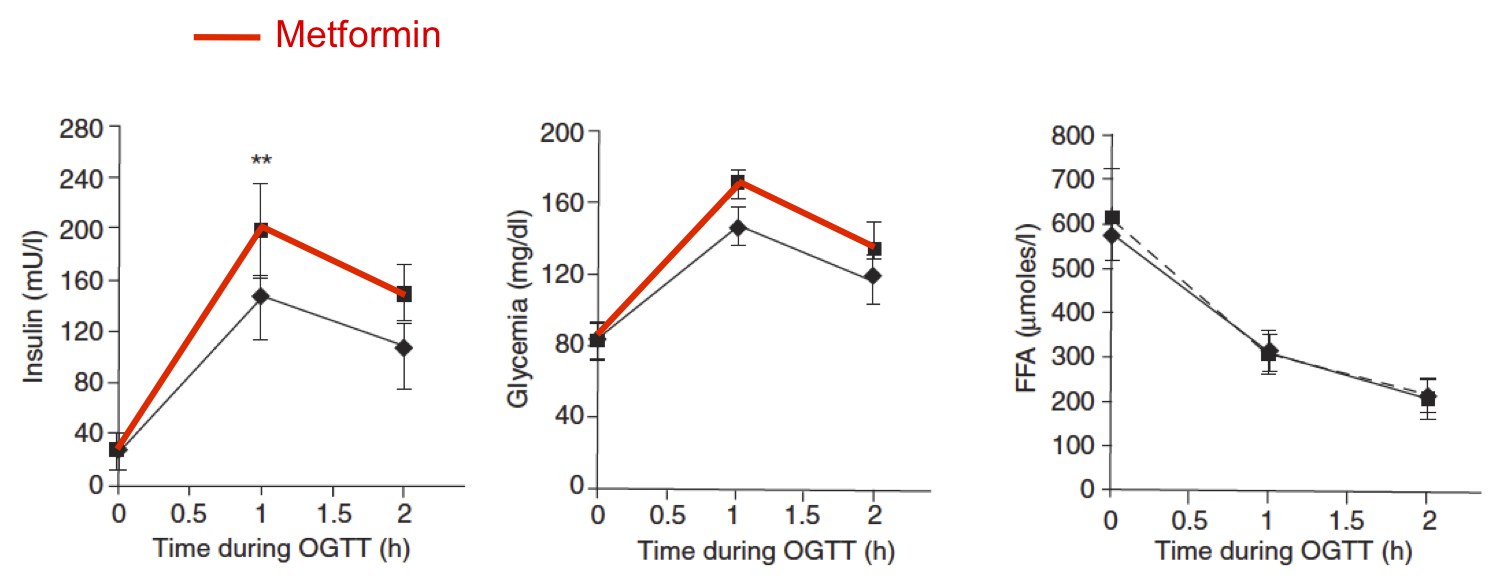
Giving metformin for 10 days has essentially no effect on fasting insulin or glucose. Gluconeogenesis will still be reduced by metformin but the accompanying blunting of hepatic insulin signalling (via blockade of mtG3Pdh) allows more glucose release, so the two roughly balance out. This may not be the case under peak metformin effect, diabetic rats do drop their blood glucose on an IV dose of metformin at a therapeutic level of hepatic glucose output suppression. This may well be dependent of how much metformin you give, by which route and at which time you measure. Fed vs fasted would matter as well.
On feeding 75g of glucose to normal people for an OGTT insulin signalling becomes important and the decreased insulin signalling intrinsic to metformin shows as mildly impaired glucose tolerance (statistically ns but clinically 130mg/dl vs 170mg/dl might be undesirable) but because of blunted insulin signalling a significant compensatory hyperinsulinaemia is needed to get even this rather impaired glucose response.
So. In insulin sensitive people metformin's easily comprehensible action to obtund insulin signalling shows, under high glucose and high insulin conditions, as an impaired glucose tolerance with compensatory hyperinsulinaemia.
With supra-maximal dietary glucose (the specific intention in an OGTT is maximal activation of the insulin system) suppression of hepatic glucose output becomes irrelevant and all we see is mtG3Pdh inhibition manifest as poor insulin signalling. As it did for the poor girl with SHORT syndrome.
Nice.
I'm now wondering if there is any logical way of working out why people with DMT2 almost always (and clearly unexpectedly) benefit from metformin, while people with simple obesity behave exactly as you would expect them to do under an insulin signal blunting agent, especially during an OGTT.
It might be possible. I'm thinking about it.
Peter