Wednesday, January 31, 2024

Electrochemistry

Passthecream posted this link in comments which is a nice listen to Nick Lane explaining his ideas to a non biochemistry audience. I enjoyed it.


Youtube recalled that I watched it and suggested this similar item which also has some core concepts in it. This few minutes really caught my eye as it's something I've been think about for a long time. It's a reiteration of his ideas from pages p133 to 140 of Transformer with all of the doodles merged in to two slides


Although he does specify a negatively charged surface in the book, this doesn't get fitted in to the brief overview he presents in the talk. But this negative charge is fundamental to the chemistry being discussed. I've snapshotted the two slides and added in the supply of electrons needed for each step of the reaction, with a different colour for each electron or pair of electrons, all coming from the charged surface.


Aside. The two red ovals pick out a single, bound, negatively charged oxygen atom. If you're trying to keep the charges balanced it is helpful to realise that they are the same moiety illustrated in two places on different slides. End aside.

This is pure electrochemistry. I picked up a paper years ago which was looking at origin of life reactions driven by an external voltage. You can drive the sort of reactions Nick Lane is describing with a tenth of a 1.5 volt battery's potential. The beauty of vents is that they supply the battery.

A subgroup of industrial chemical engineers is well aware of this phenomenon and they are amazed that electrochemistry for organic carbon based molecular synthesis has never been commercialised. This abstract gives the flavour of their frustration

A Survival Guide for the "Electro-curious"

Understandable.

Peter

Sunday, January 28, 2024

Life (40) Proton pumping

Okay. Time to finish the complex I series. Under conditions of a cell surface membrane which is partially permeable to protons and (less so) to hydroxyl ions there can be a proto-metabolism based on the ingress of protons driving both carbon fixation and energy generation, with neutralisation by OH- ions. This is dependent on having a partially permeable membrane to both of these ions. Subsequently, by using the simultaneous impermeability to (larger, less permeant) Na+ ions, combined with the above ability to neutralise protons with OH-, a Na+/H+ antiporter can establish a Na+ potential to drive a proto-ATP synthase. Koonin's group discussed it here:

Evolutionary primacy of sodium bioenergetics

As the protocell membrane becomes progressively more impermeable to both H+ and  OH- then running a Na+/H+ antiporter becomes progressively more difficult. At the same time this makes proton pumping potentially advantageous. This is how I am guessing that proton pumping may have developed.

If we start from that neat doodle from


looking like this:


we can reverse model it back to a simpler NiFe hydrogenase in a proton semi-permeable membrane and need just four images to sum it up:


This has the ocean at pH 6 protonating acidic amino acids in a channel from the ocean to the FeS cluster. There is also a side chain of acidic amino acids in contact with the NiFe cluster which are non-protonated because they are contiguous with the cytoplasmic fluid of pH10.

A molecule of hydrogen arrives at the NiFe cluster and is split in to a pair of electrons and a pair of protons:


The electrons hop on to the FeS cluster and thence to ferredoxin (accompanied by their ability to do work) to give reduced ferredoxin, Fd2-, while the protons go to the waiting carboxylates of the amino acids on the route to the pH10 cytoplasm:


which then leaves the complex ready for the next hydrogen molecule to come along after the protons on the cytoplasmic route's amino acids have been deprotonated by the pH10 cytoplasm:


The cost of this manoeuvre being a small fall in the intracellular pH, to be neutralised by the same alkaline vent fluid which supplied the molecular hydrogen.

That seems quite simple.

If we consider what might happen if the availability of hydroxyl ions is curtailed by progressively rising impermeability of the cell membrane to both H+ and OH- then the process must halt. With the evolution of soluble hydrogenases, and especially of electron bifurcation, then Fd2- might become more plentiful but molecular hydrogen less so.

We can consider what the immediate advantage might be to a cell to consume Fd2- and regenerate molecular hydrogen by running this complex in reverse.

So now I've set the intracellular pH to pH7 and left the ocean fixed at pH6. It's a big ocean.

In this scenario all of the amino acids in the complex would be protonated:


If we allow a Fd2- molecule to place a pair of electrons on to the FeS cluster:


these can combine with a pair of protons to form molecular hydrogen. These protons should come from the (very slightly) more acidic ocean channel:


This reaction is exothermic and needs no proton gradient. It leaves us with a deficit of protons in the oceanic pH channel:


which you would expect to be replenished from the bulk ocean. But we have a certain amount of free energy available from the high energy Fd2- molecule used to make the molecular hydrogen. All that is needed is an electrostatic/conformational change comparable to the "Doohickey" function of the last several posts and it becomes simple to take two protons from the cytoplasmic influenced amino acids and put then on to the oceanic side using the energy available from Fd2- oxidation:


What might be the immediate advantage of doing this?

The pH7 environment on the cellular side will allow spontaneous re-protonation of the acidic residues in the complex:


which will clearly leave a very small and very localised area of higher pH, here designated as pH8 for illustrative purposes only:


We have now produced a very localised accentuation of the progressively feebler pH gradient resulting from the cell membrane becoming progressively more opaque to OH- ions.

As cell energetics are highly Na+ dependent, as per the introduction to this post, establishing a small area of accentuated pH gradient will allow the immediate advantage of facilitating the struggling Na+/H+ antiporting process, at the cost of allowing the loss of the newly developed localised area of pH 8 (as shown) back down to pH7 (not shown). Like this:


which is fine except a simple "monogenetic" antiporter is actually pretty useless at low membrane potentials, as in:


So it would be better to have the ancient ancestor of the modern MRP ultra-low proton gradient antiporter instead. Here we have several protons each "kicking" another inward channel to finally 
"kick" a Na+ ion out of the cell:


At this point having MRP snuggle up to a membrane bound hydrogenase to access a better pH gradient is starting to look vaguely like a complex I precursor, but not quite. All we have is a small improved localised pH gradient, no gross expulsion of protons, and the sole use is to generate a Na+ ion gradient. But that would be advantageous, immediately.

Now let's worsen matters still further and drop the intracellular pH to 6.5, where even the mighty MRP antiporter is in trouble. We can get extracellular protons to the half way inward mark, and intracellular Na+ to the half way outward mark but there is insufficient pH drive to complete their respective journeys. Stalemate:


Now if we just think about that energy input from "wasting" a Fd2- molecule we can have a conformational/electrostatic change in the green outlined amino acid (modern day aspartate D72 in the original diagram) like this:


giving a "push" to help the struggling MRP antiporter:


by providing a "kick" which the pH gradient can't manage alone. As it stands there need be no outward proton translocation, just a push to the MRP antiporter. In fact the localised pH gradient would be lost on Na+ antiporting but the cell would have bought a better Na+ gradient for ATP synthase in return:


In this last image I've suggested that blocking off access to the ocean would be an incremental advantage too as it might make a conformational change in the "kicking" acidic amino acid more effective at facilitating MRP antiport completion.

None of this is a proton pump. But as the cell membrane become essentially impermeable to protons there develops an advantage to running MRP in reverse. All you have to do is attach the kicking-complex the wrong way round to MRP and you could kick a Na+ in to the cell and two H+ out of the cell, then start of using protons in ATP synthase. Or completely drop the module which translocates Na+ and just use the "kick" to push two protons outwards. Or, given a power source like the NADH:CoQ couple, kick four protons out wards, as in complex I. Notice the "kicker" is on the opposite end of the MRP antiporter derivative here and the Na+ module has been abandoned/replaced:


Given a less potent power source such as the Fd2-/H+ couple you can just drive out one proton, as Ech does:


You can also, if you're Pyrococcus furiousus living at 100degC, still pump Na+ ions (it's not easy to build a proton tight membrane at 100degC, so Na+ energetics are retained) by flipping one proton channel round, pushing a proton outwards and allowing this proton back inwards to antiport a Na+ ion outwards:


which is a proton-neutral technique to establish a Na+ ion gradient.

All you have to do is to develop a "kicker" for MRP and the world is your oyster. There are many derivatives of this type of pump with various subunits arranged in various orders. It's a molecular Lego set. All that is needed is for each step during its development to be continuously advantageous.

The concept that modern derivatives might be the best guide as to where and how life began fascinates me and has been laid out by Nick Lane's group here:


It makes a lot of sense to me.

Peter

Friday, December 22, 2023

Life (39) NuoH

This paper is almost completely dedicated to the function of NuoH and the CoQ binding pocket, AKA the Doohickey.

Redox-induced activation of the proton pump in the respiratory complex I

Here is Figure 1, it's the inset we're interested in:


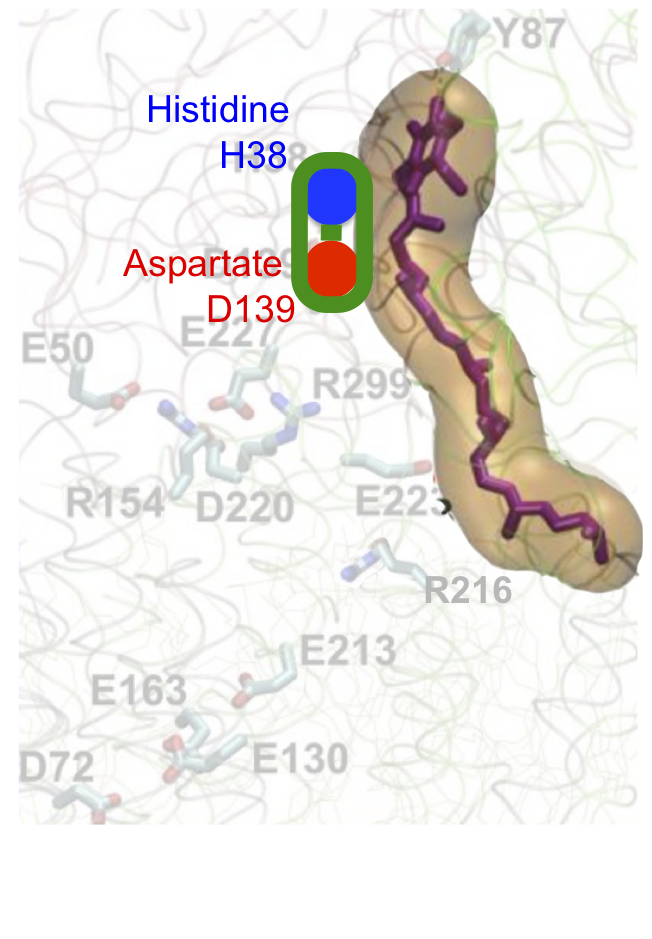
and here is the inset. I've taken the liberty of inserting arginine R216 as shown in Figure 6 (left panel) and as mentioned in the text section "Electrostatic coupling elements". Which is what we want to know about.


To make sense of this it's easiest to break it down in to three sections, each representing a specific process. We can start with the aspartate D139 which is protonated and hydrogen bonded to histidine H38, like this. I've faded the rest out:


Two electrons are delivered to CoQ from NADH and nothing happens. A few picoseconds later one electron on CoQ "steals" a proton from histidine H38 (along with a second proton, for the second electron, taken from the Tyrosine Y87 just visible at the top of the image. I've left this out for clarity) to form reduced CoQ2H:


Histidine H38 immediately replaces its lost proton by "stealing" it from aspartate D139. This aspartate becomes negatively charged and alters the protein conformation to move itself downwards (in the diagram)


taking an area of negative charge with it:


Now we can move on to step two and add in some more important amino acids. These red circles are all glutamates and the blue circles are all arginines:


The combination of change to surrounding protein shape with the localisation of the negative charge on aspartate D213 forces the combination of the arginines with the glutamates in to electrostatically bonded pairs shown as green ovals. The dotted green oval is my guess, the two solid ones are specified in the paper:


which repositions the polar amino acids like this:


Quite how this rearrangement forms a proton channel is unclear (or whether protons are simply transferred from amino acid to amino acid without a water channel forming, there doesn't appear to be a water channel modelable, yet) but the paper suggest it does so and the negative charge zone encourages protons to transfer from the bulk solvent of the cytoplasm to the centre of the complex:


The final step involves these amino acids, mostly glutamates with an aspartate D72 at the end of the chain:


The conformation change in the protein structure moves these amino acids towards the source of protons 


and puts them in to a microenvironment which makes them highly avid to gain a proton, which they do:


Working on the basis of electrostatic coupling between well investigated antiporter-like pumping modules it looks to me very much like the protonation of aspartate D72 provides the "kick" to the messy fourth proton pathway between NuoN and the small membrane subunits NuoA, J and K:


Up until now pretty much all of what I have described is what is reported in the paper from their extensive modelling work. Now I'm going to speculate.

I don't think these NuoH protons go anywhere towards being transported to the periplasm. I think they go back the way they came. One of the crucial steps after the reduction of CoQ to CoQ2H is the restoration of the protonation of the amino acids which have provided the protons to join with the electrons on CoQ to give a neutral molecule. It's not at all clear where these replacement protons might come from, so I feel free to speculate. In this particular complex I example we are talking about reprotonating aspartate D139 and tyrosine Y87, either side of the CoQ binding pocket.  Like this:


In particular the restoration of protonation of aspartate D139 will allow it to return to a hydrogen bonded to histidine H38 position and allow protein conformation to return to the baseline level overall, leaving the system ready to fire again.

This speculation is compatible with a non proton pumping function of the half-channel in NuoH/Nquo8 but a crucial function in transmitting the energy from CoQ reduction to the antiporter modules. It also gives a speculative mechanism for the reprotonation of the amino acids deprotonated in CoQ reduction. I like the idea. It makes sense (which clearly does not mean it is correct!).

I would also guess that in an optimised system that only two protons are used to effect the aspartate D72 "kick" and these two protons are the ones which are returned to neutralise the changes around the CoQ binding pocket.

I'm now set to try and work out what evolution was doing to set up a pre-adaptation to this rather bizarre system. Fingers crossed.

Peter

Wednesday, December 20, 2023

Life (38) Water Wires

These people have ideas about the water channels for the fourth proton in modern complex I.

They even made a film about its water channel from the cytosolic proton source to the central horizontal transfer zone, and it's available in the supplementary data to down load:


I had to look very carefully in slo-mo, advancing the frames manually, at some points one by one, to work out what is happening. It's simpler if you edit out the (undoubtedly very important) shuffling of hydrogen bonds to the isoleucine on the right hand side of the image. I've made a simplified gif of the track of the proton from bulk solvent at the top to where it protonates the glutamate at the bottom. This is only a half-channel, quite where the second half-channel is located is unclear but there are several possibilities discussed. Here's the grossly simplified gif with the proton highlighted in blue and the shuffling of hydrogen bonds to the isoleucine cut out:


We can summarise this as a proton from bulk solvent:


"travels" to a "half way" glutamate and protonates it, which reconfigures the proteins to expel the water molecules and so closes the input side of the channel:


Now let's speculate wildly, as you do. Next comes the "kick" from the doohickey in the redox arm and transmitted through NuoH (or Nqo8 in bacteria):


There is a convenient lysine to accept it. Tucked in behind the lysine is another glutamate which can next be protonated:


to open the water channel to the periplasm


and complete the transfer to the 4th proton:


This fourth channel is messy. Nuos N, M and L are clearly lifted straight from the MRP antiporter as complete units. The above pathway is a hotchpotch of one edge of Nuo N and the small membrane subunits Nuos A, J and K. If you had to guess, these small subunits might be remnants of the Na+ channel of the MRP antiporter but I've not seen this hypothesised anywhere.

I'll pause here because the principle of water wires and proton transfer appears to be very generic, the three tidy channels will be functionally very similar to the messy fourth channel described here.

Unlike NuoH. That's the next post. It's totally different.

Peter

Tuesday, December 12, 2023

Life (37) Just a gif of complex I

If we take the complex I from the doohickey paper


and also the mirror image of complex I from the water channels paper


and highlight the important bits, we get this


which can be rearranged to give this


which animates as a gif to show how the change in the doohickey, induced by electron transfer to CoQ, is associated with the protonation (yellow cross proton) of an amino acid in the NuoH/Nqo8 water channel:


and then we can add in the orange-crossmarked pumped protons like this:


This story explains the simple translocation of the three protons through the three antiporter-like subunits but gives us no insight as to how the fourth proton might be translocated.

And trying to reverse engineer the doohickey-NuoH water channel seems like the best chance of guessing at what happened as an intermediate process between using a geothermal proton gradient and generating a metabolic proton gradient. Each step must be immediately beneficial to early LUCA.

Peter